Ulrik Stig Hansen once looked at the careers of his manager and his manager’s manager and decided he wanted a different future. He was working at J.P. Morgan in London, a respectable place to be a young finance graduate with an appetite for analytical work. The next steps were visible. That was part of the difficulty. He could see where the path went, and he wanted to build something of his own.
Today he is a co-founder and co-CEO of Encord, which makes software for the data behind artificial intelligence. His work concerns an awkward gap between a model that performs beautifully in a demonstration and a system that can be trusted with a job. Getting across that gap requires patient attention to what a model sees, what people tell it, and what happens when circumstances change.
There is a pleasing symmetry here. Hansen left a career that looked good on paper. He now spends his working life on the difference between looking good and working well.
A profitable detour
Hansen’s route into technology took a turn through business school. He studied economics and business administration at Copenhagen Business School, then management and finance at University College London. At J.P. Morgan, he worked in emerging-market rates and foreign exchange. These were markets in which events elsewhere could rearrange the working day rather abruptly.
In 2018, he returned to university for a computer science master’s at Imperial College London. That meant learning in a different way after years in employment, without an undergraduate computer science degree to lean on. The teenager who had coded at home was returning to the subject with considerably more at stake than a hobby project.
“The only thing I regret is not leaving earlier.”
Ulrik Stig Hansen, reflecting on leaving banking
The career change is easy to romanticize after a company has raised money. At the time, its practical content was a return to study. A degree does not acquire customers or settle on a business idea for you. Hansen had put himself closer to the work he wanted; he still had to find the company worth building.
An office with a dining table
Entrepreneur First supplied a consequential introduction. Hansen met Eric Landau there, and the two began developing the business that became Encord. The partnership joined people who understood both software and financial work, but the company they chose to build addressed a different customer: the AI team struggling to prepare usable training data.
The early office arrangements were modest. They coded from couches in London, then spent their Y Combinator period working from Landau’s parents’ dining room in California. Rio, the family Akita, joined them during the day. Every company likes to talk about culture; this one had an unusually furry early participant.
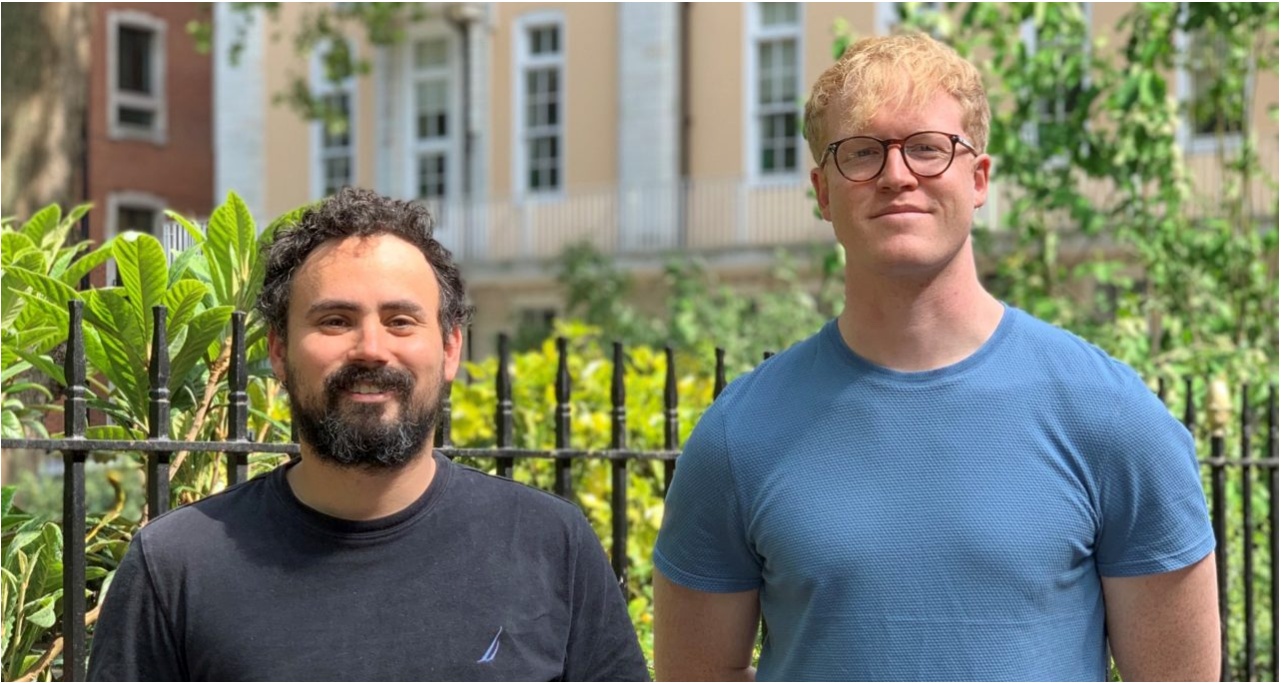
The domestic setting makes a useful corrective to the language of infrastructure. Before a platform can serve other organizations, someone has to assemble its first working version. Landau later acknowledged that the pair could code but needed help designing software systems that would scale. Recognizing the edge of their own experience became part of the work.
Encord joined Y Combinator’s Winter 2021 batch. The dining room was temporary. The problem they had chosen would prove rather harder to outgrow.
Fairy tales, with a spreadsheet
Hansen’s account of the seed round begins with an admission: “I have never been a skilful storyteller.” A Danish founder, he observed, might reasonably be expected to have some affinity with fairy tales. Venture investors, in his telling, had rather more practice at them.
He nevertheless learned to pitch. Encord closed a $4.5 million seed round led by CRV, and Hansen kept an unusually candid scorecard of the process. There were about 145 investor introductions, 52 investors met and more than 70 meetings. Immediately after the YC pitch, he received 77 emails in five minutes. An inbox can apparently experience its own liquidity event.
He compared American and European responses, but also considered the weaknesses of his sample and the ways his own choices might have influenced it. That caution is part of the charm. He had a story to tell and still wanted to inspect the arithmetic.
Fundraising gave Hansen another version of the builder’s problem. A product has to work in the present; a pitch has to make its future intelligible. He was learning to do both.
The founder’s job keeps moving
By December 2024, Hansen was discussing a company of nearly 80 people. The work had expanded from building prototypes to hiring specialists and developing a business that could sell and operate beyond the founders’ direct involvement. His emphasis was on learning quickly and adjusting to what customers needed.
That transition is less photogenic than a funding announcement. A founder can fix a line of code personally. Building a team requires making it possible for someone else to fix the next one, make the next sale or notice the next problem. The feedback arrives through people, and the work becomes harder to hold in one person’s head.
Hansen has described the organization in terms of people pursuing a shared mission, with a founder’s attention increasingly occupied by relationships, resources and culture. The trading-floor alumnus and the programmer now had to make room for the manager. Each job retained some usefulness; none could fill the calendar alone.
There is no tidy graduation ceremony for this stage. The company changes the assignment while the founder is still finishing it.
The data travels west
Hansen announced his move to San Francisco after a decade in London, taking responsibility for expanding Encord’s physical presence in the United States. His farewell to London included thanks for the friendships, support and laughter, and a particular nod to its Danish contingent. For all the talk of markets and infrastructure, a move still involves leaving people behind.
By August 2024, Encord had announced a $30 million Series B led by Next47. The company also launched Encord Index for managing and curating multimodal data. The scope had widened: images, video and other forms of information needed to be searchable, understandable and useful together.
The customer connection was tangible. Synthesia co-founder Victor Riparbelli described using Index to sort and search the data supporting its avatar models. The product’s purpose was visible in another team’s working day. Hansen and Landau were selling software to people who needed to spend less time wrestling with their inputs.
In its investment account, Next47 described a recurring obstacle among businesses adopting AI: information scattered across systems, insufficiently prepared for the models intended to use it. Encord’s products addressed the sequence from organizing data to labeling it and evaluating performance. The verbs are ordinary. The work they contain can be extensive.
A robot cannot live on a demo
Hansen’s public argument increasingly concerns what happens after a model leaves the laboratory. In conversation, he has emphasized the difficulty of collecting feedback from machines operating in physical environments. A digital system can return information quickly. A robot has to deal with the place it is in, the task in front of it and the connection available to it.
His interest is in the cycle: collect the experience, understand what happened, improve the training material and try again. It makes the data business an ongoing relationship with failure. An unexpected event can become useful evidence, provided someone has built a way to capture it.
Capture→02
Curate→03
Annotate→04
EvaluateTHE NEXT ATTEMPT STARTS WITH WHAT THE LAST ONE TAUGHT YOU
Illustrative workflow, not a performance measurement
In February 2026, Encord announced a $60 million Series C led by Wellington Management, taking its reported funding total to $110 million. The company said its platform had grown from one petabyte to more than five in the preceding year, while revenue from physical AI customers had increased tenfold. Those are dated company figures, and they show where the demand was developing.
On October 20, Encord introduced Data Labs, a research division focused on capturing, understanding and evaluating physical-world data. Its initial work included hand tracking and new sensing methods. The announcement put the company further into the practical questions of how machines learn from movement and interaction.
For Hansen, the ambition remains tied to building infrastructure other teams can use. That is a distinctive place to stand in an industry so often discussed through individual models. A useful tool has to survive contact with someone else’s project, someone else’s data and someone else’s deadline.
His spare-time interests have a pleasingly specific cast: ultra-low-latency C++ applications and experimental sushi making. The former sounds rather close to work. The latter at least changes the materials. Neither requires us to invent a grand theory of his character; they are enjoyable details in a career otherwise measured in degrees, funding rounds and petabytes.
The banking job offered Hansen a visible route forward. Encord has given him a less settled assignment, one that changes as customers ask their machines to do more. He wanted to make things. There is now a substantial organization around that wish, and a physical world with an inexhaustible supply of awkward inputs.
Continue the conversation
Follow Hansen’s work and hear the longer conversations.
- Encord · Company profile
- LinkedIn · X · Medium essays · Luma
- Watch: The Data Layer for the Robot Economy, Y Combinator
- Watch: Strategies for builders becoming AI founders, N47
- Read and watch: What Really Blocks AI Progress?
- Hansen’s seed-round essay
- The February 2026 funding announcement · Introducing Data Labs