A factory can be full of cameras and still have trouble seeing. That was the problem Christopher Van Dyke and Austin Appel encountered while working on Tesla's first Gigafactory in Reno: information about products and processes was difficult to capture and analyze. The machines could make things. Understanding exactly what had happened to those things was another engineering problem.
There is a pleasing awkwardness to this starting point. Tesla had engineering talent, money and an ambitious product. Yet the people building its manufacturing systems still needed better ways to observe the work. The problem was concrete enough to follow them out of the company. Van Dyke became co-founder and CEO of Overview AI, which develops cameras and software for manufacturing inspection.
His career invites a closer look at an overlooked kind of invention: the tool that helps somebody else do a difficult job. A charging connector, a battery production system and an inspection camera have different assignments. Each has to survive contact with people, equipment and ordinary working conditions. An elegant idea gets its examination when someone plugs it in.
For Van Dyke, the interesting question is what an engineer can accomplish with the thing after the presentation ends. His work has moved across energy, electric vehicles and computer vision. The recurring challenge is making new technology useful in a physical setting, where a mistake can become a pile of material that somebody must sort, repair or throw away.
Before the cameras, hydrogen and a charging cable
Van Dyke studied mechanical engineering at Stanford and chemical engineering at the University of Virginia. Early in his career he worked as a senior engineer at H2Gen Innovations, a hydrogen-technology company. He co-authored patents there before joining Tesla in 2010. The sequence matters: his introduction to building a business came through machinery and chemical processing.
H2Gen also gave him a lesson in uncertainty. He remembers being confident about its prospects in 2007 and 2008, then watching unexpected setbacks unravel the business. Technical progress and a company's survival could move in different directions. For a future founder, that is an education with rather less comfortable seating than a lecture hall.
At Tesla, his responsibilities grew to include the Supercharger program, infrastructure and equipment design for the first Gigafactory, and an 80-person team developing the Model 3 battery. His involvement ran from concept toward high-volume production. These were assignments in which a design had to become something repeatable, with consequences extending beyond the engineering department.
A separate strand of that work has followed him into public conversation: designing Tesla's charging connector, later adopted as the North American Charging Standard. He discussed the design on the Energy Nerd Show. A connector is an unusually intimate piece of infrastructure. Drivers encounter it with their hands. Its dimensions and handling are part of the experience, however much engineering sits behind it.
The charger offers a useful way into Van Dyke's current work. Most people using a technical product do not want to become experts in its internals. They want it to fit, respond and do the promised job. Manufacturing engineers have more technical training than most drivers, but their time is still finite. A camera that demands another specialty brings its own price.
- Before 2010H2Gen
Hydrogen equipment - 2010–2018Tesla
Charging, factories, batteries - 2018 onwardOverview AI
Manufacturing inspection
Leaving with a problem worth keeping
Overview began in 2018 and joined Y Combinator's Winter 2019 batch. Its founding team includes Van Dyke, Appel, Russell Nibbelink and Xiaoyang Kao. Van Dyke's own founder biography describes building the team that designed the Gigafactory and launching the Supercharger network, then spending his next chapter on cameras and AI recognition algorithms.
The people around him brought different experience. Appel had worked in Tesla manufacturing and research and development. Nibbelink had worked on large-scale infrastructure at Salesforce. Kao's background spans hardware, cloud technologies and backend software. The company they built needs those disciplines to meet in a device that can operate beside production equipment.
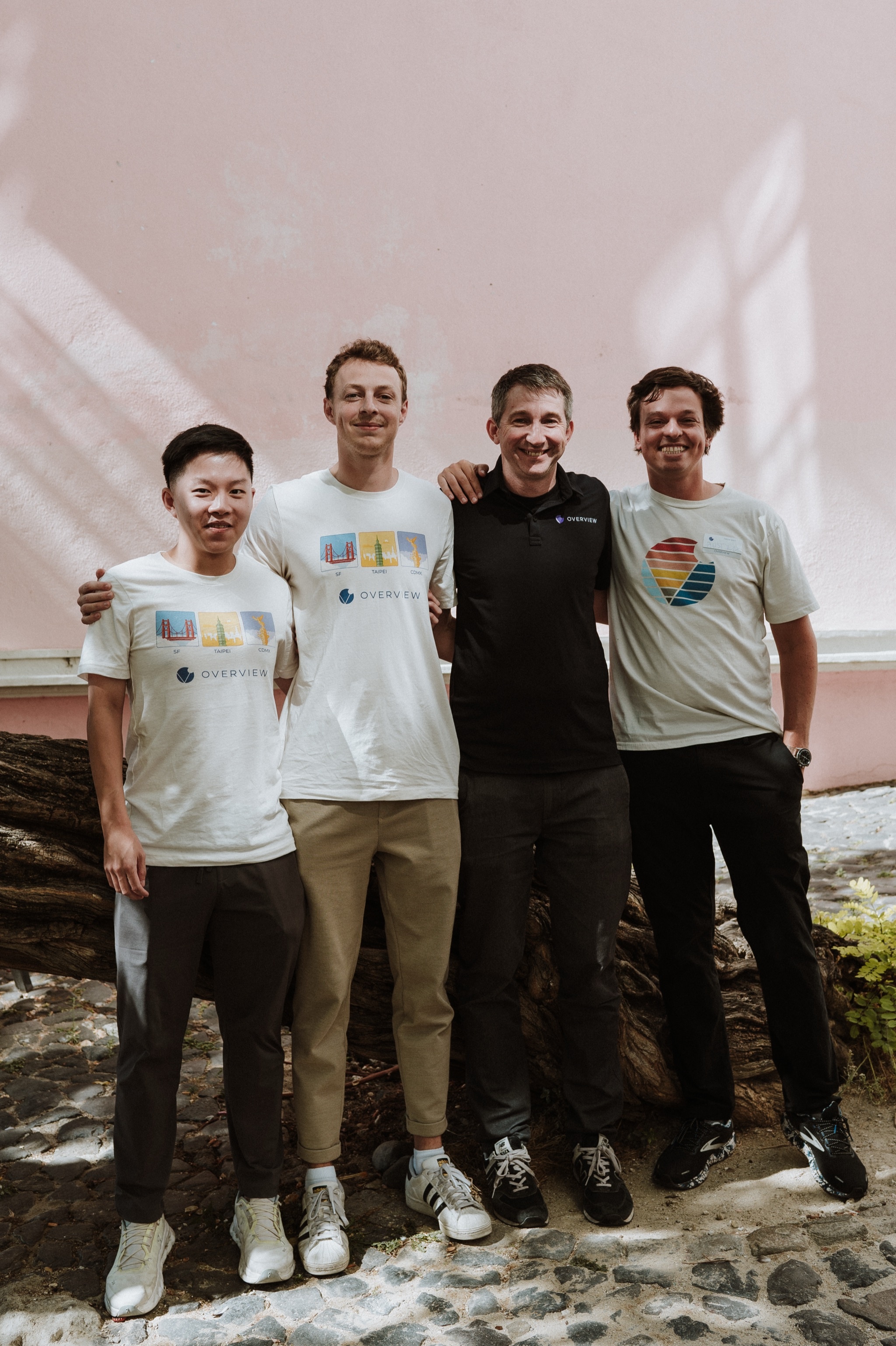
That combination is easy to admire in a team photograph and harder to manage in a product. A manufacturing problem does not politely confine itself to one department. Light, camera placement, software, controls and the definition of an acceptable part all affect the result. The founding team gives Overview several ways to approach the same inspection.
Four founders also means four people with a stake in a difficult decision. Van Dyke has spoken about early changes of direction and the value of a committed core team when a company must regroup. His public account puts the emphasis on complementary skills and shared commitment. The romance of the solitary inventor would be a poor fit for this particular photograph.
The money arrives; the factory still needs answers
In February 2022, Overview announced a $10 million Series A. Blumberg Capital led the round alongside new investors GV and Momenta, with existing investors including Bain Capital participating. The announcement described a software-led system that paired with off-the-shelf cameras and existing production lines. The promise was access to visual inspection without an elaborate replacement project.
Funding is a useful milestone in this story because inspection equipment has to become a business as well as a working demonstration. The money supported a company trying to make sophisticated tools available across manufacturers. It did not remove the need to show what the tool could do with a customer's actual parts.
The difference between a demonstration and a purchase is particularly interesting here. A picture can show a defect. A production team needs a decision it can use, under the conditions in which it works. That brings the discussion back to familiar matters: installation, testing, the people who operate the line and the other equipment already there.
Van Dyke's career gives him a reason to attend to those details. He had already worked on the production side of the table before becoming the person selling an inspection system. The appeal of Overview rests partly on that reversal. Its customers have a problem he encountered himself, although each customer's line will require its own answer.
Capital for a factory-floor problem.
Overview’s announced financing round.A browser, a camera, a decision
The current OV20i brings image capture, processing and inspection software together. Its interface runs in a browser. Its specifications list classification and segmentation, on-device computing and industrial communications including EtherNet/IP, PROFINET and OPC UA. Those last three names have little literary charm, but they matter when an inspection result must reach factory controls.
Classification assigns an image to a category; segmentation identifies regions within it. In an inspection, the distinction helps explain why seeing that something is wrong and showing where it is wrong are separate jobs. The product offers both approaches. Its published specifications also describe an image history that teams can review, with storage capacity depending on the images and configuration.
This is where Van Dyke's argument about usability becomes tangible. A camera needs a way to configure the inspection, make a judgment and communicate that judgment. Each additional step is another place where an engineer's attention can be spent. Putting those functions together changes the amount of work required around the AI.
By April 2026, Overview was reporting more than a hundred manufacturing customers and more than a thousand cameras deployed during 2025. Van Dyke also described customers in fifteen countries and the travel that comes with serving them from San Francisco. The numbers establish reach. They do not, by themselves, tell us how well any particular inspection performs.
His explanation for keeping inspection on the factory premises is equally practical. Customers wanted control over their infrastructure, and cheaper hardware made local computing more feasible. Removing a required outside connection can also simplify installation. The location of the intelligence has consequences for the person asked to get the equipment working.
“a sophisticated tool, but you don't need specialists to use it.”
Christopher Van Dyke · 2022
The new colleague is called Sparky
On October 6, 2026, Overview launched OV Spark and OV Spark Pro. Their onboard assistant, Sparky, recommends inspection tools, explains its reasoning and lets teams ask questions about captured production data. The release describes ten inspection tools and a device that continues to run its inspection workflow on the camera.
One example comes from Mansfield Engineered Components in Ohio. Overview describes a quality engineer setting up Spark on an end-of-line station where an operator had previously checked the work visually. A missing washer was the most frequent defect. The camera was subsequently moved between two lines. It is a modest-sounding example with an appropriately practical object at its center.
A washer offers little scope for a glamorous keynote. It does offer a useful test of an inspection product: can the person responsible for the part create a check that works? The company describes Spark as helping that person choose tools and understand results. Van Dyke's latest product keeps returning to the cost of getting a new inspection started.
The assistant's name introduces a small bit of levity into an otherwise serious workflow. Sparky has duties. It must help with decisions about inspection rather than merely add a conversation to the side of the screen. For Van Dyke, this is another version of the question that has followed him from physical design into software: what work becomes easier?
“Another project, another specialist, another few weeks.”
Van Dyke on the work of starting an inspection · October 2026
An ambition measured one part at a time
Overview's stated mission is to catch every manufacturing defect in the world. It is an ambition broad enough to require a little grounding. The company's own description supplies it: one application, one production line and one customer partnership at a time. The distance between those two scales is where Van Dyke now works.
There is something revealing about choosing inspection as a founder's occupation. The finished product often receives the attention; the process that catches its mistakes usually stays out of view. Van Dyke has spent his career close to that process, building equipment and teams that make an idea usable beyond its first successful attempt.
His next chapter will depend on whether the tools around the camera become as helpful as the camera's recognition. The trajectory is clear enough: from building manufacturing systems to observing them, then helping other engineers understand what the observations mean. It leaves him with a demanding, ordinary question. Does this part pass? The answer has to be useful before the next part arrives.
More from Van Dyke
Watch, listen and explore his work.
- The charging connector: Energy Nerd Show on YouTube
- Quality Vision: the career conversation
- AI Unleashed: manufacturing and product development
- The April 2026 interview on inspection
- The October 2026 Spark announcement
- Overview’s 2022 funding announcement
- Overview AI: the team and its work
- Christopher Van Dyke on LinkedIn