The first robot that changed Matthew Bush's life was called Waldo. It stood on wheels in a Tennessee factory, wore the striped shirt of its storybook namesake, and kept turning up in a different place. One day it bent sheet metal. The next it handled pick-and-place work. Sometimes it visited a local high school. To employees at Scott Fetzer Electrical Group, Waldo gradually became less an omen from the automated future and more a useful piece of shop equipment with a decent nickname.
Bush was the factory's director of operations. In 2014 and 2015, he and general manager Rob Goldiez were trying to keep a high-mix, low-volume plant competitive. The facility made electric motors and neon power supplies, the sort of production where variety can make conventional automation too rigid or expensive. They brought in 14 collaborative robots from Universal Robots and learned by doing.
Their conclusion was unfashionably balanced. Cobots could take the mundane work, but the people were still needed wherever dexterity and judgment mattered. The valuable system was neither human nor robot alone. It was the division of labor between them.
“We found that we could place these robots on the line to handle mundane tasks, and then move people to stations on the line where we really needed the manual dexterity and cognitive ability.”Matthew Bush, on the Scott Fetzer deployment
A robot with a time card
Bush had arrived at that factory after a long education in how physical things get made. He studied mechanical engineering at the University of Florida, industrial technology at the University of Northern Iowa, and later earned an MBA from Florida's Warrington College of Business. He worked in manufacturing plants across Florida, Iowa and Washington. His titles included foundry applications engineer, Master Black Belt, director of operations and director of global engineered solutions.
The résumé explains his instinct. Bush tends to approach robotics as an operating problem before treating it as a technology spectacle. In late 2015, he and Goldiez left Scott Fetzer and started Hirebotics. The name contained the original model: factories would hire a robot much as they hired a worker.
It was a literal arrangement. Hirebotics placed connected robots in factories, streamed their activity to the cloud and generated a weekly time card. Customers paid for productive hours. A short agreement resembled an employment contract, without long commitments or a large upfront purchase. If a machine logged 16 hours, 32 minutes and 18 seconds, that was the billable record.
The idea made industrial hardware feel unusually flexible. It also exposed the work hiding behind flexibility. The team still had to visit a plant, understand the job, design the tooling, integrate the cell and teach the robot. “Robots as a service” was a neat business phrase. Each deployment remained a custom engineering exercise.
Attention arrived before the model had settled. A front-page Washington Post story about one of Hirebotics' customers reached Mark Cuban, who joined a $2.4 million funding round in 2017. The connection gave the young company capital and a conspicuous advocate for American manufacturing automation. Bush and Goldiez still had to answer the less glamorous question after the announcement: which part of their clever arrangement could become a repeatable product? The answer would come from a welding equipment company with a problem already attached.
The useful subtraction
Welding finds the company
Around 2017 or 2018, Airgas Red-D-Arc approached Hirebotics with a pointed request: build a robot welder that could be rented. Welding had the right mix of urgency and repetition. Fabricators could not find enough skilled people, but conventional robotic cells often introduced another scarce role, the robot programmer. Bush saw the absurd trade immediately. A shop short of welders had little appetite for becoming short of automation engineers too.
Hirebotics and Red-D-Arc developed BotX and launched it at FABTECH in 2019. Then the company pressed further. If the product was meant for a welder, the interface should begin with what a welder knows: where the torch needs to travel, what the joint requires and what a sound weld looks like. Code could remain backstage.
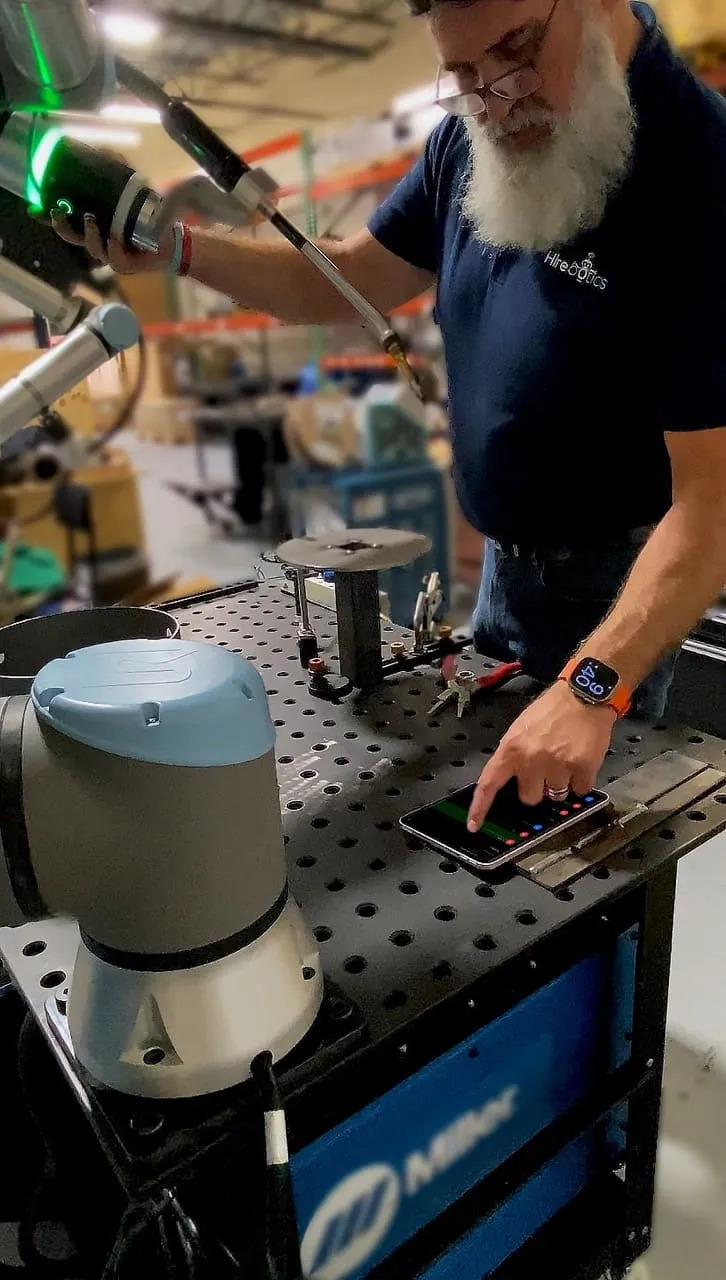
Beacon became the translation layer. An operator opens the app, physically guides the cobot arm and uses buttons on the robot to teach points. The app records the instructions, manages weld settings and turns production data into dashboards. Hirebotics launched its Beacon-powered Cobot Welder in 2021. The system has since grown to support larger parts, plasma cutting, seam tracking, multipass welding, part rotation and collaborative painting.
“If you know how to hold a torch and you know how to run a smartphone, you know how to use a robot to weld.”Matthew Bush
The line is memorable because it locates expertise in the right place. Bush is not asking a welder to admire robotics. He is asking the robot to respect welding. In one account, engineering interns assembled a delivered system from online instructions. Bush began training them around 9:30 in the morning. By 10:30 they were welding production parts. By lunch they had taught a third part.
Speed here is less about the arm moving quickly than about reducing the time between intention and useful work. A traditional cell can sit idle while programming becomes its own project. A cobot taught in minutes can suit a shop where the product mix changes often and batch sizes are stubbornly small.
At automotive supplier Advanta, that premise moved from demonstration to routine. The company deployed 20 cobots after struggling to hire and retain workers. At one plant, production on a job rose from 25 parts to 100 parts a day after the first unit was installed. Bush explained the gain as a mixture of faster welding and less lost motion. A person must reposition a part, lift a mask and occasionally wipe a brow. The robot travels directly from one taught point to the next. The arithmetic is ordinary, which is precisely why a small shop can care about it.
The craft stays in charge
Automation arguments tend to become moral theater: salvation on one side, extinction on the other. Bush's view comes from the shop floor and is more specific. Let the cobot run the monotonous eight-foot seam. Let the person fit the pieces, judge the setup and finish the complicated sections. Give repetition to the machine and ambiguity to the human.
That philosophy also shapes how automation is introduced. At Scott Fetzer, workers were anxious when the first cobots arrived. Naming them helped. Waldo's colleagues included Thelma and Louise, a joke about early fears that the robots would send the workforce over a cliff. The joke aged well because the machines took tedious tasks and people began looking for the next place to use them.
Bush has encouraged companies to involve employees, let them name cobots and treat operators as stakeholders. The advice can sound quaint beside cloud infrastructure and motion control. It is actually implementation discipline. A technically elegant cell that people resist is a poor production system.
A new title, the same constraint
On February 20, 2026, Bush became Hirebotics' CEO. Goldiez retired after more than a decade leading the company. The handoff formalized work Bush had already been doing across electro-mechanical product development, manufacturing operations and customer success. It also placed an operator at the head of a business whose product is, in the end, operations made physical.
His public comments about the transition did not drift toward corporate abstractions. He talked about skilled welders being in short supply, shops needing to do more with the people they have and the opportunity for no-code, app-based cobots. He thanked Goldiez for partnership, leadership and friendship. Continuity was the point.
Hirebotics now sells systems for welding, plasma cutting and painting, with Beacon as the common interface. The company has also added AI-driven setting recommendations, while retaining manual and offline options. This is a telling combination. Recommendations can shorten the path to a workable setting. The operator still owns the result. Connectivity can enable support and data. A shop can still prefer to run without it.
The ambition is substantial, but Bush's language remains grounded: help fabrication shops use the talented people they already have. The most useful part of his story is the sequence of removals. Remove the large upfront commitment. Remove the specialist programming bottleneck. Remove the assumption that sophisticated machinery must feel complicated. Remove dull work where possible, while preserving the human knowledge that makes the work good.
Waldo, in his striped shirt, was never a vision of a people-free factory. He was a machine that could turn up where the work needed him. A decade later, that remains Bush's proposition, only the time card has become a product platform and the director of operations has become the CEO. The robot is more capable. The welder is still holding the reins.