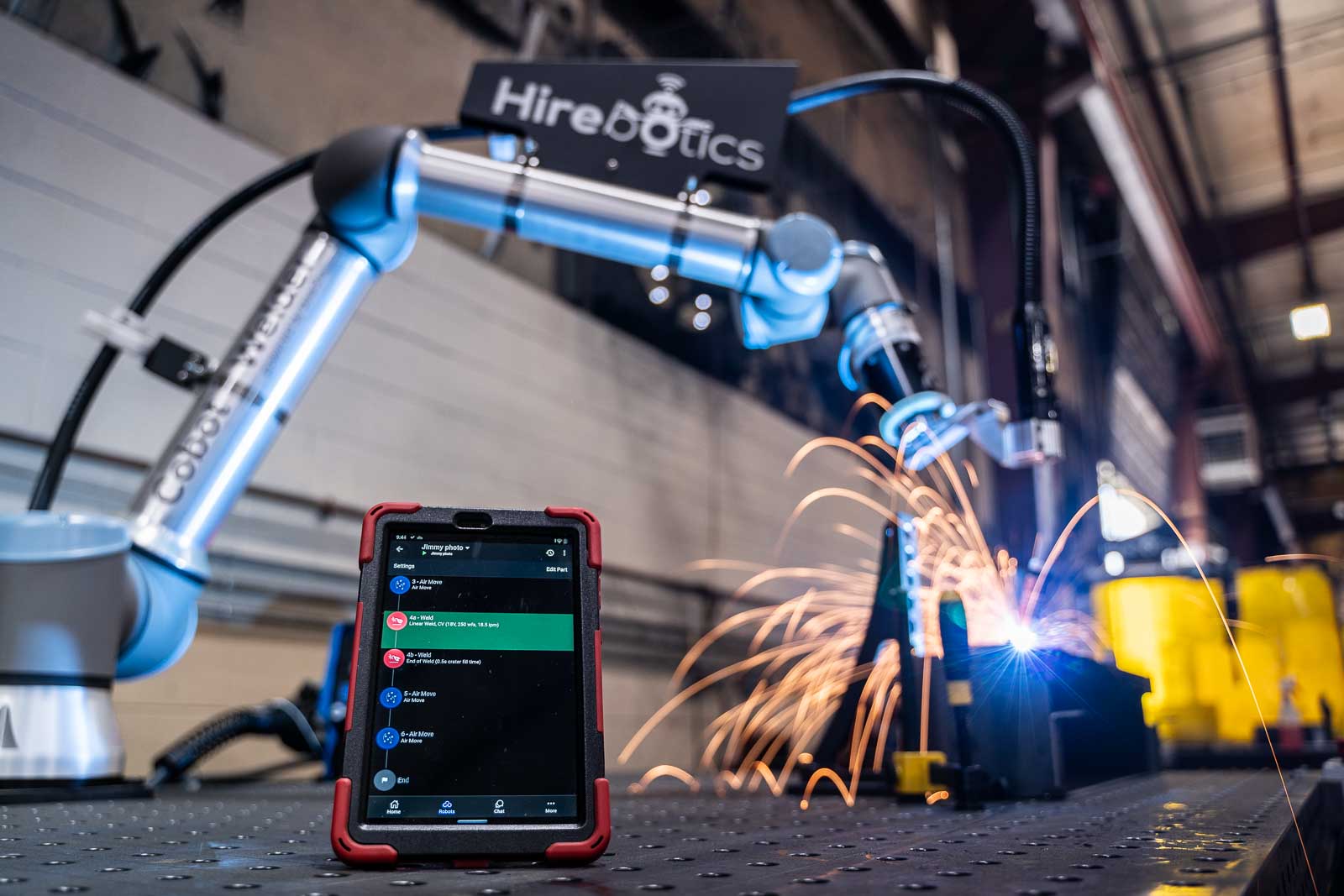
The most revealing part of a Hirebotics Cobot Welder is not the blue collaborative robot bent over a shower of sparks. It is the tablet standing nearby. On its screen, the job appears as a short sequence of moves and welds. The operator guides the torch, taps points, enters familiar welding parameters and presses play. No robot coordinates. No programming language. No engineer arriving next Thursday.
That interface explains the company better than any robot demo. Hirebotics is a Nashville maker of packaged automation for welding, plasma cutting and industrial painting. It buys proven arms and process equipment from companies such as Universal Robots, FANUC, Miller and Hypertherm, then adds its own controls, mobile workstation, deployment method, support and Beacon software. The result is sold as shop equipment, not a custom integration project.
For a fabrication manager, the pitch is plain: put repetitive, physically tiring work on a cobot; let scarce skilled welders handle fit-up, difficult joints and judgment-heavy jobs; capture repeat programs for the next batch. For an operator, the useful promise is smaller. The machine speaks in wire feed, travel speed, torch angle and part paths - the language of the process rather than the syntax of robotics.
The originA robot with a time card
Matthew Bush and Rob Goldiez met the problem from inside a factory. In 2014, while working together at Scott Fetzer, they used Universal Robots cobots to automate high-mix production in Nashville. The plant made electric motors and neon power supplies while competing with overseas manufacturers. Cobots helped move parts and clip wires without the fixed cages and large footprint associated with traditional industrial robots.
They left in late 2015 with a literal business idea: manufacturers already understood how to hire workers, so why not let them hire a robot? Early Hirebotics systems handled machine tending and assembly. Customers paid according to a digital time card generated from cloud usage data. A robot could be deployed for a job and, at least in the sales metaphor, fired when the work disappeared.
What failed first was not the robot. It was the breadth and friction around it. General-purpose automation still meant complex, skill-heavy turnkey work. Then, around 2017 and 2018, the rental-welding specialist Red-D-Arc, part of Airgas, approached Hirebotics about the nationwide welder shortage. Together they built BotX and launched it at FABTECH in 2019. The product narrowed the job and lowered ownership risk, but programming remained the tax on adoption.
That bottleneck changed the product. Hirebotics rebuilt the experience around Beacon, a cloud-connected app, and launched Cobot Welder in 2021. The important pivot was from making automation available to making one process teachable. The rental idea supplied the name; welding supplied the focus; software supplied the leverage.
“The clever bit is not asking a welder to become a robot programmer. It is asking the robot to become a welding tool.”The Hirebotics product thesis, in one sentence
The offerHardware up front, software alongside it
Hirebotics now sells three complete systems. The Cobot Welder starts at $105,000. Its current core package includes a Universal Robots UR8 Long arm, Miller welding power, Tregaskiss torch, mobile workstation, operator controls, consumables, Smart Puck and Beacon Standard. The Cobot Cutter starts at $100,000 with Hypertherm plasma equipment. The 2026 Cobot Painter starts at $140,000 and uses FANUC's explosion-proof CRX paint cobot with powder or liquid spray equipment.
Those are starting prices, not universal project totals. Fixtures, facility changes, safety work, options and training time still belong in an honest budget. Hirebotics offers financing, rent-to-own and try-before-you-buy arrangements. Its published comparison places custom robotic welding cells around $150,000 to $250,000 or more, though a fair comparison depends on reach, guarding, tooling, throughput and integration.
The business is hardware plus optional recurring software and service. Beacon Basic is included and can teach jobs, monitor live production and reach support. Beacon Pro starts at $80 a month per cobot, adding AI suggestions for weld settings, 30-day data history, exports, operator permissions, workflow tools and finer path control. BeaconCare is published at $5,000 a year for priority field service, loaners and discounted repairs. Advanced functions such as multipass welding and seam tracking are additional options.
The customerThe job shop in the awkward middle
Hirebotics fits between manual work and the traditional robot cell. Its natural customer is a job shop, contract manufacturer or OEM with too much repeatable work for the available crew, but too much product variety for a fixed, code-heavy line. Public examples span automotive supply, defense, aerospace, heavy machinery, marine fabrication and tank manufacturing.
Industrial Manufacturing Services had four conventional six-axis robots and a three-person group handling their programming. Its team reported that a traditional robot could take an hour to program while a Cobot Welder job could be taught in four minutes. The value was not merely speed. Saved programs could move between cobots, and simpler work could move away from the most experienced welders.
Tank Technology offers a different proof point. Its workers manually cut openings in curved tank heads, a geometry that did not suit a flat CNC plasma table. The company reported that the Cobot Cutter dropped cutting rework from about 25 percent to nearly zero, reduced common cycle times from five minutes to under one and paid back in roughly two months. The eye-catching return rested on an unusually expensive existing problem: complex geometry, manual strain and recurring errors.
The company competes with manual labor, custom cells and packaged systems from specialists including Vectis, THG, Smooth Robotics, Path Robotics and Miller. Its difference is the full stack around adoption: an application-specific interface, pre-integrated equipment, a movable footprint, production data and support inside Beacon. It was named Universal Robots' 2023 Global OEM of the Year and later became the first UR partner to support PolyScope X, making Beacon available on the newer teach pendant as well as phones, tablets and browsers.
The catchA cobot repeats the fixture, not the fantasy
No-code does not mean no process engineering. A welding cobot can repeat a path, but it cannot make a warped part square or rescue inconsistent fit-up by optimism. Shops still need suitable fixtures, controlled joint locations, safe risk assessments, correct consumables and somebody who understands the weld. Collaborative arms have force-limiting features; a live torch, sharp part or shower of sparks creates hazards of its own.
Conditions that help
- Recurring parts or families of similar parts
- Repeatable fit-up and solid fixturing
- A painful capacity or quality constraint
- Operators who own the process
- Enough utilization to earn back the system
Conditions that fight back
- Every part arrives in a different place
- Low volume with no repeat demand
- Work beyond the arm or process envelope
- Unsafe surroundings left unaddressed
- A purchase made without testing real parts
It also will not work economically just because welders are difficult to hire. The target task must consume enough hours, scrap, overtime or forgone sales to justify six figures. For very stable, extremely high-volume production, a faster conventional cell may win. For genuinely one-off work with unpredictable geometry, a skilled human remains difficult to beat. Hirebotics is strongest in the broad middle where batches repeat but changeovers still matter.
The copyable bitSteal the workflow, not the robot
The strategic lesson travels beyond welding. Hirebotics did not try to invent every component. It paired mature hardware with a vertical interface, packaged the installation and built a support loop around live usage. Expansion then followed the operator habit: teach a path, attach process settings, run it, measure it. Welding led to plasma cutting in 2023 and to painting in 2026. Different tools, same mental model.
A five-part industrial product recipe
- Choose one costly, repeated workflow - not “automation” as a category.
- Translate the controls into the operator's existing vocabulary.
- Bundle the parts so the buyer purchases an outcome, not an integration scavenger hunt.
- Let customers test their own work before forcing a capital decision.
- Use connected software for support, learning and add-ons after the hardware ships.
The newest Cobot Painter makes the platform ambition explicit. Built with FANUC's certified paint arm, it works inside an existing manual spray environment and supports stationary powder and liquid coating. Line tracking is a stated future capability, not part of the current stationary release. The restraint matters: a useful industrial product is defined as much by the boundary it admits as by the demo it performs.
Hirebotics began with the charming fiction that a robot could clock in like a person. A decade later, the more durable idea is almost the reverse. The people already know the craft. Good automation clocks in without making them learn somebody else's profession.