The first surprise in Vipin Raghavan's story is how little it resembles the familiar tale of a software founder. His revelation did not arrive in a dorm room or at a whiteboard. It arrived in industrial plants around Pune, amid tanks, pumps, paper machines and the stubborn chemistry of making physical things. Raghavan had worked in the digital worlds of healthcare and gaming. The factories looked as if they belonged to another clock. Their experienced operators could hear trouble in a machine and see a process drifting before a dashboard could. Yet much of that judgment lived in heads, habits and handwritten routines. When a shift ended, a portion of the factory's intelligence walked out with it.
Raghavan saw a software problem hidden inside an industrial one. His phrase for the solution was compact: put the subject-matter expert in software. The idea was not to dismiss the human expert. It was to make the expert's pattern recognition available continuously, then join it with sensors and algorithms that never tired of watching. A plant might detect a quality problem sooner, dose a chemical more precisely, use less water or find a fraction more yield in the same raw material.
Fractions matter here. In a consumer app, half a percent can disappear into a weekly report. In a mill processing enormous volumes, it can alter the cost of materials, energy and waste. Raghavan likes that arithmetic. It is the language of someone trained as an engineer who spent much of his career in finance, where every splendid idea is eventually introduced to a spreadsheet.
A career assembled from mismatched parts
Raghavan earned a Bachelor of Technology from Model Engineering College and studied at Iowa State University. His first listed role was as a project engineer in the biomedical technology wing of SCTIMST in Thiruvananthapuram. Then the route bent. He moved through KDV and Ernst & Young, followed by finance jobs at Ecolab, Cummins and UnitedHealth Group. In 2011 he became director of financial planning and analysis at Zynga, the game company then famous for turning digital crops and poker chips into a formidable business.
A year later, he returned to industrial water as director of finance for Nalco Water India, part of Ecolab. The résumé may look restless, but its pieces became unusually compatible. Engineering gave him sympathy for physical constraints. Audit taught him to distrust decorative numbers. Corporate finance made outcomes hard to romanticize. Nalco returned him to factories where chemistry, water and production costs met every day.
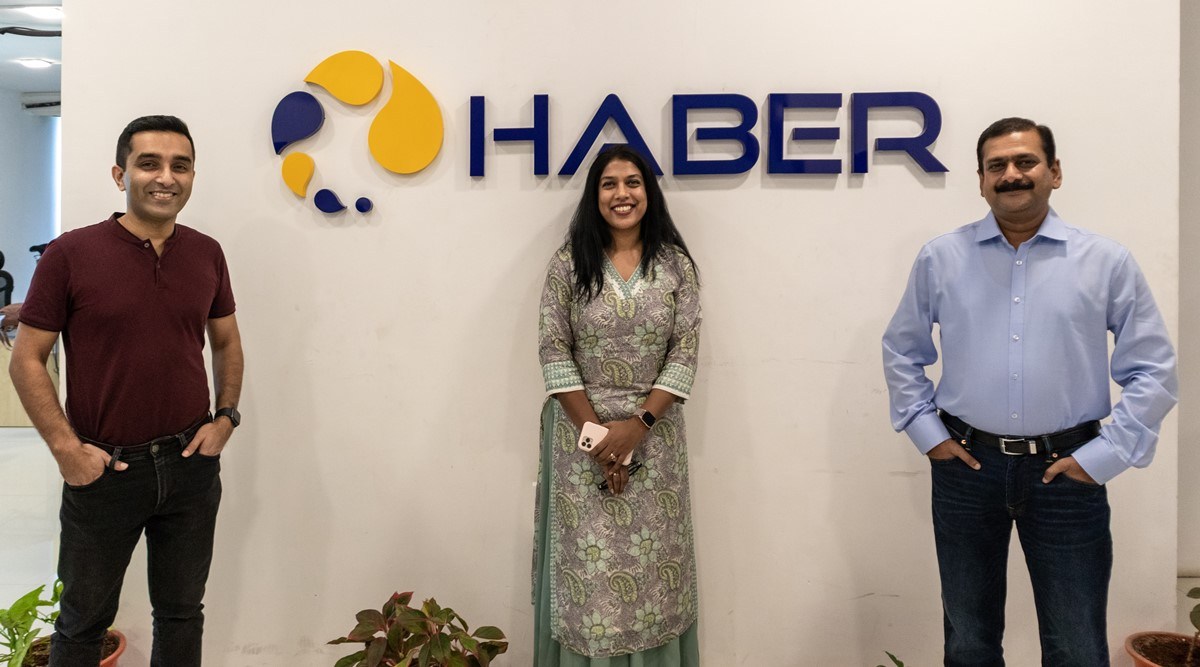
In 2015, Raghavan started Haber with his own funds. Priya Venkat and Arjunan P N joined him as co-founders. The opening team contained five engineers across software, mechanical and electronics disciplines. That mix was a necessity. Their first product, eLIXA, was not merely a dashboard. It combined sample collection, measurement, analysis and intervention. Code had to converse with valves, sensors and chemical processes, all while remaining intelligible to the people responsible when anything went wrong.
The first customer was a local paper manufacturer. Then came ITC's pulp and packaging division. Raghavan remembers ITC as a turning point because proof travels quickly through a cautious industry. Once one serious operator demonstrated gains, other mills began paying attention. Factories are conservative for sound reasons. A novelty that misbehaves in an office may spoil an afternoon. One that misbehaves on a production line can spoil a batch, a machine or a quarter.
“Even a half-per-cent improvement in yield is a big deal for these plants.”Vipin Raghavan
The slow transfer of authority
The central drama of industrial AI is not whether an algorithm can recommend an action. It is whether a plant will permit the algorithm to act. Haber approaches that question in stages. First the software predicts. If its predictions repeatedly match reality, it may recommend. Only after accuracy and confidence accumulate does a customer consider closed-loop control, where the system adjusts the process itself.
How a factory learns to trust software
This progression explains why Raghavan speaks about operators with more care than the usual automation pitch permits. In India, he has observed, a plant head's decision can move swiftly through the organization. In North America, operators often have more individual authority and want to know why the algorithm recommends a particular adjustment. Raghavan regards the interrogation as useful. It forces transparency and improves the system. Trust, in this view, is less a feeling than a production record.
His commercial model carries the same impatience with abstraction. Haber has priced by production output rather than by software seat. Raghavan has also described telling clients they should pay only when Haber keeps production costs within a promised range. It is an elegant piece of self-discipline. The vendor and the plant share the same scoreboard, and nobody can hide behind logins or feature counts.
By 2021, Haber reported more than 100 eLIXA installations and closed a $20 million Series B. It later introduced Mt. Fuji, a manufacturing intelligence platform for historical data, digital twins and predictive interventions, and Kaiznn, a planning system designed to reduce trim loss and schedule production. The names are playful. The work remains severe: reduce variability, catch trouble sooner and make production less wasteful.
Efficiency and sustainability share a ledger
Raghavan's most durable argument is that sustainability and efficiency are versions of the same problem. Process manufacturers use large quantities of water, energy, chemicals and raw materials. Overdosing is both expensive and wasteful. A quality defect consumes resources twice: once to make the rejected product and again to replace it. Better control can improve margins and environmental performance without requiring a manager to choose one over the other.
Haber says its platform has helped save 29.8 million cubic metres of water. Raghavan has cited customer cases with higher output, reduced raw-material use and faster payback, including a mill that improved chemical efficiency by 18 percent. Such figures are company-reported and will vary by plant, but they reveal the way he sells: not as an oracle, but as a set of measurable deltas.
What a useful algorithm leaves behind
Selected improvements reported by Haber for pulp and paper applications.
In 2025, Haber expanded an AI Green Chemistry Lab in Pune with a reported $10 million research and development investment. Its pilot plant lets scientists test formulations under controlled conditions before taking them to a working factory. This is the unglamorous bridge that industrial innovation requires. A promising molecule or model must survive heat, vibration, inconsistent feedstock, old equipment and the midnight shift.
The company also expanded into the United States and Canada, backed by a 2024 Series C that included $38 million in equity and $6 million in debt. Raghavan's fundraising education began much earlier. For Haber's Series A, he met more than 20 investors and received four offers. His advice afterward was brisk: study each investor's thesis, build a funnel, and remember that the first and last 90 seconds of a presentation matter. Invite investors to speak with customers and employees. The longer they inspect a sound business, he reasoned, the more substance replaces theatre.
“At the end of the day, the goal isn't to replace people but to help them make faster, more informed decisions.”Vipin Raghavan
The factory as a learning system
Haber now describes its direction as industrial agentic AI. The phrase suggests systems that do more than analyze, but Raghavan's route toward autonomy is deliberately incremental. Factories are not clean datasets. Sensors drift. Raw materials change. Production priorities collide. A system must understand the process around a number, not merely notice that the number moved.
That makes the experienced operator a collaborator rather than an obstacle. The software contributes memory, vigilance and calculation at a scale no shift team can sustain. The operator contributes context, skepticism and responsibility. Each teaches the other. If the arrangement works, the plant grows less reactive. It catches drift before it becomes waste, schedules maintenance before a breakdown and adjusts chemistry before quality wanders outside its target.
There is a pleasing modesty in the ambition. Raghavan speaks of near-autonomous factories, not immaculate machines floating free of people. His AI is expected to inhabit the world of valves and invoices, where a claim is eventually weighed against a tonne of output. That world has little patience for fluent nonsense. It asks whether the paper is stronger, the water use lower and the line steadier than it was yesterday.
A decade after those early plant visits, the gap that bothered Raghavan has narrowed. Factories are connected. Edge computers have become cheaper. Models can watch thousands of signals and respond in real time. The harder gap is social: how much authority people will give those models. Haber cannot close it with a slogan. It must close it the old industrial way, through repetition, evidence and a machine that behaves properly when nobody is giving a tour.
That may be the most useful thing Raghavan brought from finance to artificial intelligence. Technology gets to be exciting for an afternoon. Results have to reconcile every day.