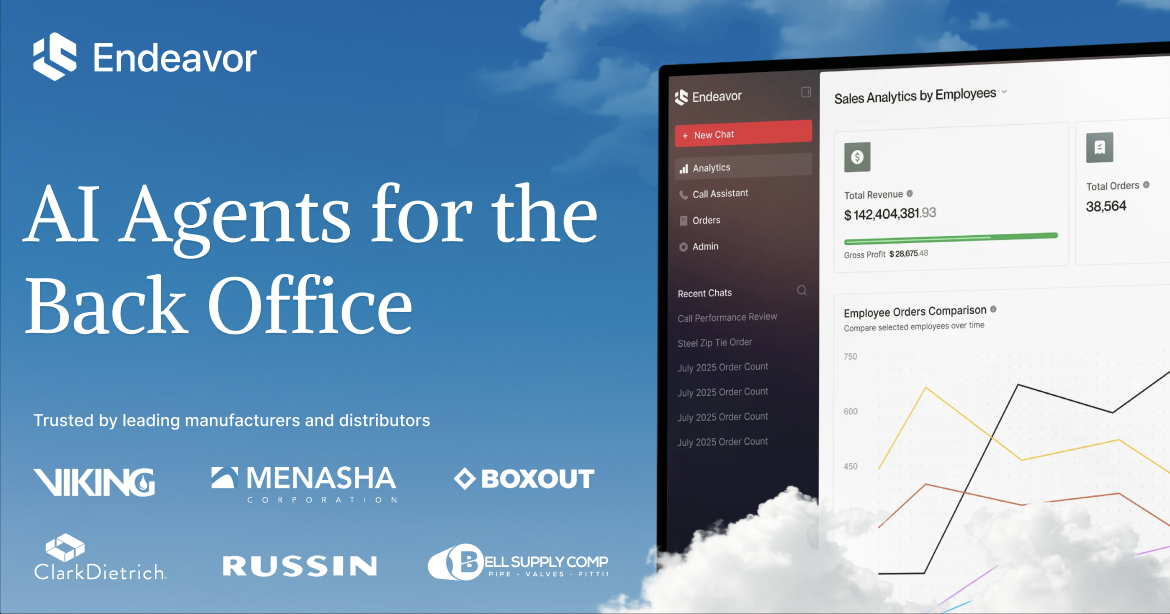
There is a version of the artificial-intelligence story that involves robots, and there is a version that involves a purchase order arriving as a PDF attached to an email from a customer who has been doing business the same way since 1997. Endeavor, a San Francisco company founded in 2023, decided the second version was the more valuable one, which is either an unglamorous choice or a shrewd one, and increasingly it looks like both.
The pitch is compact: "AI Agents for the Back Office." Endeavor builds software agents that read the unstructured stuff manufacturers and distributors actually run on - emails, spreadsheets, PDFs, phone calls - and turn it into structured work inside the ERP system the company already owns. An order comes in as a mess; it goes into the system as a clean entry. A quote that used to take a person an afternoon comes back in seconds.
That quote is from Jeff Fluhr of Craft Ventures, which led Endeavor's $7 million seed round in 2024, with Heartland Ventures, Contrary Capital, and BoxGroup along for it. Fluhr met the founder at a Craft hackathon in June 2024. The thing that reportedly sold him was not the demo. It was that a seed-stage company had already signed large, public manufacturers - the kind of customers that usually take years and a sales team to land.
Meet the founder
The founder is Sahitya "Sami" Senapathy, a Wharton graduate who started the company young - the press coverage puts him at 22 - and out of a college dorm room. His backstory is the sort a screenwriter would flag as too on-the-nose: he grew up in Michigan to parents who worked for Ford and Chrysler, built his first software application at age 11 to help FEMA with disaster recovery, and worked on autonomous drones as a high-school contractor for the Air Force Research Laboratory. Before Endeavor he touched AI projects at AWS and Palantir.
Put plainly, he grew up inside the industry Endeavor now sells into, then spent a decade learning the tooling. That is the useful kind of unfair advantage: not a secret algorithm, but knowing exactly where the paperwork piles up on a factory floor and why nobody there wants to be the one keying it in.
Why the back office
Here is the market logic, and it is genuinely large. U.S. manufacturing is roughly a $2.8 trillion sector, and a lot of it still runs on systems that predate the smartphone. Most of the AI attention has gone toward the front of the factory - vision systems, robotics, predictive maintenance. Endeavor went to the back, where orders, quotes, and invoices move as human-readable text that software historically could not parse without a small army of integrators.
Large language models changed that math. Reading a PDF and understanding a customer's oddly-formatted order is now something a model can do reliably enough to trust, which is why Endeavor can promise things like a 90% reduction in manual entry tasks and go-live in under 30 days. Those are the company's own figures, so treat them as marketing until an auditor says otherwise - but the direction is real, and the customers echo it.
That last line, from Eric Chippeaux at Star Lumber, is the whole thesis in one breath. The win isn't that the AI is magical. The win is that one repetitive, error-prone job gets done reliably, and a human is freed to go do something a human is better at. Endeavor's product surface has grown to match: order entry, quote automation, accounts payable with three-way matching, accounts receivable, and phone-call automation.
The strategy nobody applauds but everyone should
The smartest thing Endeavor did may be what it did not do. It did not ask manufacturers to rip out their ERP. It plugged in beside it. When you sell into legacy industries, the switching cost is your biggest competitor, and Endeavor chose not to be one. Deploy fast, measure in ROI and error rates, and let the incumbent system keep running underneath. It is a patient strategy dressed up as an aggressive one.
The customer list reads like a tour of the industrial economy: ClarkDietrich Building Systems, Menasha, Viking, Star Lumber, Russin, Bridgestone Americas, Oshkosh Corp. None of these are companies that adopt software on a whim, which is part of what makes the traction interesting. The team is small - around 39 people - and pulls engineers from Palantir, AWS, and NASA, with a bench of former senior executives from those firms and Fortune 500 industrials advising.
What can you actually do with it? If you run a manufacturer or a distributor, the practical answer is: stop paying people to retype orders, generate quotes while the customer is still on the line, and get your finance team out of the reconciliation weeds. Whether Endeavor becomes the default layer for that work or one of several contenders is the open question. But the bet is clean, and it is refreshingly free of hype: the largest un-automated surface in the American economy is not the factory floor. It is the desk next to it.