Founder & CEO / Endeavor AI
Sami Senapathy
He flopped at soccer, painting, and violin. Coding was the only thing left - and he never let go.
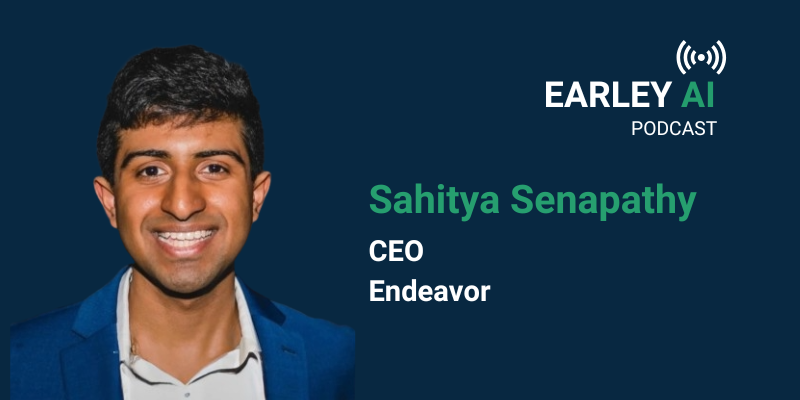
// Sahitya "Sami" Senapathy. The pun in his X handle (@sahitYAML) is intentional.
He flopped at soccer, painting, and violin. Coding was the only thing left - and he never let go.
Walk into an American factory and you'll find a contradiction. Million-dollar machinery humming next to a fax machine. Robotic arms welding chassis while a person three doors down retypes a purchase order into a spreadsheet by hand. Endeavor AI exists to close that gap, and Sami Senapathy built it to do exactly one thing: take the boring half of the job and hand the interesting half back to the human.
Endeavor sells AI agents to suppliers, distributors, and manufacturers - the unglamorous spine of a $2.8 trillion economy. The agents quote orders, enter sales, reconcile invoices, and onboard suppliers. These are the medium-complexity tasks that the big ERP and SaaS systems quietly left to people because they were too fiddly to automate. Endeavor's bet is that generative AI is finally good enough to do them, and that the real money isn't in a dazzling chatbot but in faster quotes and lower costs.
The company brands itself as "Silicon Valley AI meets America's industrial heartland," and Senapathy means both halves literally. Endeavor runs U.S.-based, sends people to visit plants in person during sales and rollout, and recruits engineers out of NASA, MIT, and UC Berkeley. The pitch to the factory worker is not subtle: keep your job, lose the drudgery.
Born in Michigan, raised around the manufacturing industry, Senapathy tried the usual childhood menu and found it didn't suit him. By his own telling, the list of failures was long and ordinary. The exception was the thing his mother did for a living.
Coding stuck. As a sixth grader he built a disaster-response application for FEMA with a few peers and walked away with a $5,000 grant from the Army - the kind of line that sounds invented until you notice it keeps showing up in every interview he gives. In middle school he was a Math Olympiad semifinalist. At 16 he was at the US Air Force Research Lab working on deep reinforcement learning alongside PhDs, and he earned a Secret security clearance before he could legally buy a drink.
Then came the resume that reads like a speedrun: an AWS internship on Amazon Q and large-language-model infrastructure, followed by Palantir, where in 2023 he built and shipped the company's first commercialized generative AI product and led a manufacturing rollout for a Fortune 500 client. That last job is the one that mattered. He spent weeks driving to factories around the country - and saw the spreadsheets.
In June 2024, Senapathy showed up at Craft Ventures' HackAIthon. Partners Jeff Fluhr and Brian Murray noticed something rare: a technical founder who could also sell, already closing large public manufacturers as an early-stage startup.
Craft led a $7M seed. The thesis, in Fluhr's words, was practical AI for an industry ready to change - not technology for its own sake. The round closed while Senapathy was still wrapping up a dual degree at Penn.
Backers and 40+ advisors include David Sacks, Lattice's Jack Altman, leaders from Snowflake, Palantir, Walmart, and ServiceTitan - and four-time Super Bowl champion Joe Montana.
// Earley AI Podcast, Episode 58 - "AI-Driven Manufacturing and Data Transformation."