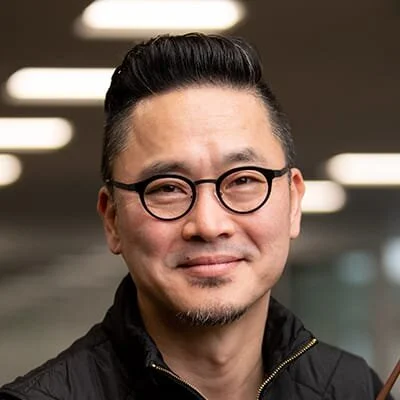
The category-maker who keeps starting over
Mok Oh spends his days at Foundation EGI arguing with a stubborn idea: that the smartest large language model on Earth still cannot read a mechanical drawing the way a 40-year machinist can. His company, launched out of stealth in April 2025, calls its fix Engineering General Intelligence - EGI - and the pitch is blunt. Generic AI guesses. Engineering cannot afford a guess.
The platform takes the disorganized sprawl of how products get built - tolerances, work-step sequences, technical manuals, spare-parts catalogs - and turns it into something machines can execute without inventing a number. It generates GD&T drawings straight from CAD. It writes optimized process plans from raw geometry. It translates a technical manual into another language without quietly fabricating a dimension. The market it is chasing is not small: Foundation EGI frames the prize as the roughly $8 trillion the world burns every year on engineering that is slow, manual, and error-prone.
The company was born at MIT. Oh co-founded it with Professor Wojciech Matusik, a computer-graphics and generative-AI researcher at MIT CSAIL who serves as chief scientist, and Michael Foshey, a manufacturing-systems researcher who heads research. The intellectual seed was a 2024 MIT paper, "Large Language Models for Design and Manufacturing." The money followed fast: an oversubscribed $7.6M seed from backers including the E14 Fund, Stata Venture Partners, Samsung Next, and - in a detail that writes its own headline - Henry Ford III. By July 2025 a $23M Series A led by Translink Capital pushed total funding past $30 million.
A resume that reads like a dare
To understand why investors trust Oh with the hardest problem in industrial software, look at the strange shape of his training. He left Oberlin College with two bachelor's degrees - computer science and art history. The art history was never a detour. A career spent obsessing over how people see and consume visual space runs straight through everything he has built since. He added a master's at the University of Pennsylvania and then a Ph.D. at MIT in the overlap of computer graphics, computer vision, and design and computation. Twelve patents trail behind him.
His first company carried his fingerprints in its name. He founded it in 2002 as "Mok 3," a pun stitching his own name to 3D modeling, before rechristening it EveryScape. The product was a Street View for the indoors - immersive 360-degree walkthroughs of city streets and, more to the point, the insides of stores, hotels, and restaurants. He understood early that a hotel is not selling beds. It is selling a space, and its inventory is that space.
EveryScape raised over $17 million across three rounds. It also handed Oh a lesson he still tells on himself. The company built a 30-person direct sales force spread across multiple regions before it had figured out the economics in even one of them - and then the 2008 downturn arrived. He has since been disarmingly candid about it: test in one city, find the right team size, partner with someone who already has a sales army before you go build your own. EveryScape eventually reached scale not by brute force but by riding AT&T's thousands-strong sales team through YP.com.
From maps to money to marketplaces
Oh left EveryScape in early 2011 and joined Where Inc., a location startup later swept into eBay's PayPal unit in a deal reported around $135 million. One PayPal executive said the acquisition was "because of the people" - Oh among them. He became Chief Scientist at PayPal, where he built and led the company's data science organization from the ground up. It was the moment his work shifted from rendering the physical world to mining the digital exhaust of millions of transactions.
Then he scratched a different itch. In 2013 he joined North Bridge Venture Partners as an entrepreneur-in-residence to build a "consumer big data" startup, and out of it came Moju - an interactive photo app he described, with characteristic flair, as "a personalized memory machine." His sales pitch was a single question he liked to put to anyone who would listen: you take a lot of pictures, but when was the last time you actually looked at them?
The next chapter was global. Oh became Chief Technology Officer of Mercari US, the American arm of the Japanese marketplace giant, running engineering teams across Palo Alto, Cambridge, and Tokyo before stepping into a VP of product and engineering role. He keynoted Mercari Tech Conf 2018 in Tokyo. Somewhere in the same stretch he also led strategy and marketing for the mobile division at Samsung's headquarters - a reminder that his career refuses to sit in one box, which, fittingly, is the title of one of his podcast appearances: "Don't put yourself into one box."
Why engineering, and why now
The throughline is not maps, or payments, or secondhand sneakers. It is the conviction that there is always a better metaphor for how humans and machines should work together - and that the people closest to a problem have usually been told what is impossible by the very tools meant to help them. That belief now points at the factory floor.
Foundation EGI is already piloting with Fortune 500 industrial companies across automotive, appliances, energy, and heavy equipment, with early results aimed squarely at compressing the design-to-manufacture cycle. The thesis is that engineering knowledge - the kind that lives in a veteran's head and a tangle of PDFs - can be captured, codified, and made verifiable, so an AI can reason about a gearbox the way it reasons about a sentence. If that sounds like a tall order, recall that Oh once insisted you should be able to stroll inside a restaurant on the internet, years before anyone agreed.
He bootstrapped that first idea for 18 months, crediting a working spouse and a shared willingness to "live poorly" while the vision caught up to reality. Two decades and four companies later, the pattern holds. Mok Oh tends to be early, tends to be specific, and tends to be building the thing the old tools said could not exist.
The man behind the metaphors
What makes Oh worth watching is not a single exit. It is the refusal to specialize. The art historian who learned computer vision. The maps founder who became a payments scientist. The marketplace executive who walked away to teach AI about torque specs and tolerances. Each pivot looks like a clean break and turns out to be the same person asking the same question in a new room: what is the better way for people to make sense of the world in front of them?
For a founder who has run teams on three continents and pitched everything from photorealistic cities to interactive photo albums, the through-stitch is almost philosophical. He keeps betting that the gap between what people imagine and what machines can render is closeable - and that closing it is a business. Foundation EGI is the most ambitious version of that bet yet, because this time the render is not a picture of a building. It is the building itself.