At four in the morning, a factory is a wonderfully impolite place for a theory. The lights are hard, the shift is real and every elegant claim about artificial intelligence must answer to the day’s actual work. Ishaan Makkar was there to watch. During one of Hexa’s early discovery engagements, he shadowed operations and mapped the friction in a manufacturing business. The surprising part was where the friction gathered. Much of it appeared after the physical work, in the administrative ritual of validating what had happened and entering it into systems that had long ago become part software, part archaeology.
This is the territory Makkar has chosen. As co-founder and CEO of Hexa, a Y Combinator Spring 2026 company, he is building software for industrial distributors and manufacturers that still move crucial information through email, PDFs, spreadsheets and established enterprise resource planning systems. Hexa’s agents handle pieces of sales, procurement, finance and customer operations. The company’s more revealing choice is architectural: it does not ask a distributor to abandon the ERP on which the business depends. It goes inside.
Makkar’s path to industrial software runs through physics lectures, a previous education startup, British running tracks and a family connection to manufacturing. On paper, it looks eclectic. In practice, the pieces rhyme. Physics trains attention on systems. Distance running makes feedback brutally legible. Manufacturing punishes software that does not respect either.
The stopwatch and the spreadsheet
Before Makkar was measuring response times for industrial quotes, he was measuring himself in metres. World Athletics records a 5,000-metre best of 14:57.69, run at Wimbledon Park in August 2024, and a 10-kilometre road best of 31:52 from that November. He competed for Imperial College and South London Harriers. A sub-15-minute 5K does not materialize from enthusiasm. It is built from repeated sessions, controlled discomfort and the willingness to see an unflattering split for exactly what it is.
The other Makkar dashboard · official personal bests
Bar length represents race distance, not relative performance. All three results appear in public athletics records.
At Imperial College London, Makkar studied physics and graduated with an MSci in 2026. He was also active beyond the department, with roles in entrepreneurship, data science and student sport. He attended a generative AI hackathon built around IBM Granite. The résumé suggests a person comfortable crossing domains, though Hexa’s origin is less a campus brainstorm than a return to familiar ground.
Makkar says he grew up around manufacturing; his family runs a large paper-producing business in India. Before Hexa, he founded a B2B education company that reached more than 5,000 users and over 70 partners. He later worked at a manufacturer building versions of the automations Hexa now sells. The back office was not an abstract market map. He had seen its habits from close range.
The earlier company also placed Makkar on the other side of a familiar founder problem: growth creates its own paperwork. Five thousand users sounds like a single milestone, but serving them through more than 70 partners means maintaining many small chains of communication, expectation and follow-up. Public descriptions of that venture are brief, so the precise lessons remain his to tell. The documented scale is enough to show that Hexa was not his first encounter with the gap between winning an account and operating the relationship well.
The inbox behind the factory
Industrial distribution has a timing problem disguised as clerical work. A request for quote arrives by email, perhaps as a PDF or spreadsheet. A salesperson identifies the parts, checks customer pricing, looks up inventory, calculates freight, asks a supplier about a shortage and retypes the result into an ERP. Each step is sensible. Together they consume the day. The factory floor may contain robotics and precise production controls while the commercial layer nearby remains a relay race of copy and paste.
“The back office shouldn’t be decades behind the factory floor.”
Hexa’s answer is a set of purpose-built modules. In sales, the system reads incoming requests, matches parts to a catalogue, applies pricing and prepares a quote. In procurement, it flags shortages, compares vendors and helps generate purchase orders. In finance, it matches invoices with purchase orders and receipts, tracks aging and follows collections. Customer operations can answer routine status and delivery questions from live ERP data. Humans review exceptions and approvals rather than manually assembling every transaction.
There is a quiet strategic wager here. Industrial businesses are often described as reluctant adopters, a phrase that flatters the seller and insults the buyer. A better explanation is earned caution. An ERP implementation can take years. Product catalogues contain histories no clean demo anticipates. Pricing may depend on relationships, exceptions and knowledge stored in a veteran employee’s head. Makkar’s public writing returns to the distinction between a familiar process and a healthy one, but Hexa’s own method acknowledges why familiarity persists.
Data is where the romance drains out of the agent story. One spreadsheet became the source of truth by accident. A supplier uses a part number that differs from the catalogue. An experienced clerk knows which field in the ERP is routinely wrong and which customer expects an exception. Put automation above that landscape without mapping it and the system merely makes mistakes faster. The Hexa team’s fieldwork treats those details as product requirements. The agent begins with what it is allowed to read, what it can safely change and which ambiguities must return to a person.
The company begins by embedding with a team. It shadows operations, audits workflows and decides where an agent would have a measurable effect. Deployment comes after discovery; optimization follows deployment; broader rollout follows evidence. This sequence lacks the theatrical snap of a chatbot answering perfectly on command. It is also closer to how industrial trust is accumulated.
A founding team with old mileage
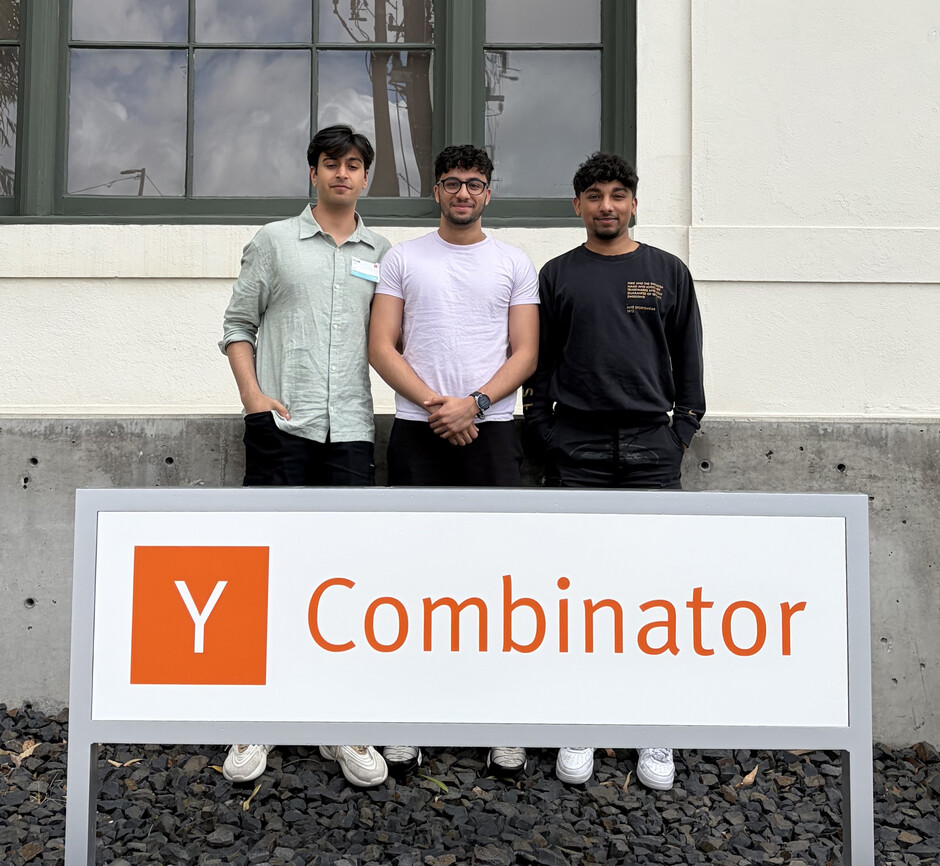
Hexa’s three co-founders arrived with unusually aligned histories. Makkar brought manufacturing exposure, customer work and the experience of scaling an earlier B2B venture. Mann Patira, the CTO, studied computer science at Imperial and worked on machine learning at Bloomberg and manufacturing software at Autodesk. Auri Nayak, the COO, covered distributors while working in private equity at KKR and previously worked in technology investing at Apax.
The relationship predates the company by more than a decade. The three went to the same school, came from the same town and later lived together while building Hexa. Long friendship is no guarantee of corporate peace, of course. It does remove one common piece of founder theatre: the hurried attempt to manufacture intimacy between complementary LinkedIn profiles.
Their division of experience creates a tidy triangle. Makkar speaks to workflow and market, Patira to the technical machinery, Nayak to the economics and buying logic of distributors. Hexa’s customer conversations have ranged across operators, sales teams, procurement managers and accounts-payable clerks, gathered through conferences, cold calls, online forums and direct outreach. The breadth matters because a quote does not belong to one department for very long.
The useful question was plain: “Can this scale without doubling headcount?”
Hexa reports that customers can quote materially faster and reduce certain pricing and stock errors. Those figures are company claims, and the more durable story will be written in renewals, expansion and uneventful Monday mornings. One early account described a distributor winning a £500,000 contract it previously could not have answered in time. The anecdote captures the commercial premise: speed matters when it is attached to accuracy, inventory and an actual buyer waiting at the other end.
The public customer trail is beginning to fill in. Hexa has described work with Nikko Electronics, automating repetitive tasks so its team can spend more time on higher-value work. Aim Industries has also publicly discussed using Hexa to strengthen internal processes while preserving its hands-on customer service. These are modest signals, appropriately so. Industrial software earns credibility one functioning workflow at a time, usually far from a launch-stage spotlight.
Endurance for an unglamorous market
Makkar is early in his career and Hexa is early in its life. The company was founded in 2026, joined YC that spring and operates from San Francisco. Its market is busy with startups promising agents for legacy workflows. The differentiator will not be the word “agent.” It may be the stamina required to clean data, map exceptions, survive integrations and make software useful after the launch meeting ends.
Here the runner comparison earns one final lap. Distance racing teaches a peculiar humility: ambition is public, but improvement is granular. A season is made from ordinary mornings. Industrial software follows a similar schedule. Every matched part number, correctly applied price and reconciled invoice is small. Enough of them, performed reliably, change the pace of a business.
At 4 a.m. in the factory, Makkar found the kind of problem that rarely photographs well. Administration is the shadow cast by every physical operation. Hexa wants to shorten that shadow without asking the company to stop being itself. For a founder who has spent years learning how to hold a pace, it is an appropriately patient race.