The successful day, in Igor Marinelli’s line of work, can be difficult to describe. The machines ran. The shift ended. Someone went home when they expected to. There is little to photograph, and no particularly stirring announcement to make. A factory that carries on doing its job has a public-relations disadvantage: catastrophe is much better at attracting attention.
Marinelli has a family reason to appreciate the distinction. His father spent 35 years in manufacturing, working his way through maintenance roles in the pulp and paper industry. His son grew up around the people responsible for keeping equipment running. When Marinelli eventually co-founded Tractian, he chose their working day as his problem.
On October 22, 2026, Tractian announced a $130 million funding round at a $1.4 billion valuation. Those are numbers that command a headline. The ambition underneath them is quieter: give a maintenance team enough warning, and enough useful information, to keep a developing fault from becoming everyone’s emergency.
The customer on the other end of Skype
Long before the industrial sensors came a young programmer with an awkward commercial limitation. At 13, Marinelli was building an inventory system for a motorcycle manufacturer in Portugal. He communicated through Skype, text, and email. His father sometimes joined calls about pricing. Marinelli preferred to say less because his voice would give away his age. The software was old enough to do business; its author was another matter.
He had begun learning PHP around ten, experimenting with circuits and old computers alongside his father. The paid project already put his programming next to an actual manufacturer’s administrative work. Years before Tractian, he was learning what it meant to make a tool for somebody who needed to use it.
His teenage record also includes a less welcome demonstration of technical initiative: detention for hacking his school’s computer system. By his October 2019 TEDxInsper appearance, he had put a different emphasis on what to do with that ability. The talk’s title was The Purpose of Life is Usefulness.
Its proposition was deliberately accessible. A useful contribution could involve coding, making something, or helping somebody with an ordinary task. The ability to act mattered. It was a practical philosophy for someone whose teenage client had been an ocean away, and whose first obstacle had included sounding sufficiently grown-up on the telephone.
A problem inherited at home
Marinelli studied computer engineering at the University of São Paulo and later spent time at the University of California, Berkeley. University also supplied a durable working relationship. He met Gabriel Lameirinhas on his first day of classes at São Paulo. Both had fathers who worked in industrial maintenance. Their familiarity with the sector preceded their company.
Tractian was founded in 2019, with Lameirinhas and Leonardo Vieira as fellow co-founders. The family connection gave the venture a concrete constituency: people who dealt with machinery, maintenance schedules, and the consequences of equipment going wrong. It was a field the founders knew through the work around them.
Early financing had a domestic scale. Marinelli says he sold his Honda Fit in the company’s first week. Gabriel sold his Ford Fiesta the next. He also recalls buying roughly 40 internet domains at the outset because the company was intended to operate internationally. The cars supplied money for the present; the domains reserved space for a possible future. A balance sheet rarely offers a neater pairing.
Tractian joined Y Combinator’s Winter 2021 batch. That accelerator affiliation belongs to its technology-company history. The maintenance background explains the particular technology company Marinelli decided to build: one whose usefulness would have to be established beside real equipment, in places where a production schedule already existed.
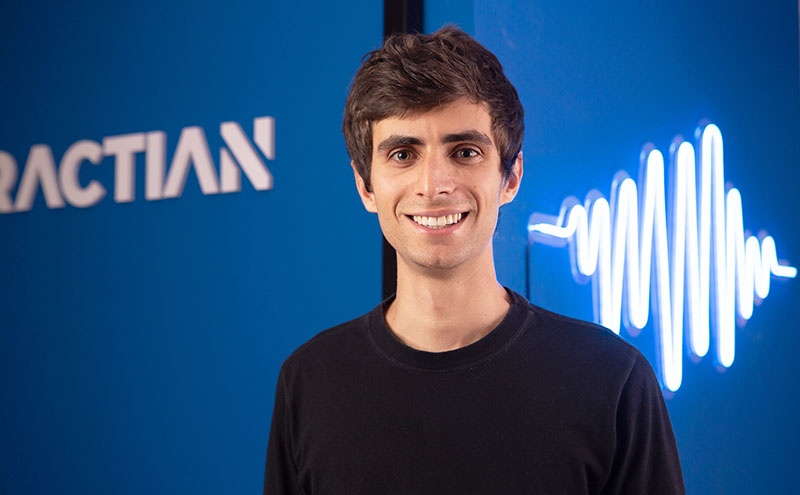
His father’s career in manufacturing helped put industrial maintenance on Marinelli’s map.
A sensor needs somewhere to send its news
By late 2022, Marinelli was describing Tractian as a combination of hardware and software. A maintenance manager needed to understand what was going to break and how. Selling a sensor, then leaving the customer to assemble the data infrastructure and interpretation, left too much of that job unfinished.
At that stage, the company had 150 people across the United States, Mexico, and Brazil. Its team included hardware, electrical, and mechanical engineers, alongside applications specialists and salespeople. The mix followed the product’s demands: a physical measurement had to become information a person could use.
The same interview contains a more personal admission. Coding remained something Marinelli enjoyed, while the company’s growth required him to learn sales, marketing, and customer success. He also found time for basketball and, while in Mexico, padel. A founder’s expanding curriculum can include both account management and learning where the ball is going.
By September 2026, his writing focused on an especially practical friction: alerts that maintenance teams still felt obliged to verify manually. More monitoring can mean more work if every notification needs another inspection. His stated goal was to earn confidence in particular diagnoses so that teams could delegate some of that checking.
He described software that could explain severity, likely causes, and recommended next steps, with specialist review available when needed. These were claims about what Tractian was building and how he wanted it judged. The test he proposed was recognizably human: whether the tool reduced the work on someone’s plate.
A conceptual product workflow, not a performance measurement.
Atlanta, by way of the workshop
Building across those disciplines made recruiting a consequential part of Marinelli’s geography. He has described struggling to find the engineering talent he needed in the Bay Area in 2019. Georgia Tech offered a different connection, with strengths across mechanical and electrical engineering as well as computing. Tractian’s first hire came from the university.
Atlanta also put the team closer to customers concentrated in the central and eastern United States. The choice combined a recruiting relationship with a practical location. For a company serving physical operations, the address had a relationship to the product.
In April 2026, Tractian was preparing to recruit as many as 30 interns across several functions. Marinelli argued that new AI tools gave interns more ways to demonstrate what they could do, and said the company supplied computing resources so they could begin working. The planned move to Coda in Midtown would give the growing Atlanta team a new base.
His public arguments about management follow a similar preference for direct involvement. In discussing his 2024 Web Summit presentation, he praised leaders promoted from within who retained an individual contributor’s approach and could operate at different levels. He was challenging the idea that management experience alone settled the question of who should lead.
His writing offers a longer record of that interest. Essays address engineering culture, leadership availability, and the company’s Blue Cap identity. A 2025 piece returns to first-principles thinking and the ambition to make the organization simpler as it grows. For Marinelli, culture is something to keep revising in public, alongside the product.
What the funding can buy
The financing changed scale quickly. Tractian announced a $45 million Series B in 2023, led by General Catalyst. A $120 million Series C followed in December 2024, led by Sapphire Ventures. Sapphire returned to lead the $130 million Series D announced in October 2026, with M&G’s Catalyst as co-lead.
Individual announced round sizes. These bars do not represent revenue or personal wealth.
Marinelli has been outspoken about choosing investors. In his fundraising discussions, he emphasized the people on the ownership table and their fit with the company. Raising capital brought a relationship as well as a bank balance. The independence he valued as a young builder now had to coexist with outside shareholders.
There are also distinctly physical places to spend the money. In a March 2026 discussion of Tractian’s development work, he described a 100,000-square-foot testing facility where equipment could be subjected to failure conditions. The purpose was to produce examples that helped train the company’s models. Industrial AI required an encounter with industrial failure.
The October announcement said Tractian served more than 2,000 critical facilities worldwide and employed over 700 people. Its intended expansion included manufacturers, utilities, data centers, and other operators of heavy equipment. The financing gives that effort resources. The work still comes back to what happens between a measurement and a maintenance decision.
The cloud has moving parts
Marinelli’s October 2026 writing turns to data centers. His argument is that high demand can squeeze the time available for preventive maintenance, even as the equipment operates continuously. Chillers and pumps become central to a business usually discussed in terms of computing capacity.
It is a natural extension of his industrial interests. The software economy depends on machinery with moving parts, and that machinery needs people who understand it. In his account, monitoring must help those people identify which asset needs attention and find an opportunity to intervene.
“if we are successful: no one will notice.”
Igor Marinelli, on the work Tractian serves
He has used that thought in his public posts about the company: a successful outcome may look like another ordinary day. Products arrive, infrastructure keeps operating, and the people responsible receive little ceremony. His father’s trade supplies the continuity in the story, from a family’s experience of manufacturing to a company now selling industrial tools internationally.
Marinelli’s milestones are easy to list: the early programming, the university partnership, the accelerator, the funding rounds. The purpose he keeps describing is harder to put in a trophy cabinet. Somewhere, a person finishes a shift without an unexpected breakdown to resolve. Nothing much happens. An excellent result, with remarkably poor dramatic timing.
Follow the work
Tractian · LinkedIn · X · Instagram · Essays
- Watch: Winning at Physical AI, NGP Capital
- Watch: the Funded conversation with Jason Yeh
- Watch: the Tractian journey, CMMSradio
- The Purpose of Life is Usefulness, TEDxInsper
- Read: Data Centers Are at Full Capacity. At What Cost?
- Read: Tractian’s Atlanta hiring and engineering story
- October 22, 2026: the Series D announcement
- The 2022 Predictiva21 interview