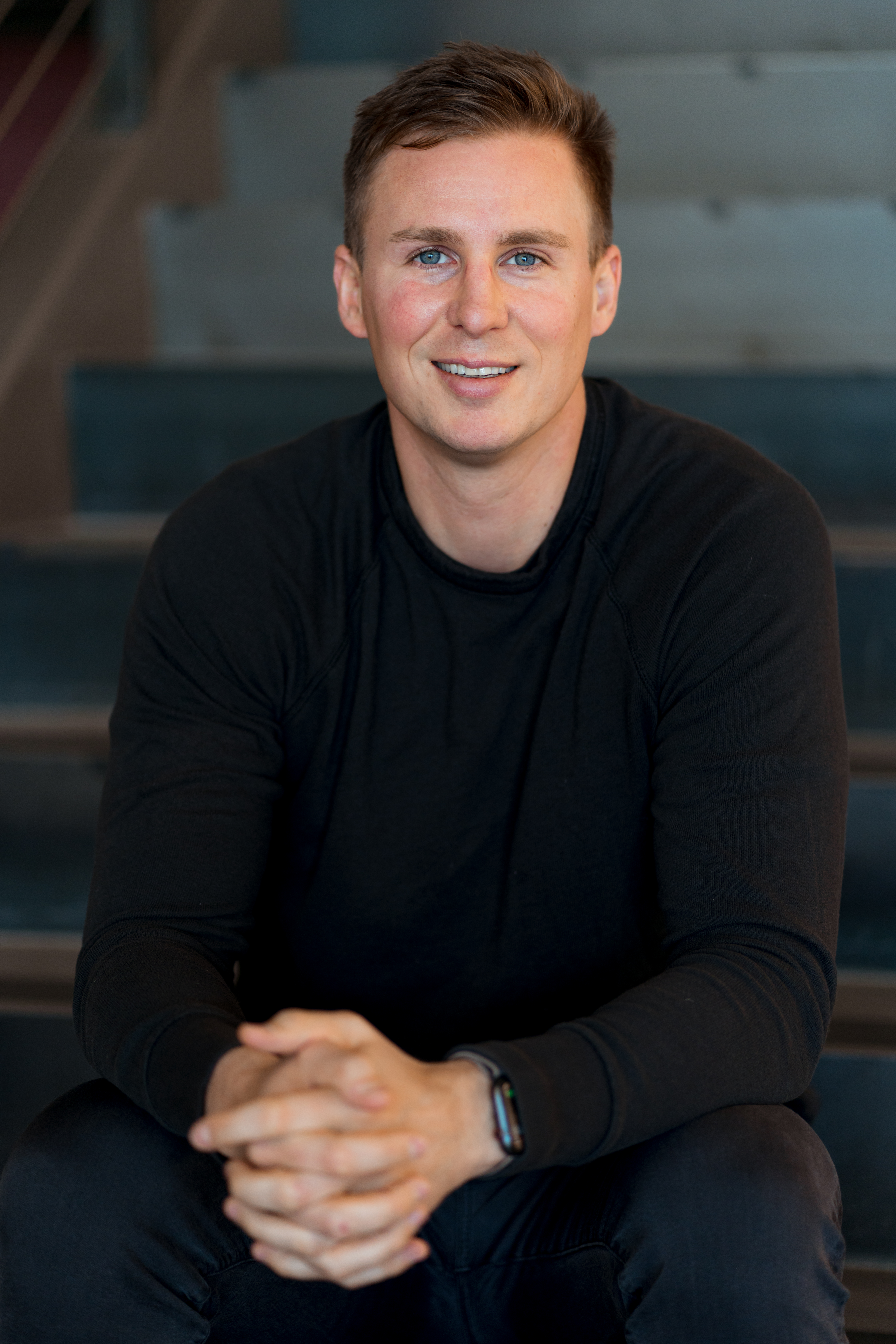
Three companies, one frontier
Right now, somewhere in a BMW factory in Spartanburg, South Carolina, a robot built by Brett Adcock's company is reaching into a car frame and doing something a human used to do. It works an eight-hour shift. It doesn't need a break. And it has contributed to more than 30,000 vehicles since deployment began.
This is what Adcock has been building toward since 2022, when he walked away from a publicly traded aerospace company he co-founded and started over. Not because Archer Aviation was failing - it wasn't - but because he had decided to go after a harder problem. That decision, made at 36, is why he is now running three companies and sitting on a net worth Forbes and the New York Times estimated at $19 billion as of early 2026.
The setup sounds improbable. Moweaqua, Illinois. Population: roughly 1,800. Third-generation family farm. Adcock grew up understanding that you work with what you have. His grandfather farmed it. His father farmed it. Brett was building websites at 16 - an e-commerce store for outdoor electronics and a content site called Street of Walls - because the internet was the only frontier available from central Illinois, and he was going to find it.
With extreme practicality, I make crazy ideas real.
- Brett AdcockThe education of a serial builder
He graduated valedictorian from Central A&M High School, then enrolled at the University of Florida's Warrington College of Business. He started in industrial engineering before switching to finance and real estate - a pivot that reflects something consistent about him: he is not attached to the technical credential, only to the outcome it enables.
At 25, he co-founded Vettery with Adam Goldstein in New York City. The pitch was straightforward - a machine learning platform matching tech talent with employers - but the execution was not. Vettery scaled to a network of 30,000 companies, with hundreds of employees, before being acquired by The Adecco Group in February 2018 for approximately $100-110 million. Adcock was 31.
He didn't pause. Within months, he and Goldstein had started Archer Aviation - electric vertical takeoff and landing aircraft. They took it public on the NYSE in February 2021 at a $2.7 billion valuation, raised over $1 billion in capital, and secured a $1.5 billion deal with United Airlines. By late 2022, Adcock had stepped down as CEO and resigned from the board. Not because anything went wrong, but because he had made a calculation: there was a problem more significant than flying cars, and he needed to work on it full time.
Four bets, four frontiers
General-purpose humanoid robots for manufacturing, logistics, warehousing, and eventually homes. Backed by OpenAI, Microsoft, NVIDIA, Jeff Bezos, and Intel. BMW partnership deploying robots on the production floor.
AI lab building models and hardware for a personal AI assistant designed to replace the phone-and-laptop interface. Launched publicly March 2026 after 8 months in stealth. Team from Meta's Superintelligence Lab, Google, and Amazon.
Non-intrusive, high-frequency scanners using NASA JPL technology to detect concealed weapons at school entrances. 4-meter detection range. Adcock personally invested $10M. Beta units targeting school deployment by end of 2026.
Electric vertical takeoff and landing aircraft. Went public on NYSE at $2.7B valuation. Secured $1.5B United Airlines deal. Raised $1B+ in capital. Flight-tested 5 generations of aircraft.
Machine learning-based employment marketplace connecting tech employers with talent. Scaled to 30,000 companies. Later became Hired after acquisition.
Figure: from nothing to $39 billion in 3.5 years
Adcock founded Figure AI in May 2022 with an idea that most people in the industry thought was 10 years away: a general-purpose humanoid robot that could actually work in a real factory. Not a research demonstration. Not a proof of concept in a controlled lab. A robot doing actual billable labor on a production line.
He assembled a team from Boston Dynamics, Tesla, Google DeepMind, and Apple - people who had spent years building robots in places that knew how robots failed. Within two years, Figure had robots at BMW. Within three years, Figure raised a Series C exceeding $1 billion at a post-money valuation of $39 billion, with a roster of backers that reads like a roll call of the most influential technology investors alive: OpenAI, Microsoft, NVIDIA, Jeff Bezos, Intel, Qualcomm Ventures, Salesforce, LG Technology Ventures.
The BMW deployment wasn't a beta. As of early 2026, Figure robots have contributed to more than 30,000 vehicles built at the Spartanburg plant. The company hit a production rate of one robot per hour in March 2026, with plans to triple that output. Adcock's stated target is to scale from thousands of units to one million per year.
Every home will have a humanoid within 10 years.
- Brett Adcock, TIME interview, October 2025Breaking from OpenAI
In January 2026, Adcock posted on X: "Today, I made the decision to leave our Collaboration Agreement with OpenAI. Figure made a major breakthrough on fully end-to-end robot AI, built entirely in-house. We're excited to show you in the next 30 days something no one has ever seen on a humanoid."
The announcement triggered significant industry discussion. OpenAI had been one of Figure's Series B investors. Exiting the collaboration to build proprietary AI was a bold signal - Adcock was betting Figure could outperform any external AI partner for its specific domain. The robots that followed demonstrated autonomous multi-day task execution in previously unseen environments, running entirely on Figure's own models.
That's the pattern with Adcock: he makes a decision, he tells you about it on X, and then he shows you whether he was right. The record so far suggests he usually is.
In his own words
A humanoid won't be the best at every single thing, but it will be universal. It will be able to do thousands of things instantaneously when you ask it to do it.
Useful robot work is all that matters.
I thought, okay, now I have a personal balance sheet to go after some harder problems. And rather than just throwing ideas around like I did in my 20s, I wanted to be very thoughtful about what I worked on next.
We're building a new species.
Humanoid robots are working now - and it's pretty simple.
This was a full team effort. Every group at the company came together to build a system that could do this autonomously end-to-end.
Hark and the problem with your phone
While running Figure AI as CEO, Adcock launched a second venture in late 2025. Hark is an AI lab building models and hardware to replace what he calls "the 20-year-old interface" of phones and laptops with personalized intelligence that has persistent memory, proactive behavior, and real-time interaction.
He funded it with $100 million of his own capital before a single outside investor came in. The team included people from Meta's Superintelligence Lab, Google, Amazon, and Tesla. The head of design was previously the Apple industrial designer for the iPhone Air. After eight months in stealth, Hark launched publicly in March 2026.
Two months later, Hark raised a $700 million Series A at a $6 billion post-money valuation, with Nvidia, ARK Invest, Qualcomm Ventures, Salesforce Ventures, and Parkway Venture Capital leading. First AI models are expected summer 2026, with hardware to follow.
Running Figure AI and Hark simultaneously - while also funding Cover - puts Adcock in a category occupied by very few people. He is not delegating these companies from the top. He is founder-operating all three.
How he got here
The record
The Cover project: schools and NASA technology
In 2023, Adcock founded a company most people haven't heard of yet. Cover uses technology licensed from NASA's Jet Propulsion Laboratory to build non-intrusive, high-frequency scanners that detect concealed weapons at school entrances. The system has a 4-meter detection range and is designed to be safer than airport body scanners.
He personally invested $10 million of his own money. The goal: deploy beta units to schools by end of 2026. It's a quiet project relative to Figure and Hark, but it signals something about how Adcock thinks about what money is for. He has said he believes in building valuable companies first, then deploying resources toward problems that don't otherwise attract enough capital.
The farm, the books, and the philosophy
Adcock has cited Isaac Asimov's Robot series as a direct influence on his decision to pursue humanoid robotics. The idea that robots could be universal - able to do anything a human can do, deployable to whatever problem exists - is closer to Asimov's vision than to any specific industrial robotics application. That's the long game Adcock says he's playing.
He keeps a Figure 02 robot in his own home. He has demonstrated it doing laundry autonomously using the company's Helix system. He uses Waymo with his family for weekend dinners. He is, functionally, a beta tester for the future he is trying to build.
He is also raising a family - married to Catherine, three children - while operating as CEO of Figure, founder of Hark, and founder of Cover simultaneously. He keeps his family largely out of public view. The few glimpses that surface suggest someone who is deeply motivated by what the world looks like for the next generation, not just the next funding round.
His philosophy, condensed: find the harder problem, build the practical version of the impossible thing, and keep going. He did it with Vettery when ML-based hiring seemed premature. He did it with Archer when eVTOL aircraft were theoretical. He is doing it with Figure when humanoid robots at commercial scale seemed implausible. His net worth is one piece of evidence. BMW's production floor is another.