BREAKING ·  Pickle Robot clears a floor-loaded trailer in ~90 minutes $50M Series B closed, Nov 2024 Six customers ordered 30+ robots in one quarter Over 10,000,000 lbs of freight unloaded Reported throughput: ~1,500 boxes/hour Mission: 1,000,000 warehouse doors in 10 years BREAKING ·  Pickle Robot clears a floor-loaded trailer in ~90 minutes $50M Series B closed, Nov 2024 Six customers ordered 30+ robots in one quarter Over 10,000,000 lbs of freight unloaded Reported throughput: ~1,500 boxes/hour Mission: 1,000,000 warehouse doors in 10 years
Company Profile · Physical AI

Pickle
Robot Company

The Cambridge startup that built a robot for the one job in the warehouse nobody fights to keep: unloading the back of a truck.

Founded 2018 Cambridge, MA ~130 people Robotics · Logistics
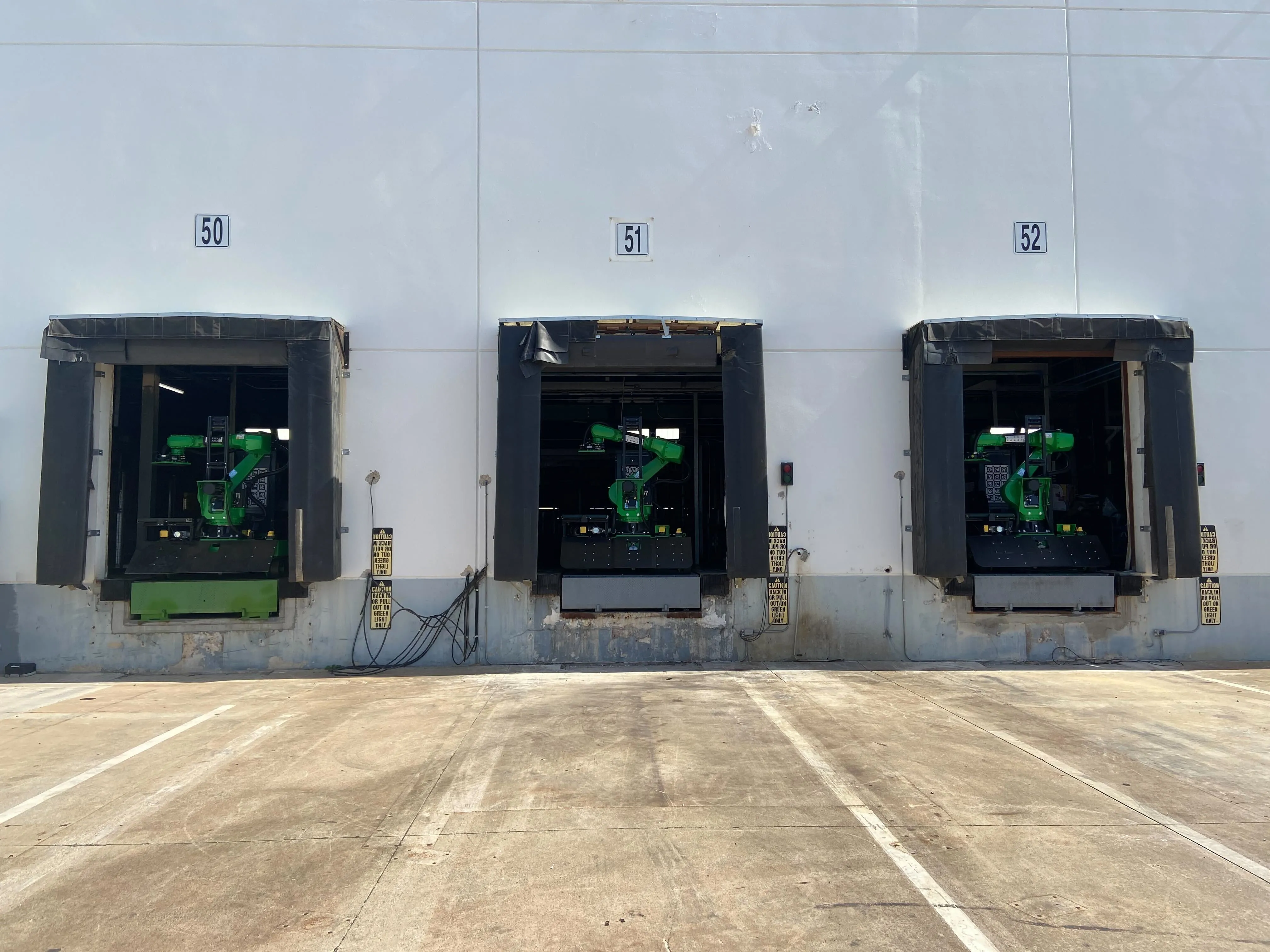
Three Pickle Robot unloading systems lined up at warehouse loading docks, ready to unload trailers
Three Pickle robots, idling at the dock like they own the place. They sort of do.
On the dock, right now

A trailer arrives. The robot is already waiting.

Picture the back of a 53-foot trailer packed wall to wall with loose cardboard - no pallets, no order, just boxes thrown in by hand somewhere overseas. For decades, clearing it meant a person climbing in and lifting, one carton at a time, in summer heat and winter cold. At a growing number of distribution centers, a Pickle robot now drives itself into that trailer and gets to work.

It is a KUKA industrial arm bolted to a base that moves on its own, tipped with a suction gripper and surrounded by cameras. It looks at the messy wall of freight, decides what to grab next, and starts feeding boxes onto a conveyor. A floor-loaded trailer that used to swallow a shift gets cleared in about 90 minutes. The people who used to do the lifting are still there - they just stopped lifting.

This is not a research demo running in a clean lab. Pickle robots work inside live distribution centers, beside human crews, handling whatever a supplier decided to cram into a container that week. The company describes what it does as Physical AI: software smart enough to operate in the unpredictable physical world rather than a tidy simulation of it. The loading dock turns out to be a near-perfect test of that idea, because nothing about it is tidy.

"The best working experience is one where machines do the heavy lifting and people do the problem solving."

- Pickle Robot Company
The problem they saw

Everyone automated the warehouse. Almost no one touched the truck.

Robots have been picking, sorting, and shuttling goods around warehouses for years. The industry got comfortable automating the tidy parts - the parts where boxes sit neatly on pallets and conveyors hum along. The truck remained stubbornly human. Unloading a floor-loaded container is hot, heavy, repetitive, and, by reputation, the highest-turnover station in the building.

Which is a polite way of saying people quit it constantly. That is the tension Pickle decided to live inside: the hardest, least glamorous task on the dock is also the one most resistant to a robot, because loose freight is chaos. No two trailers look alike. Boxes range from 5-inch cubes to 24-by-30-inch slabs, stacked at angles physics never intended.

A conventional industrial robot hates this. Factory arms are brilliant precisely because their world never changes - the same part arrives in the same place a million times in a row. Back the same arm up to a trailer of mixed cartons and it freezes, because it has no idea what it is looking at. The economics make the problem worse: rising parcel volumes and a thinning pool of people willing to do the work meant the demand for unloading kept climbing while the supply of hands kept falling. Somebody was going to have to teach a machine to improvise.

"Truck unloading is one of the most labor-intensive, physically demanding, and highest-turnover work areas in logistics."

- Pickle Robot, on why it picked this fight
The founders' bet

AJ Meyer wagered that messy was a software problem.

Co-founder and CEO AJ Meyer, an MIT alum, started Pickle Robot in 2018 with an unfashionable premise: the way to win the loading dock was not a better mechanical arm, but a better brain for it. Hardware could be bought. Perception was the moat. If a system could truly see a wall of disorganized boxes and reason about what to grab, the rest was engineering.

The company calls the result Physical AI - a multi-camera vision system feeding generative AI foundation models trained on millions of data points from real logistics operations. The robot is not following a fixed script. It is making thousands of small judgments about a scene it has never encountered, the way a worker would, minus the lunch break and the worker's compensation claim.

It is a contrarian bet in a field that loves clever hardware. Plenty of robotics startups spend years perfecting a gripper or a chassis and then discover the machine still can't cope with a real trailer. Pickle inverted the priorities. Buy proven industrial hardware, the thinking went, and pour the company's energy into the perception and decision-making that no supplier sells in a box. Every container the fleet unloads becomes training data, which sharpens the models, which makes the next unload a little better. That feedback loop - real freight in, smarter software out - is the thing that compounds.

2018
Founded
$114M
Total raised
~130
Employees
~90min
Per trailer
The short history of a heavy idea

Milestones

The product

One robot, three brains, zero pallets required.

The Pickle Unload System is deliberately unglamorous to describe and genuinely hard to build. A mobile base drives the arm into the trailer and repositions as the wall of freight recedes. Onboard compute runs the perception and planning. A suction gripper does the grabbing. Cloud dashboards let an operator watch a whole fleet from a screen instead of a forklift.

Pickle Unload System

Drives into trailers and import containers, clears non-palletized freight in roughly 90 minutes, and hands boxes from 5-inch cubes to 24x30-inch cartons onto the conveyor.

Pickle Physical AI

Multi-camera real-time vision plus generative AI foundation models trained on millions of points of real logistics data - the part competitors can't just buy off a shelf.

Fleet Dashboards

Cloud-native monitoring and reporting so one operator can manage many robots across many docks.

The collaboration model

Robots don't replace the crew. They take the lifting; people handle exceptions, jams, and the judgment calls a gripper can't make.

"Pickle is bringing Physical AI to supply chain automation."

- The company's one-line thesis
The proof

Ten million pounds is a hard number to argue with.

Skeptics are right to ask whether a demo-friendly robot survives contact with a real dock. Pickle's answer is volume. Its robots have unloaded more than 10 million pounds of merchandise from import containers and floor-loaded trailers - footwear, apparel, power tools, toys, kitchenware, packaging, small appliances. Not a staged box. The actual messy stuff.

The money followed the freight. In November 2024 Pickle closed a $50M Series B with Teradyne Robotics Ventures, Toyota Ventures, Ranpak, Third Kind, One Madison, Hyperplane and Catapult - plus a strategic customer writing a check. In the same stretch, six customers ordered more than 30 production robots in a single quarter. Public references to its work include UPS and Cintas.

Read the investor list closely and a pattern shows up. Teradyne owns Universal Robots and other automation brands. Toyota moves more freight than almost anyone. Ranpak, a packaging company, liked the robot enough to invest twice and take a board seat. These are not tourists chasing an AI headline; they are the people who would actually deploy the thing, which is a more demanding kind of due diligence. The order book backs that up - a meaningful share of the new orders were pilots converting into production and existing customers buying more, the quiet signal that the robot earned its keep the first time.

Funding, round by round

Disclosed amounts · USD millions
Series A · Nov 2022$26M
Series B · Nov 2024$50M
Total raised to date~$114M
Bars scaled to the $50M Series B. The "total" bar tops out because, frankly, the chart ran out of trailer.

"Machines do the heavy lifting. People do the problem solving."

- The pitch, compressed to seven words
The mission

They count their goal in doors.

Most companies measure ambition in revenue. Pickle measures it in dock doors: one million of them, automated within ten years. It's a strangely physical unit for an AI company, and that's the point. Every door is a real opening at the back of a real building where, today, a person is still climbing into a metal box to move someone's online order along.

The wager underneath is bigger than warehousing. If generative models can handle the unscripted chaos of a floor-loaded trailer, they can handle a lot of physical work that has resisted automation for the same reason - because the real world refuses to arrive on a pallet.

Floor-loaded

Pickle specializes in freight thrown loose into a container with no pallet - the messiest unloading job there is.

Self-driving arm

The KUKA arm rides a base that drives itself into the back of the trailer and repositions as it works.

5in to 24x30in

One gripper, a wild range of boxes, from tiny cubes to oversized cartons.

MIT roots

Founder AJ Meyer is an MIT alum; the company sits in Cambridge, a few minutes from campus.

Back at the dock

The trailer arrives. Same as before. Except it isn't.

The truck still backs up to the door. The freight is still a wall of loose cardboard. What changed is who climbs in. The robot was already waiting, and ninety minutes later the trailer is empty - no strained backs, no one quitting by Friday.

Pickle Robot didn't pick a flashy problem. It picked the dull, painful, expensive one at the very edge of the building, and bet that seeing clearly was the whole game. Ten million pounds in, the bet is still on the table - and the line of robots at the dock keeps getting longer.

Share & explore

Pass it down the line

Watch
Links