He builds robots to do the job that fifteen people were doing on a freezing UPS night shift. The robots do not mind the cold.
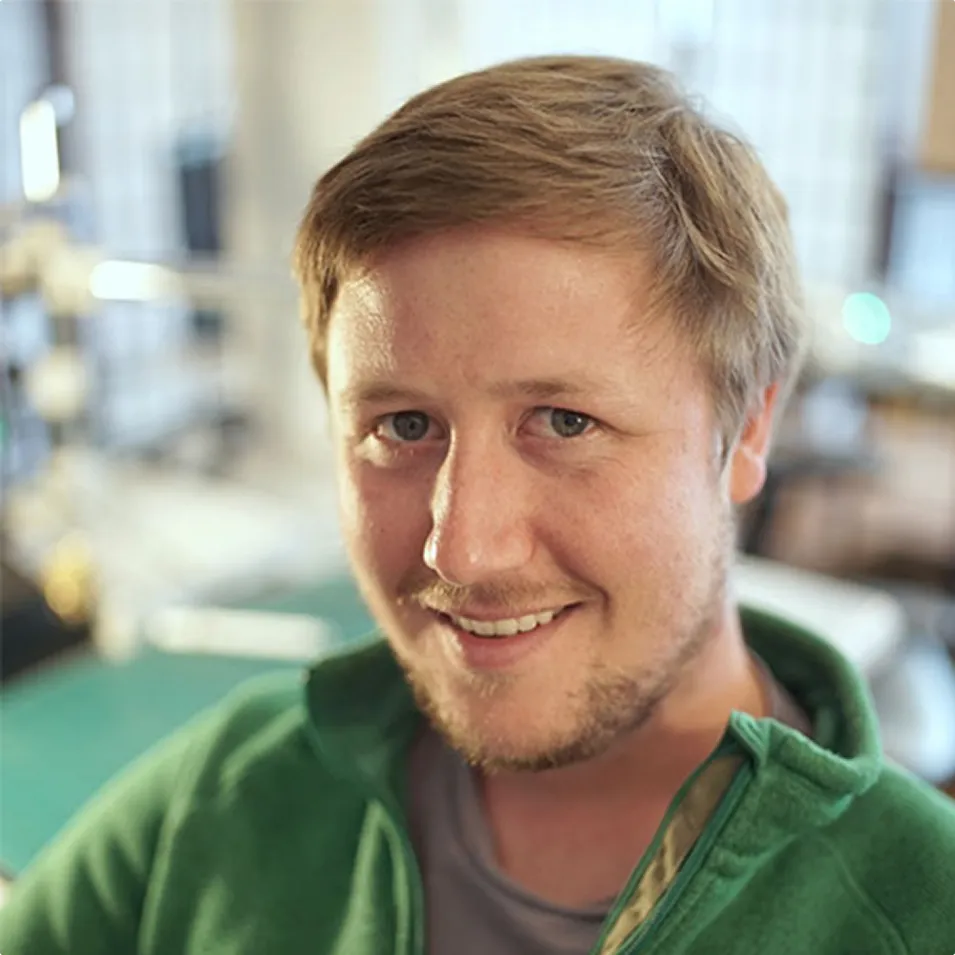
Andrew Meyer, who answers to AJ, runs a company whose robots spend all day inside the back of a trailer. It is dark in there. In summer it hits 115 degrees. In winter it is below freezing. Boxes weighing up to fifty pounds are stacked to the ceiling, and someone has to pull each one down and set it on a conveyor. For decades that someone was a person. Meyer decided it should be a one-armed robot named for a vegetable.
Pickle Robot, the company he founded in 2018 with two fellow MIT alumni, sits at the center of a phrase you now hear everywhere in warehousing: Physical AI. The idea is to fuse the pattern-hungry brains of generative AI and foundation models with cameras, sensors, and industrial arms, so that software can finally reach out and touch the real world. Pickle's version reaches out and grabs a box. Then another. Then a few hundred more per hour.
The company is headquartered in Charlestown, just across the water from the MIT labs where Meyer learned the trade. Its robots are already at work for UPS, Ryobi Tools, and Yusen Logistics. In November 2024 it closed a $50 million Series B and booked orders for more than thirty production machines. The market it is chasing is not small: Meyer pegs global spending on manual truck loading and unloading at roughly $100 billion a year.
Modified KUKA arm · foam-tipped suction head · works -0°F to 115°F
The problems we solve are human problems, not technical ones.— AJ Meyer, Founder & CEO, Pickle Robot
In 2018 Meyer and his co-founders were doing what founders do when they have a technology and no target: looking for the right job to point it at. They went to a UPS warehouse and stood there on a winter night shift, watching fifteen people unload trucks. Cold. Repetitive. The kind of work that grinds down backs and burns through staff. Nobody grew up dreaming of it.
The trio - Meyer, Ariana Eisenstein, and Dan Paluska - had met at Leaf Labs, the deep-tech consultancy Meyer started after graduating from MIT in 2009. Leaf Labs built oddball hardware and software for clients that included Google and Facebook, and reportedly worked on things as exotic as brain-implantable devices. Truck unloading was, by contrast, refreshingly concrete. A box is a box. Pick it up. Put it down. Do it a million times.
Here is the twist that says everything about how Meyer thinks. Pickle did not start with unloading. It started with the harder problem of loading a container - packing boxes in tight, like a game of physical Tetris. "We thought that was the hardest problem, and it hadn't been solved yet," he has said. When money ran dangerously low, the team pivoted to the more tractable job of taking boxes out. His reasoning was blunt: "Why spend our last dollar on a warm-up task?"
Then came the video. Nearly broke, the team filmed their robot emptying a trailer and posted it to YouTube. Hundreds of customer inquiries poured in. Investors, who had cooled, warmed back up. A clip of a machine doing dull work turned out to be the most valuable pitch deck they ever made.
In 2018, we went to a UPS warehouse and watched 15 guys unloading trucks during a winter night shift.
Why spend our last dollar on a warm-up task?
We thought that was the hardest problem, and it hadn't been solved yet.
The problems we solve are human problems, not technical ones.
Graduates MIT with a degree in electrical engineering and computer science. Founds Leaf Labs, building embedded systems for robots, cars, and satellites.
Launches Industry Labs, a startup co-working operation across the Boston area.
Co-founds Pickle Robot with Ariana Eisenstein and Dan Paluska after the UPS night-shift visit.
Public debut of the truck-unloading robot arm at the ProMat trade show.
Closes a $50M Series B; secures orders for 30+ production robots. Total funding tops $114M.
Scales toward 130 employees; deployments running at UPS, Ryobi, and Yusen Logistics.
Physical AI for logistics. One-armed robots that autonomously unload trucks and feed conveyors inside distribution centers.
Embedded software and hardware for hard problems - robots, cars, satellites, and prototypes for the likes of Google and Facebook.
A tech-startup co-working company with locations around Boston, seeding the next batch of hardware founders.
Meyer, Eisenstein (CTO), and Paluska (VP Robotics) turned a Leaf Labs collaboration into a robotics company.
A box is a box. The genius is not in the grab - it is in doing it a million times, in the dark, at 115 degrees, without complaint.— On the unglamorous economics of Physical AI
Plenty of robotics companies chase the demo that goes viral - the humanoid that dances, the arm that flips a pancake. Meyer went the other way. Pickle's pitch is spreadsheet-simple: unloading a trailer is expensive, injury-prone, and hard to staff. A robot that does it earns its keep on labor and workers'-compensation savings alone. The machine does not need to be charming. It needs to show up for every shift.
That is the quiet radicalism of Physical AI as Meyer frames it. The intelligence lives in the software - vision, motion planning, learning from every box it touches - but the payoff is physical and boring and enormous. The arms improve over time, adapt to new trailers on the fly, and connect into the wider choreography of the warehouse.
The vision does not stop at one dock door. Meyer talks about connecting fleets of robot platforms across supply chains, so that unloading hands off cleanly to sorting, palletizing, and everything downstream. In mid-2026 Pickle announced an integrated solution with Ambi Robotics to automate inbound logistics end to end - a sign that the loading dock is only the opening move.
It is a curiously humane mission wrapped in industrial hardware. The robots take the jobs people did not want, in conditions people should not endure, and the humans move up the value chain. Or, as Meyer puts it, the problems are human ones. The robots are just how he answers them.
Series B investors included Teradyne Robotics Ventures, Toyota Ventures, Ranpak, Third Kind Venture Capital, One Madison Group, Hyperplane, and Catapult Ventures.