The useful thing about a field is that it has no patience for a keynote. Dust enters the enclosure. Sunlight changes by the minute. Steel vibrates, plants overlap, a season refuses to wait, and the customer has work to finish before the weather turns. Paul Mikesell had spent a career making complicated computer systems scale. In agriculture, he found a sterner examiner: reality with roots.
His route there began in Seattle's software world. He earned a computer science degree from the University of Washington in 1996, worked at RealNetworks, and in 2001 co-founded Isilon Systems. Isilon made clustered storage behave like one large system, a useful trick as digital files multiplied. The company went public in 2006. Mikesell then co-founded Clustrix, applying distributed-systems thinking to databases. Two startups, two versions of the same appetite: take a bottleneck and make the machinery behind it disappear.
At Uber, where he became director of infrastructure engineering, the machinery changed. Neural networks were beginning to give computers a practical way to interpret the physical world. Mikesell worked around deep learning, computer vision and self-driving technology. He has described that period with the unmistakable excitement of an engineer watching a threshold move. When a technology creates that feeling, he says, you have to dive in because it may be the future.
The problem hiding in plain soil
Farmer friends supplied the problem. In conversations with them, weed control kept surfacing as a serious and worsening burden. Weeds compete with crops. Pulling them is punishing and costly. Herbicides bring their own limits, and resistance does not improve with wishful thinking. Farming had plenty of technology, but Mikesell saw that modern perception systems had not traveled far enough from their usual technology corridors.
He started buying lasers online and experimenting. The pairing was almost comic-book simple: teach cameras and software to tell crop from weed, then direct a laser at the plant that did not belong. Simplicity lasted roughly as long as the first sketch. A commercial machine needed cameras, compute, targeting, industrial lasers, cooling, power and safety systems. It needed to move through imperfect rows without singeing the crop. It needed to operate when the field was hot, dusty and very far from a lab.
The mission close to my heart is deploying advanced technology to make real-world work safer and better for people.Paul Mikesell
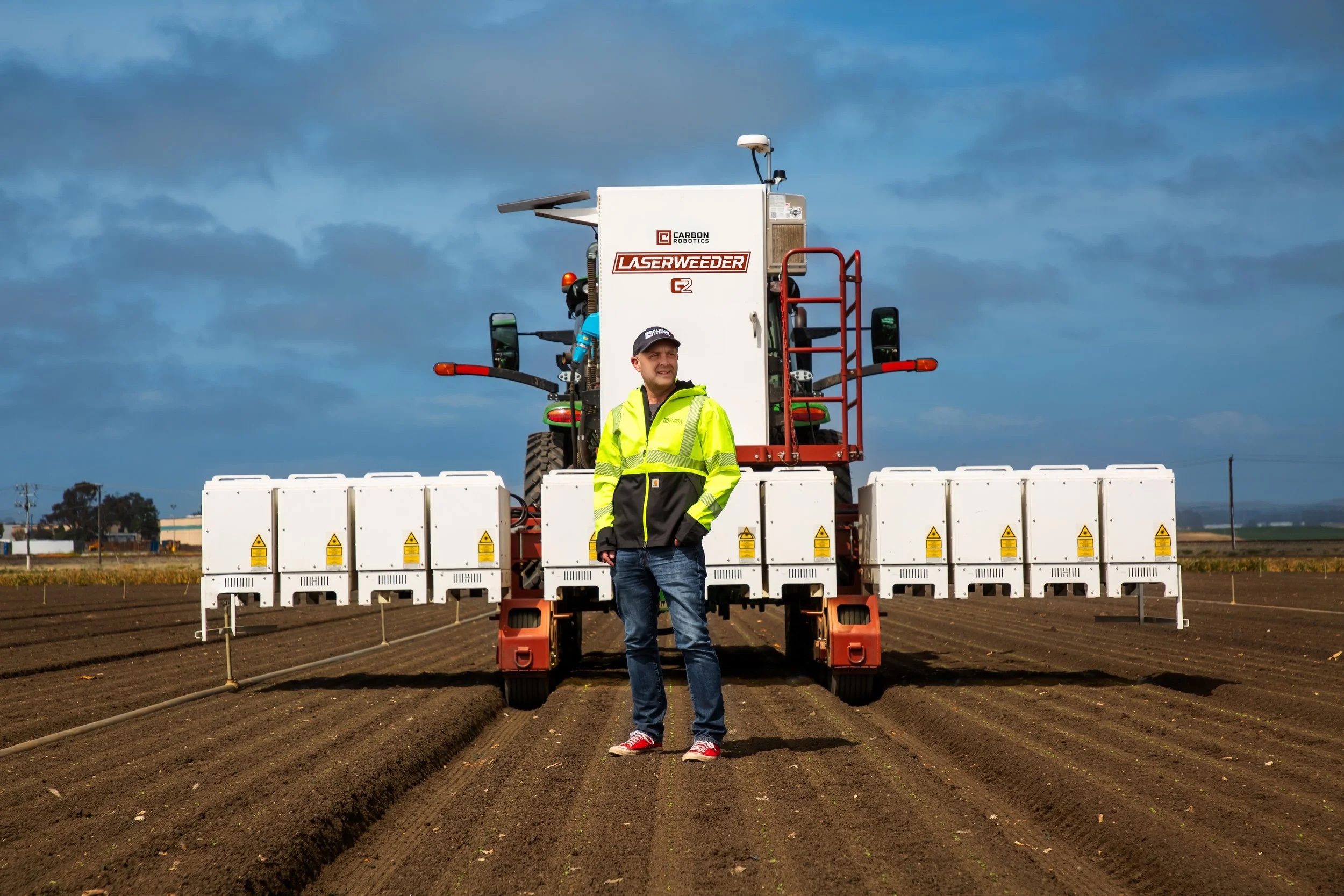
Carbon Robotics was founded in 2018. Its first product was an autonomous LaserWeeder, a self-driving machine that proved the central idea. Growers, however, offered a correction. They already owned tractors, understood them and had built operations around them. What they wanted was an implement that joined the fleet rather than demanding a new one. Carbon listened. In less than a year, the team introduced a pull-behind version.
This is the less cinematic part of invention and the more consequential one. A machine may perform its task and still be wrong for the workflow. Mikesell's great subject was becoming adoption: how an unusual technology could fit into an old, precise and financially unforgiving business. The laser made the demonstrations memorable. Compatibility made the product buyable.
The skeptical farmer is the product review
Mikesell tells a joke about Carbon's early attempt to define an ideal customer. One storyboard showed a farmer who was skeptical and thought the product would never work. Another showed a farmer who loved the machine. The trick was that both storyboards depicted the same farmer. The distance between them was evidence.
It is a revealing joke. Agriculture does not need to be dazzled. A grower makes large bets inside short windows, and failure cannot always be repaired with a software patch on Monday. Mikesell has also observed that a farmer who looks thoroughly unimpressed may, when asked, explain that the machine is saving the farm. Silicon Valley sentiment analysis is no match for agricultural reserve.
Carbon's answer has been unusually direct. Rather than hand the customer relationship to a dealer network, the company built global sales and support teams. Mikesell argues that direct contact tells Carbon how equipment is used, where it struggles and what growers need next. The customer, in turn, knows whom to call. For a company selling advanced machines into remote fields, the telephone may be as important as the neural network.
That feedback loop extends into the software. Machines collect field imagery; models improve; updates return to the fleet. By 2025, Mikesell said the company's equipment had eliminated more than 15 billion weeds across more than 100 crops. The modular G2 line, launched that year, ranged from compact configurations suited to smaller European plots to broad implements intended for large acreage. The product was no longer a single imposing machine. It was a system learning to fit different farms.
A platform underneath the spectacle
A laser destroying a weed is excellent video. Mikesell calls the company's social footage “candy,” with obvious affection. Yet his deeper bet is the shared intelligence underneath. In 2025 Carbon introduced tractor autonomy that could retrofit existing equipment, again following the logic of working with what farmers already own. In early 2026 it announced a Large Plant Model trained on 150 million labeled plants, designed to recognize unfamiliar plants without beginning a fresh model for every crop and geography.
The compounding loop: cameras encounter more plants, field data improves recognition, recognition expands the useful crops and locations, and every deployed machine can make the underlying system more capable. The implement is visible. The accumulating plant knowledge is the platform.
The strategy rhymes with his earlier companies. Isilon pooled storage. Clustrix distributed database work. Carbon aims to reuse one perception backbone across LaserWeeders, autonomous tractors and future machines. In 2025, after a $20 million funding extension, Mikesell teased another AI-powered farm robot that would work beyond weeding. He offered few details and one concise promise: “It'll blow your mind.” Discretion has rarely sounded so pleased with itself.
Capital has followed. Carbon raised a $70 million Series D in 2024 and the extension the following year. By 2026 the company said it operated in 15 countries and generated more than $100 million in annual revenue. Mikesell has spoken openly about a possible public offering, but his conditions are sober: consistent revenue growth, profitability and receptive markets. A date matters less than readiness.
Recognition has arrived too. The University of Washington named him its Alumni Entrepreneur of the Year in 2024, almost three decades after his computer science degree. He received the 2025 AgTech CEO of the Year award. The pleasant irony is that a career built on increasingly sophisticated abstraction has earned attention for a machine whose success can be inspected by kneeling down and looking at the row.
Meaning, earned one acre at a time
The name Carbon Robotics carries no elaborate founding myth. Mikesell says roughly half a dozen early colleagues tossed around names, voted and chose “Carbon” because it sounded cool, tough without being imposing. His conclusion is better than a branding workshop: names mean little until people build meaning into them.
His leadership comments have the same practical grain. He talks about teams of stars and underdogs, about encouraging risks even when they fail, and about execution as a form of trust. Former colleagues have praised his ability to build engineering teams and ship products. The record suggests a founder more interested in operating systems than in founder theater.
Yet Carbon has enlarged his canvas. Software engineers can control a great many variables. Farms restore perspective. Biology changes, machinery wears, customers improvise and a deer may wander into the autonomous tractor's path. Progress happens anyway, through a thousand decisions that never fit inside the glossy phrase “AI-powered.”
Names mean little until you build meaning into them.Paul Mikesell
For Mikesell, the aspiration now reaches beyond weeds. He wants to reuse Carbon's perception and autonomy across more physical work, making difficult jobs safer and farms more productive. The grand vision is carried by ungrand things: a scanner calibrated correctly, a service call answered, a machine that fits through the gate, a grower willing to run it for another season.
There is a larger argument inside that ambition. Artificial intelligence is often valued by how convincingly it can imitate thought. Carbon's machines are valued by whether they can perform a job, repeatedly, under conditions nobody can prompt away. Their intelligence has consequences in fuel, labor, crop quality and time. It must coexist with operators, equipment and routines that were there first. Mikesell's version of the future is therefore less about replacing the farm than giving it sharper tools. The technology earns a place by respecting the place it enters. For an industry that has endured more futuristic promises than most, this may be the only sales pitch worth making.
This is what happened when a systems engineer left the clean metaphors of the cloud and met the literal ground. The problem became messier. The standard became clearer. A field does not care how elegant the architecture looks. It cares whether the crop remains and the weed does not. Paul Mikesell seems delighted by the arrangement.
Watch, read, follow