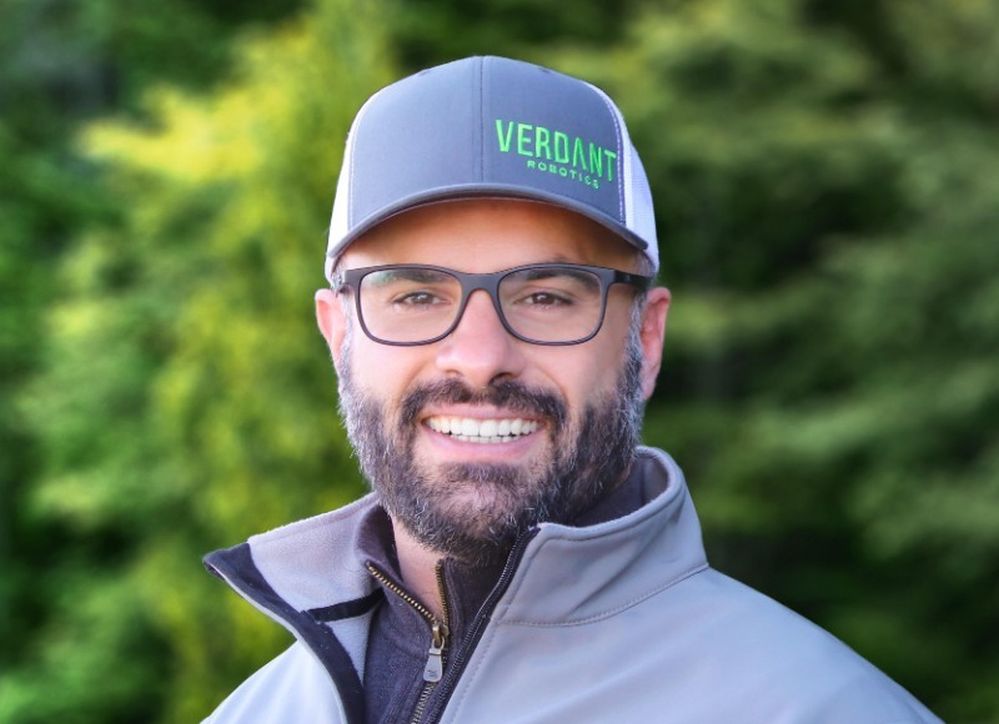
The summer the Mars Pathfinder mission put Sojourner on another planet, Gabe Sibley was teaching computer science to high-school and junior-high students. The little rover gave him an unusually practical revelation: robotic exploration of the solar system was not merely something to admire. It was a job a person could get. “Sign me up,” he remembered thinking. He arranged his education accordingly, moving to Southern California to be near NASA’s Jet Propulsion Laboratory and beginning a career spent teaching machines to perceive, map and move through places that refuse to hold still.
It is tempting to draw a bright line from a Mars rover to a smart farm implement, but Sibley’s path wriggles more like a field row seen from a bouncing tractor. There was doctoral work at the University of Southern California, five years in JPL’s Computer Vision Group, a postdoctoral fellowship at Oxford, faculty posts in Washington and Colorado, an early autonomous-car company, a delivery rover, an acquisition and a brief stay at Cruise. Agriculture came later, after a question had begun to nag him: where could autonomous systems make themselves useful now?
A career in narrowing the distance
At JPL, Sibley worked on perception and navigation for autonomous mobile robots while completing a Ph.D. in computer science. His research vocabulary included estimation, long-range stereo, localization and SLAM - the art of building a map while working out where you are inside it. At Oxford, he studied long-term autonomy and outdoor navigation. Back in the United States, he became a computer-science professor, first at George Washington University and then at the University of Colorado Boulder.
Industry was beginning to absorb the computer-vision work that universities and government labs had cultivated. Students who once might have gone to JPL were starting companies. Sibley was invited to co-found Zoox, declined, then joined a few months later anyway. He has joked about the reduced equity attached to that hesitation. As chief science officer, he helped assemble an early team when self-driving cars still felt like a small, charged province occupied mainly by Waymo and Zoox.
The excitement came with a sober constraint. Releasing vehicles capable of harming people demanded an appropriately high safety bar, and the arrival of autonomy at societal scale looked distant. Sibley wanted the work to land sooner. He left to co-found Zippy, choosing packages over passengers. The company built sidewalk rovers that completed deliveries for Postmates and DoorDash. Then the geometry of the business asserted itself: to scale sidewalk delivery in the United States, the rover needed the road. The package problem had curved back into the car problem. Zippy was sold to Cruise.
“Specific solutions for specific problems.”Gabe Sibley on where robots make an earlier impact
The meeting at the bar
The next turn arrived through old collaborators. Sibley had worked with Moog on DARPA-funded robotics; people there believed agriculture was a promising place for the same capabilities and introduced him to Curtis Garner, an experienced farm operator. They met in a San Jose bar. Sibley later described the chemistry with a dry little flourish: they looked at each other, realized they should get married, and their introducers should foot the bill.
The joke works because the match was structural. Sibley knew computer vision, machine learning and autonomous machines. Garner knew what the machines would have to survive and which farm expenses made a new tool worth considering. Rather than emerge from the bar waving a blueprint, they spent six months on the road talking with growers. There were no demos and no polished pitch, Sibley has said. They listened to worries about scarce labor, rising input costs, narrow operating windows and equipment that could not be precious about dust.
That tour supplied the product brief. Labor and chemical inputs occupy major lines in a grower’s budget. A useful machine would fit equipment already on the farm, operate quickly enough to cover commercial acreage and earn its keep on work growers already pay to have done. Verdant settled on non-contact applications: identify a target, decide what it needs, and deliver a carefully placed liquid. Weeding was one job, but the same basic act could include thinning, pollen, fertilizer or crop protection.
The split-second field loop
The intelligent squirt gun
SharpShooter is not a humanoid wandering between lettuces. It is an implement attached to the tractor’s standard three-point hitch. Sibley likes to call tractors Transformers: a grower clips on one tool, completes the operation, drops it and picks up the next. Verdant designed itself into that familiar rhythm. Cameras face the ground. High-speed stabilization keeps track of targets as the tractor jostles ahead. Computer-vision models classify what they see. Aimable nozzles fire at the selected spots.
An early prototype used an array of fixed nozzles. Adding more nozzles improved resolution but made the contraption unwieldy. The team stepped back and built aimable turrets instead. Now a shot could arrive from an angle, reach over or under foliage and address three-dimensional crops. The same mechanism could aim upward at an apple blossom or downward at carrots, garlic, onions and leafy greens. Software and models changed between crops; the hardware did not have to be reinvented each time.
The numbers describe speed and accuracy, but the useful unit is judgment. A camera pair produces a spatial picture. The machine must know not only that a leaf is green, but which plant it belongs to, where that plant will be a fraction of a second later and how large the application should be. In one interview, Sibley compared the desired splat to a pinky fingernail. In another, he described the system as an agronomist with a paintbrush, except the brush is riding behind a tractor and making decisions in real time.
Nature supplies the edge cases
A farm is a fine place to cure a technologist of laboratory manners. There is shock, vibration, dust, heat, cold and high-pressure chemical washing. Crops occlude one another. Light changes. Soil changes. One frosty morning, carrot tops turned purple. The model had never met a purple carrot. It called them weeds and began happily treating them. Automatic flags went up, the system stopped, and the team supplied examples that taught it what frost had done.
The episode is funny only because the safeguards worked. It also captures Sibley’s description of field learning: unusual events accumulate, people label them, and the model becomes less surprised by different soils, lighting and weather. “They have got to be insanely robust,” he has said of agricultural machines. Elegance may win a demo. Washdown seals, automatic stops and a growing library of purple carrots win another morning in the field.
“Ag is super advanced. Farmers are advanced appliers of technology and always have been.”Gabe Sibley
That respect for the customer gives Sibley a portable operating idea. Verdant originally offered robotics as a service, believing close support would keep the company in conversation with growers as the system evolved. Customers increasingly wanted to buy the machines, so the model shifted toward direct sales. The form changed; the attention did not. In 2025, Sibley wrote that repeat customers had placed multi-unit orders, double-digit SharpShooters had been ordered in a quarter and production had reached three units a week.
His reading offers another clue to the sensibility. Sibley admires Zen and the Art of Motorcycle Maintenance for its attention to quality, craft and the private reward of doing a job well. He tries to get employees to read it, with mixed success. More recently, Cadillac Desert sharpened his interest in the engineering and politics of water in the American West. For someone building machines meant to use agricultural inputs sparingly, water, soil and farm economics refuse to remain separate subjects.
Impact at tractor speed
Sibley’s ambition is broad, though his preferred machine is specific. He has said he wants Verdant to help as many growers as possible farm efficiently and sustainably, across more crops and more regions. By 2025 he was describing applications across more than three dozen crops, with demonstrations beyond the United States as well. In 2026, Verdant announced an expansion into grass seed and sod production, another variation on the same act of seeing first and applying second.
There is no repudiation of Sibley’s earlier work in this move. The farm implement contains the same family of problems that animated his research: perception under uncertainty, mapping, timing, control and the stubborn behavior of machines outdoors. What changed was the distance between the technical feat and the customer’s arithmetic. A grower can count acres, hours, passes and gallons. The value of a better decision can appear on the same day it is made.
He still enjoys the big horizon. In a 2025 conversation, Sibley imagined a future in which people speak naturally about automating agriculture, construction, forestry and logistics. Agriculture simply offered a tractable place to begin. He grew up in the country, likes skiing and biking, and says the outdoor mission speaks to him. The work is difficult, which is partly the attraction. “It’s a lot of fun,” he said. “It’s hard, so it better be fun.”
A young teacher once watched a small rover make another planet navigable. Decades later, his machines watch ordinary earth pass beneath a tractor and decide where a few milliliters should go. The distance is shorter. The terrain is no less alive.