An autonomous parachute has a wonderfully obvious job: put the supplies where people need them. Before it can do that, however, someone has to tell it where to go. A mission plan must leave one screen, reach another team, and become instructions inside a guidance unit. Somewhere in that unglamorous journey, a very clever machine acquires a very human problem.
- MORSE builds defense software, algorithms and integrated autonomous systems.
- Its work connects user interfaces, aircraft engineering, data management and testing.
- Employee ownership and government data rights are central to its stated approach.
For MORSE, that journey is part of the engineering assignment. The Cambridge company works on artificial intelligence, mission planning, guidance, navigation and control. These are imposing subjects. Its most interesting work often concerns a less imposing question: how does a person actually get this thing to work?
A parachute with a usability problem
In its 2022 account of the Joint Precision Airdrop System upgrade, MORSE described replacing manual mission-plan entry with a camera that could read a QR code. The preparation team could scan the plan. A revised guidance interface also made programming status visible at a glance. The machine was autonomous; getting it ready had required considerable human attention.
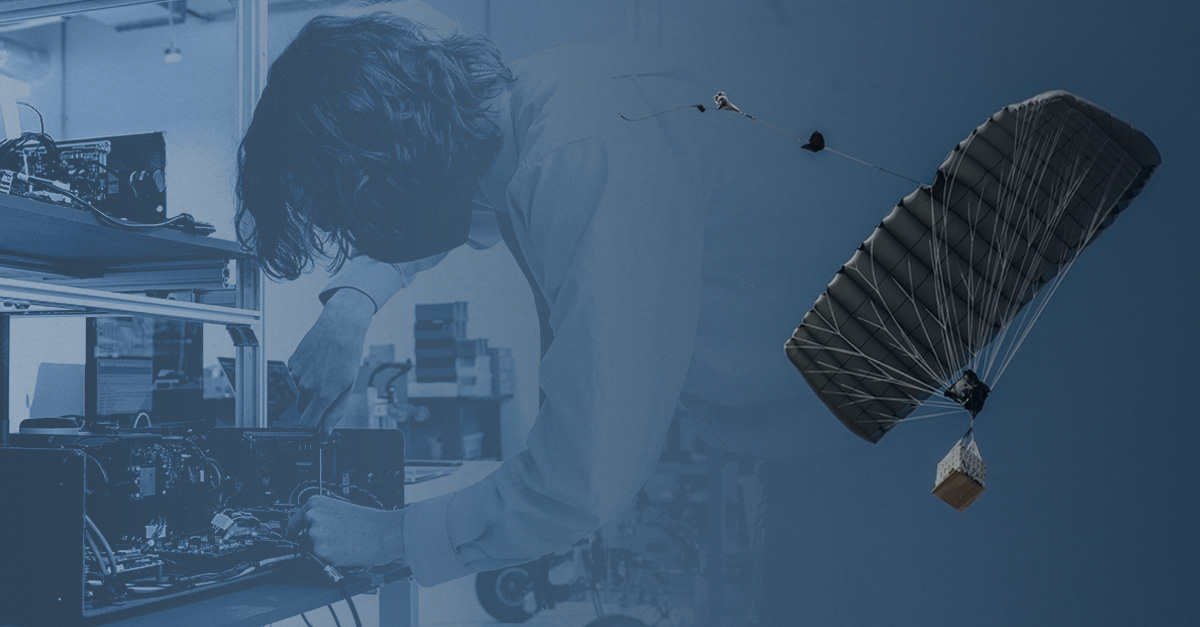
The Army’s 2024 equipment fact book describes the upgraded guidance unit as easier to use and maintain, with modular avionics, field-serviceable battery packaging and secure radio capability. It also describes vision navigation: a camera helps establish location. These are several different engineering disciplines sharing one practical assignment.
During Project Convergence 2022, the Army experimented with JPADS in a GPS-jammed environment. That setting explains the interest in navigation that can use visual information. It also explains why a tidy software demonstration cannot settle every question. The equipment has to function within a mission, with other equipment and with people preparing the load.
Three founders, one couch
The origin is pleasingly domestic. Asked about his luckiest career break in a 2021 Boston Business Journal profile, CEO Andreas Kellas named his two co-founders, Adam Ray and Bobby Cohanim, quitting their jobs to join him on his couch and start MORSE. The company dates to 2014. Its name expands to Mission Oriented Rapid Solution Engineering, an acronym with the air of a project brief that escaped the meeting.
Kellas also described growing up above his grandfather’s auto-parts business in England. His grandfather had brought the family out of war-torn Cyprus. Watching him manage customers, employees and difficult situations provided Kellas’s earliest example of business leadership. In the same interview, he placed the people in a business ahead of its clever idea or secret sauce.
MORSE is employee-owned and says it has no external investors. Its careers material lists company equity, flexible hours, open paid time off and parental leave. Those are the employer’s stated terms; the ownership structure itself is the more consequential detail. Outside capital is not the organizing character in this company’s public account of itself.
“Happy cows make happy cheese”A MORSE company value
There it sits among the values: an agricultural argument for a pleasant workplace. Nearby are efficiency, rigor and sustained customer relationships. Defense engineering acquires enough acronyms without inventing one for the proposition that people work better when they enjoy working together.
The customer gets the keys
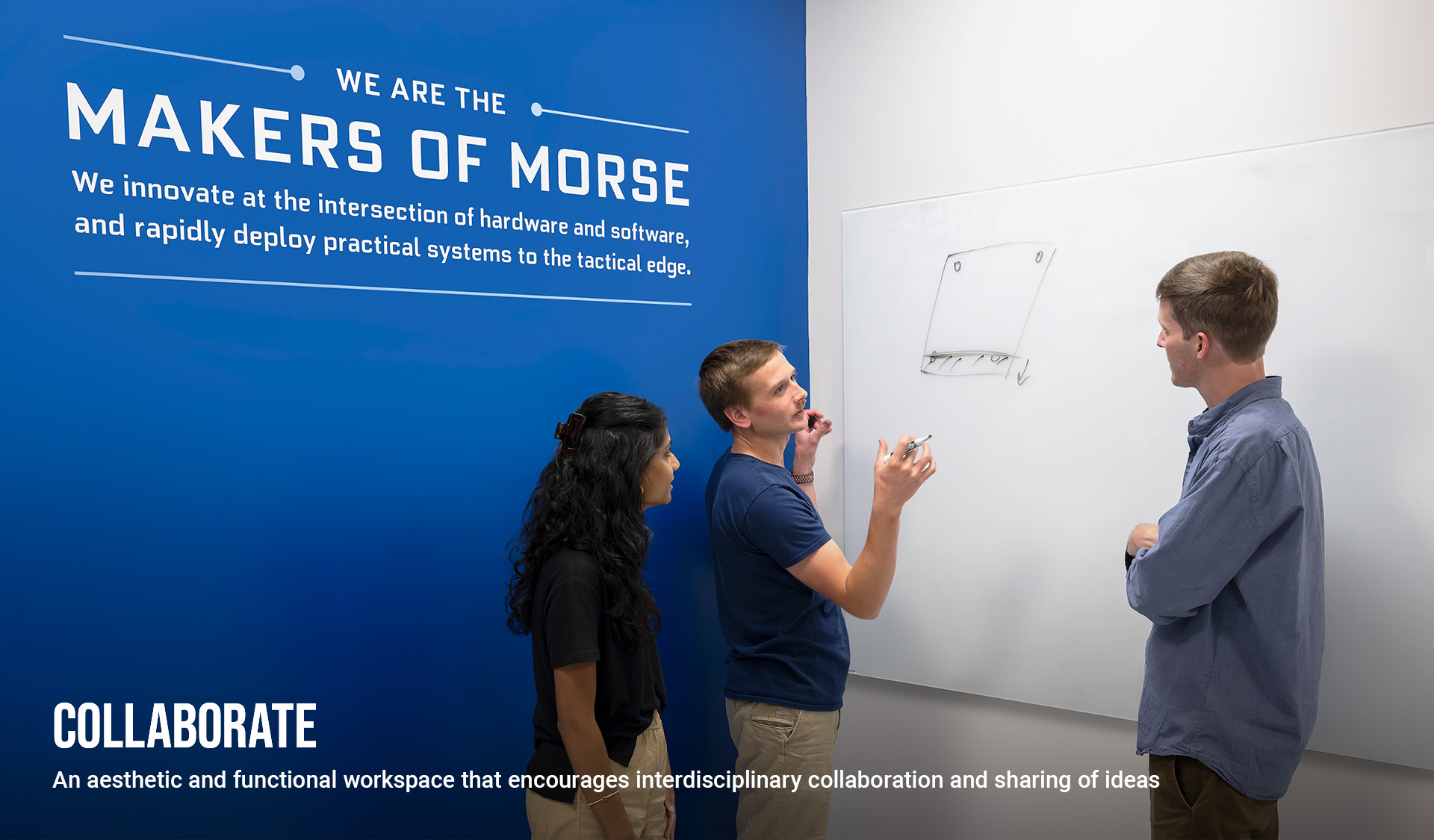
MORSE’s public process starts with understanding the user’s pain. It proceeds through concepts of operations, analysis, algorithms, prototypes, evaluation and support for operational use. A concept of operations is essentially an account of how the system will be used. Starting there gives the engineers something more useful than an abstract feature list.
The company describes continuing contact with users and field testing in conditions representative of operations. Its intended result is a system that fits existing needs and constraints. This is a service-intensive proposition: access to users, repeated engineering work, and attention to the environment around the product.
Unlimited government data rights appear among its stated values. The 2025 STEAM announcement similarly emphasizes capabilities that are independent of particular platforms, environments and tools. For a public customer, the attraction is control: the ability to integrate and extend a capability without tying every future choice to one supplier.
- 01 Understand the user
- 02 Model the mission
- 03 Build and revise
- 04 Test in context
- 05 Support operational use
The company works as both prime contractor and team member. In 2017, it joined Tapestry Solutions and Jacobs Engineering on Air Force airdrop-planning development. In 2018, it announced a partnership with Revision Military on a coxswain helmet demonstration for the Office of Naval Research. The common thread is software and algorithms embedded in a larger operational system.
The expensive art of finding out
A second part of MORSE’s business concerns proving whether technology can do its assigned job. In April 2025, it announced STEAM, a vehicle for Army Research Laboratory work on AI-enabled systems. The scope covers research, data analysis, applied machine learning, generative AI, human-machine integration and test and evaluation.
STEAM carries a $97,509,340 indefinite-delivery, indefinite-quantity ceiling. A ceiling sets the upper boundary of possible orders under that vehicle. It does not say that the company has received the entire amount. Anyone using contract headlines to judge a defense business should make that distinction before reaching for a calculator.
ADEPT is a more tangible piece of the data business. The Artificial Intelligence, Data, and Engineering Processing Toolbox supports data management across on-premises, cloud-native and classified computing environments. MORSE’s August 2024 announcement connected it to a $66.7 million Army data and software engineering contract.
That combination places MORSE within the market for specialist defense engineering and system integration. A buyer is procuring expertise and delivery around a mission. Depending on the requirement, alternatives could include a government laboratory, a larger integrator or another specialist contractor. The public record supports this positioning; it supplies no basis for declaring MORSE faster or cheaper than all of them.
A small library, a revealing decision
There is a refreshingly specific account of something that did not fit. When MORSE adopted snapshot testing, it began with an existing Python library, Snapshottest. The company reported missing features and insufficiently active maintainers for contributing the changes it needed. It responded by developing Snappiershot, announced publicly in November 2020.
Snapshot tests save an expected result and compare subsequent outputs against it. MORSE’s scientific applications needed comparisons that could tolerate insignificant floating-point differences across platforms. An exact comparison can complain about a numerical difference that has no practical meaning. Its library also addressed scientific data types and inspection of saved results.
The public GitHub project lets other developers use that idea. It is a modest, copyable artifact from a company whose larger assignments often belong inside government programs. A snapshot is useful for detecting change; engineering judgment still has to establish that the saved result was correct. Preserving an error faithfully would be a rather successful failure.
The wind joins the engineering team
In September 2025, MORSE announced a prime contract for DARPA’s Albatross program. DARPA describes the assignment as autonomous soaring: combine weather-informed planning, onboard sensing and control so an aircraft can exploit atmospheric energy and reduce its own power demand. The work is to be evaluated through real flight testing.
Albatross focuses on integrating these capabilities into existing or quickly assembled small aircraft. It is not a dedicated new-airframe program. That makes the planning and control work particularly interesting: the aircraft must identify useful conditions and respond to them. Range gains depend on finding atmospheric energy worth exploiting. A promising forecast alone does not extend a flight.
A separate August 2025 Army agreement gives MORSE five years to develop long-range autonomous aircraft for GPS-denied, contested logistics. Its announced scope includes navigation, mission tools, independent evaluation and a transition into initial manufacturing scale-up. That is a development path, with production ambitions attached. The announcement does not establish that the resulting aircraft are already deployed.
What travels beyond defense
The practical lesson is to engineer the handoff as carefully as the algorithm. Give the user a way to prepare the system, see its state and discover mistakes. Give the customer enough control to integrate the work. Give developers tests that tell them something useful when behavior changes.
These habits require conditions: access to real users, representative testing and authority to fix integration problems. A team confined to a demonstration cannot copy them merely by renaming its development process. MORSE is interesting because its public work makes those conditions part of the assignment. The parachute has a destination. The engineering has to follow it all the way there.