On a shelf at an autonomous-car company sat two very good gyroscopes doing absolutely nothing. They were accurate. They were dependable. They were also too large, too bulky and too expensive to put into every vehicle. The head of sensors gave Mario Paniccia the plainest possible product brief: build something smaller and cheaper with the same optical performance, and it would go into every car.
This is how a market sometimes introduces itself. It does not arrive in a slide deck. It gathers dust beside the person who cannot use it.
Paniccia knew the materials well. At Intel, he had spent more than two decades turning silicon photonics from a proposal that drew disbelief into a technology used to move data through modern computing infrastructure. Now he and co-founder Mike Horton were considering a different job for light on silicon: measuring motion precisely enough to navigate when satellite signals vanish or lie.
ANELLO Photonics grew from that opening. Its Silicon Photonics Optical Gyroscope, known as SiPhOG, aims to retain the low drift and low noise of a fiber-optic gyro while shedding the fiber coil's bulk, cost and power demands. The company wraps that sensor in an inertial navigation system that can serve vehicles on land, at sea and in the air. The destination is easy to state. The engineering was not.
A childhood with work in it
Paniccia was born in 1966 to Italian immigrants and grew up in Endicott, New York. His parents, Antonio and Domenica, had worked on family farms in postwar Italy before coming to the United States in 1958. Their son started earning money at about 12. There was landscaping, restaurant work, and weekends and summers helping his uncles on construction projects.
Good grades took him to Binghamton University to study physics. A professor named Robert Pompi urged him to look beyond the path he could already see and apply for research opportunities. Internships followed at Rutgers, AT&T Bell Labs and IBM's T.J. Watson Research Center. Paniccia later called those experiences invaluable because they showed him how science was actually done. The statement is modest, but the shift was large: research stopped being an abstraction and became a life one could enter.
At IBM, atomic force microscopy caught his attention. The instrument renders surfaces at nanoscale resolution, a little like feeling a landscape with a needle fine enough to notice individual features. At Purdue, he joined Ronald Reifenberger's group and combined scanning-probe techniques with a question he had encountered during an earlier year at Intel: how do atoms move when high current densities push through an integrated circuit? His 1994 doctoral thesis studied electromigration in gold films.
Purdue supplied another durable connection. He met Rachel, his future wife, outside the physics lab near the nitrogen tanks. A university building rarely gets a better romantic subplot.
Teaching silicon a new trick
When Paniccia joined Intel in 1995, one of his early projects used an infrared laser to observe transistor switching inside a running microprocessor. Silicon looks opaque to us but is transparent to infrared light. That fact made a clever diagnostic tool possible. It also suggested a larger question: if light could inspect a chip, could it carry information between chips?
Intel founder Gordon Moore, longtime executive Les Vadasz and future CEO Pat Gelsinger supported the inquiry. Paniccia founded the company's Photonics Technology Lab. The prevailing materials wisdom was not encouraging. Silicon was a workhorse for electronics, not an obvious medium for fast optical devices. The fastest silicon modulation sat around 10 megahertz. Paniccia's team demonstrated a one-gigahertz modulator, then moved to 10 and 40 gigahertz. Their 2004 result reached the journal Nature.
“Let's prove everyone wrong.”Mario Paniccia to his Intel team
The line carries some founder swagger, but the work underneath it was collaborative and cumulative. The lab developed a hybrid silicon laser by bonding indium phosphide onto silicon, demonstrated a Raman silicon laser, and built fast photodetectors. In July 2010, the group transmitted real data at 50 gigabits per second between two integrated silicon-photonic chips. Paniccia became an Intel Fellow in 2007, later led the Silicon Photonics Solutions Group, and helped turn the research into a business.
He is proudest of the people. He describes a small team that “did not know what was not possible.” Alumni later spread across major semiconductor and optical companies, carrying the field with them. A laboratory had become an industry partly by becoming a diaspora.
The chip that said no
After Intel, Paniccia spent nearly four years as founding CEO of Versalume, a startup built around light-emitting fiber. Then came ANELLO. It was 2020, which was not a gentle year to start a hardware company. The pandemic disrupted ordinary collaboration and supply chains. The first test chip did not work.
The failure mattered because ANELLO was operating without established models for its specialized photonic circuits. The sensor is an interferometer designed to resolve roughly 50 nanoradians of phase shift. The team had to develop its own models, fabricate the device, test it, adjust the model, and begin again. In software, an iteration can happen before lunch. In semiconductors, an error can return weeks later wearing an invoice.
Paniccia's leadership method fits that reality. He talks about challenging people, giving direction and continuing after the first attempt fails. With age, he says, he has calmed. Open forums have become more frequent, especially when bold goals stir a perfectly rational fear of failure. He values the ability to work across disciplines as much as narrow technical skill. Photonics, electronics, software, packaging and manufacturing all need to agree before a vehicle can know which way it turned.
When the sky becomes unreliable
Satellite navigation is wonderfully convenient and surprisingly fragile. Buildings can block it. Signals can be jammed or spoofed. Underwater, they do not reach a vessel at all. An inertial system instead tracks motion from within. ANELLO combines its optical gyro with processors, satellite receivers and sensor-fusion algorithms. The system can compare its inertial position against GPS every 10 milliseconds. If the two diverge sharply, it can flag the satellite input as suspect and continue on its own estimate.
The product logic stretches across orchards, mines, construction sites, urban canyons, drones and maritime vehicles. Defense adds urgency because the loss of a navigation signal may be deliberate. Yet the commercial and military needs share a useful constraint: the sensor has to be accurate, compact, affordable and manufacturable. A beautiful lab instrument that cannot survive a production line is only a persuasive exhibit.
Paniccia therefore talks about volume early. The photonic integrated circuit, the tiny laser that feeds it, its placement on a printed circuit board and the rest of the package have to support automated assembly. ANELLO works with Tower Semiconductor and manufacturing partners on that transition. The company raised $28 million in 2021, added a Series B in 2024, and in 2026 announced a $25 million Series B-2. A separate $20 million APFIT award is intended to accelerate procurement and fielding for GPS-independent navigation.
The technical horizon keeps moving. A Purdue-ANELLO collaboration published in 2026 demonstrated a foundry-compatible silicon-nitride phase modulator with broadband optical performance, operating up to 704 megahertz. Paniccia has also described resonant optical gyroscopes built around very low-loss rings only millimeters across. Smaller footprints and tighter integration could eventually put higher-grade inertial sensing into tiny drones, robots, handheld devices and wearables.
“Don't be afraid to fail. Take risks when you're young, but don't assume there is a simple or clear path ahead.”Advice Paniccia gives university students
A compass for the builder
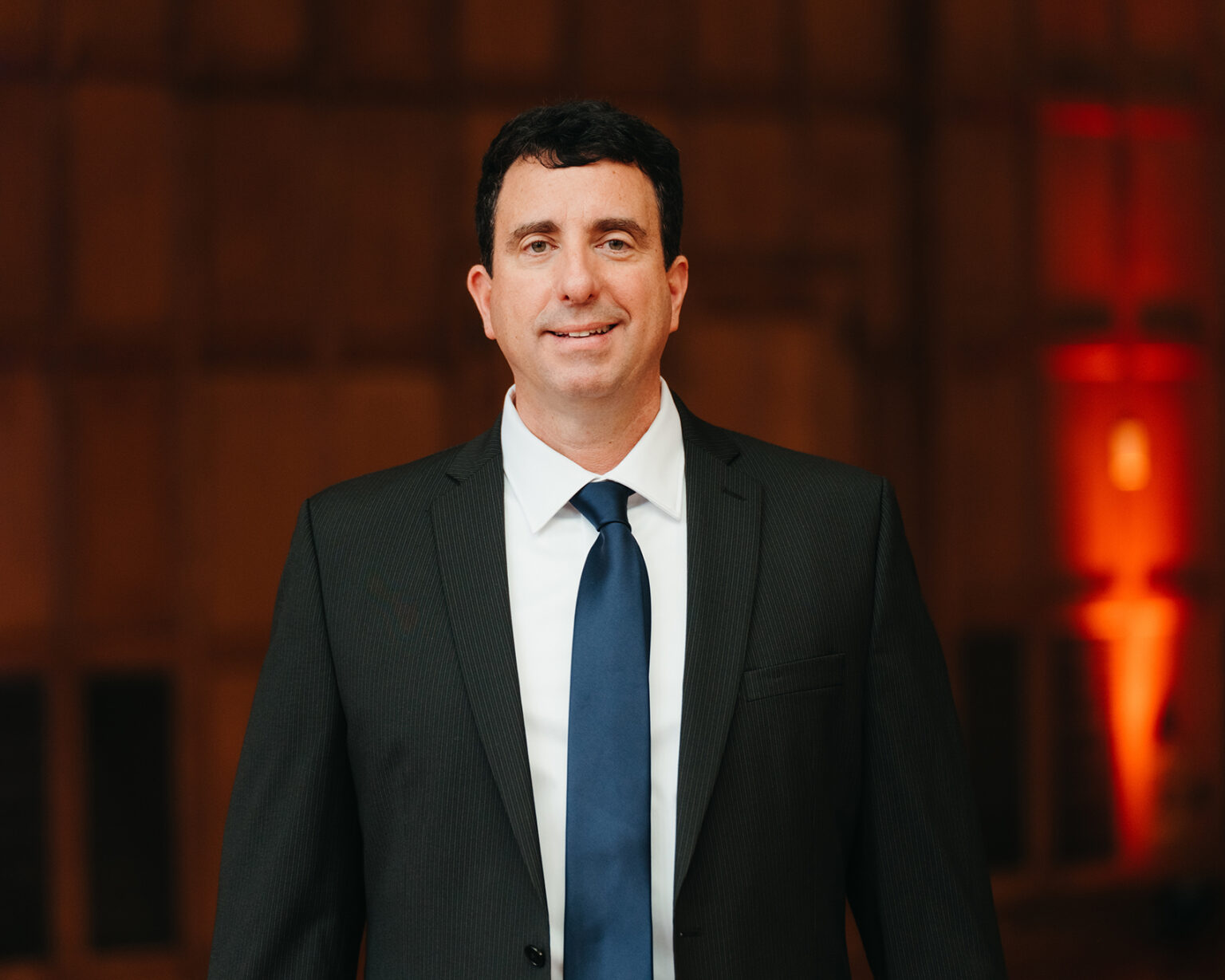
Paniccia now holds several identities at once. He is ANELLO's chairman and CEO. He chairs OpenLight, which offers an open silicon-photonics platform for custom chips. He is an inventor on more than 80 patents issued or pending, a Fellow of IEEE, SPIE and Optica, and a member of the National Academy of Engineering. Purdue has twice honored him as an alumnus.
The list is formal. His advice is not. When he speaks to students, he tells them not to build a life around avoiding regret. Risk is useful, failure is ordinary, and new businesses take longer than the tidy retrospective suggests. He gives his two sons an even simpler version: find your passion and give it everything.
There is a pleasing continuity to the career. A child learns work by landscaping and construction. A student learns research by entering real laboratories. An Intel team discovers that a supposedly awkward material can carry light at startling speeds. A startup notices two excellent sensors stranded on a shelf and asks the material to perform another trick.
Navigation is often described as knowing where you are. Paniccia's story adds a second requirement: knowing which signals deserve belief. Silicon did not become an optical platform because everyone agreed. ANELLO did not get a working sensor on its first pass. Direction arrived through comparison, correction and repeated measurement. It is an engineer's kind of optimism, calibrated every 10 milliseconds.