An empty driving seat makes a good photograph. But consider the less photogenic achievement: getting supplies to someone who needs them, over bad ground, while keeping the operator out of the vehicle. That is the business Forterra is trying to build. The driving is one part of a longer chain.
- Start with the job: automate dangerous military missions and repetitive industrial transport.
- Use existing vehicles: add autonomy, communications and operator controls.
- Finish the system: make the data, people and machines work together.
A mission, not a joyride
In July 2026, Forterra disclosed that it had delivered 105 Lancers for Ukraine in under six months. Built around the Polaris Ranger 1500, Lancer combines its AutoDrive autonomy with Vektor communications. The company reported more than 1,100 missions and 88 casualty evacuations. Those are company-reported totals, but they offer a more useful starting point than a carefully choreographed lap around a test track.
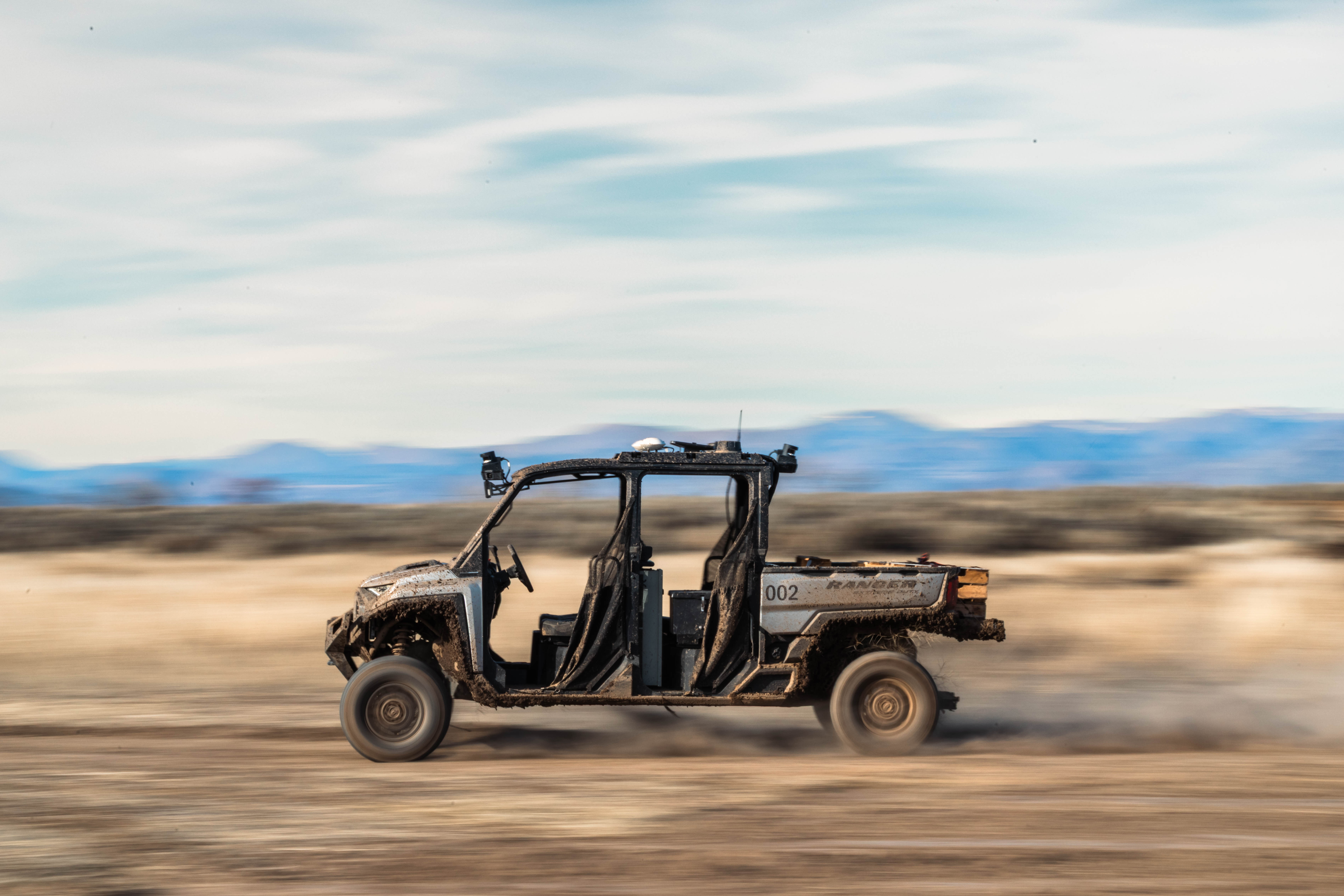
Forterra sells the machinery behind such assignments: sensing, navigation, planning, controls and connections. AutoDrive combines hardware and software to interpret surroundings and control a vehicle through its drive-by-wire system. Its localization uses redundant inputs for operation without GPS. This is a supplier of vehicle intelligence and mission tools, with customers ranging from military programs to industrial logistics operators.
The business began as Robotic Research in 2002, founded by Alberto Lacaze and Karl Murphy. It adopted the Forterra name in 2024. The years matter: this company arrived at today’s enthusiasm for autonomous machines with a long history of working on ground robotics.
The traffic jam was in the data
One revealing obstacle appeared behind the scenes. According to an Encord customer case study, Forterra was getting only a few hundred sensor sequences annotated each quarter. Turnaround took at least two weeks. Inconsistent quality pulled machine-learning engineers into reviewing the material themselves. Vehicles could collect experience faster than the organization could turn it into usable training data.
Forterra and Encord rebuilt the workflow around multiple sensor types and shared quality review. Encord reports ten times the ground-truth volume and 50% faster model iteration. These are vendor-reported results, rather than an independent vehicle-performance test. Still, the practical lesson travels well: inspect the handoffs feeding the model. A queue can be an engineering problem.
A queue can be an engineering problem.
The lesson beyond robotics
That emphasis on useful output also appears in Forterra’s published workplace principles. They ask employees to accept hard feedback, take ownership and prioritize customer value. A careers page cannot prove a culture, but it does show what management wants to reward: people who finish the job, including its unglamorous middle.
A vehicle needs a conversation
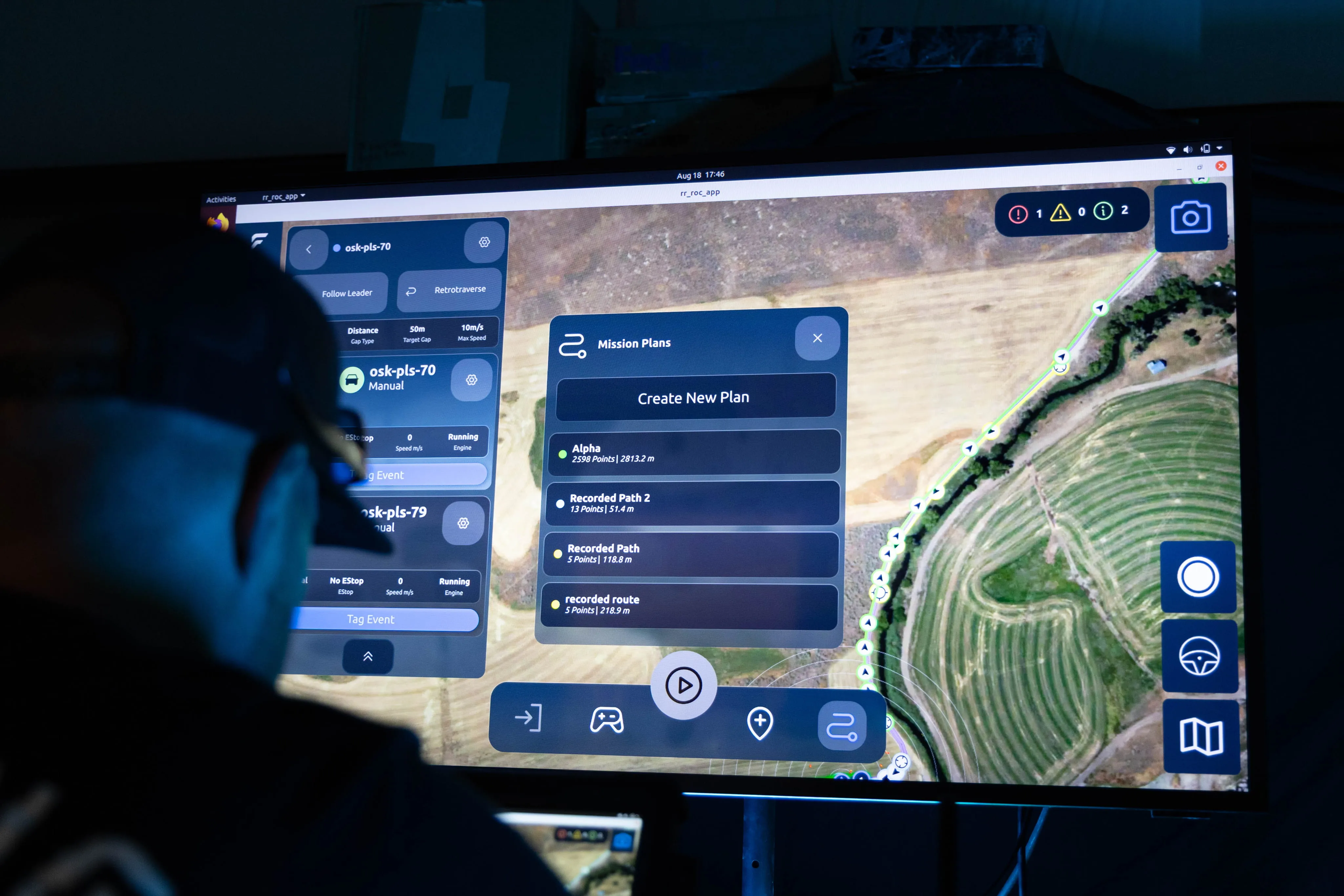
Driving software answers one set of questions. Where am I? What is ahead? Where can I move? An operator has another set: which vehicle is available, what is it doing, and can I change its assignment? TerraLink supplies planning, map-based oversight and retasking through consoles, remote interfaces and connections to existing systems.
Vektor handles another dependency: the connection itself. It evaluates available network paths and routes different streams according to latency, throughput and stability. A command and a video feed have different needs. Forterra’s October 2025 acquisition of mesh-networking company goTenna extended that communications business. The announcement explicitly described a shift toward complete mission systems. The acquisition price was undisclosed.
The factory is part of the product
Forterra’s approach depends on other companies’ vehicles. With Oshkosh Defense, it supplies autonomy for the Marine Corps’ ROGUE-Fires launcher. Their earlier work integrating autonomy into Oshkosh trucks helped the partnership reuse mature technology. With BAE Systems, it is developing an autonomous Armored Multi-Purpose Vehicle prototype. Production and prototype development are different stages, and should be read that way.
The commercial example is wonderfully workaday: Kalmar’s AutoTT terminal tractor moves trailers around logistics sites. Kalmar supplies factory-fitted vehicle hardware, sells the solution and provides dealer maintenance; Forterra supplies AutoDrive and associated tools. Kalmar currently lists Ottawa T2 AutoTT commercial availability for 2027, with customer pilots underway. Distribution and servicing belong inside the autonomy story.
Financing supports that expansion. Forterra announced a $228 million Series A in 2021, a $75 million Series B in 2024, and a $238 million Series C in November 2025. The last figure includes equity and debt. It funds production, computing and mission capabilities; it is not a price list for vehicles.
That places Forterra between specialist autonomy developers and established vehicle manufacturers. Overland AI also develops off-road autonomy for defense; Outrider targets autonomous yard operations. Forterra’s argument is the breadth of its connected offering. Buyers still have to judge integration effort, operating conditions and support, rather than treating the number of products as a performance score.
There are limits to the idea. GPS-denied navigation does not make a vehicle immune to every disruption. Sensors need useful observations, vehicle controls need integration, and fleets need maintenance. A working pilot in one yard does not establish readiness for every yard. The part readers can copy is more modest: choose a specific job, reuse proven equipment, and make feedback and support part of the design.
October’s problem: too many dashboards
By October 2026, Forterra was addressing the clutter created by adding machines. Its OASIS-OneLink launch promises a common operator interface for vehicles and mission applications, working alongside existing tools. Phil Cotter described “one place from which to monitor and command.” Native desktop applications also support offline operation. The pitch is recognizable to anyone who has accumulated too many business software tabs.
That month, Forterra also announced an integration role at the Army’s Joint Readiness Training Center, connecting multiple vendors’ unmanned systems and supporting the opposing force. The assignment makes training and performance evidence part of the product. It also sharpens the buying question: can this system fit the vehicles, operators, networks and support arrangements you actually have? Forterra’s opportunity lies in making those pieces work together, through the whole assignment.