A small brick sits on a road 150 meters away. It is only 10 centimeters high - the sort of anonymous, unphotogenic hazard that does not have a neat label in a computer-vision training set. At highway speed, it matters. In NODAR's 2021 debut demonstration, two cameras spotted it and calculated its distance. The Massachusetts company has been dining out on that brick ever since, and fairly so: it makes a complicated point about machine perception understandable before the coffee gets cold.
NODAR builds camera-based 3D vision for machines. Its core product, Hammerhead, accepts synchronized images from a pair of cameras, continuously corrects their alignment and matches the same points in each picture. Geometry does the rest. The output is not merely a label that says car or pedestrian, but a dense depth map and a colored point cloud - measurements of where surfaces sit in three-dimensional space.
Founder and CEO Leaf Jiang arrived at this idea by knowing the rival technology unusually well. Before founding NODAR in 2018, he spent years building optical ranging systems at MIT and MIT Lincoln Laboratory. LiDAR was then the autonomous-vehicle industry's favored new sense organ: precise, legible and expensive. Jiang's change of mind was not that lasers were useless. It was that rapidly improving cameras, processors and algorithms might produce comparable information with components the automotive supply chain already buys by the millions.
The thing that failed first
Stereo vision is an old trick. Your eyes see a scene from slightly different positions; your brain uses that disparity to infer distance. Put two cameras on a vehicle and the same principle applies. Move those cameras farther apart - increase the “baseline” - and tiny angular differences become easier to measure at long range. A hammerhead shark has famously wide-set eyes, hence the company's name for its software.
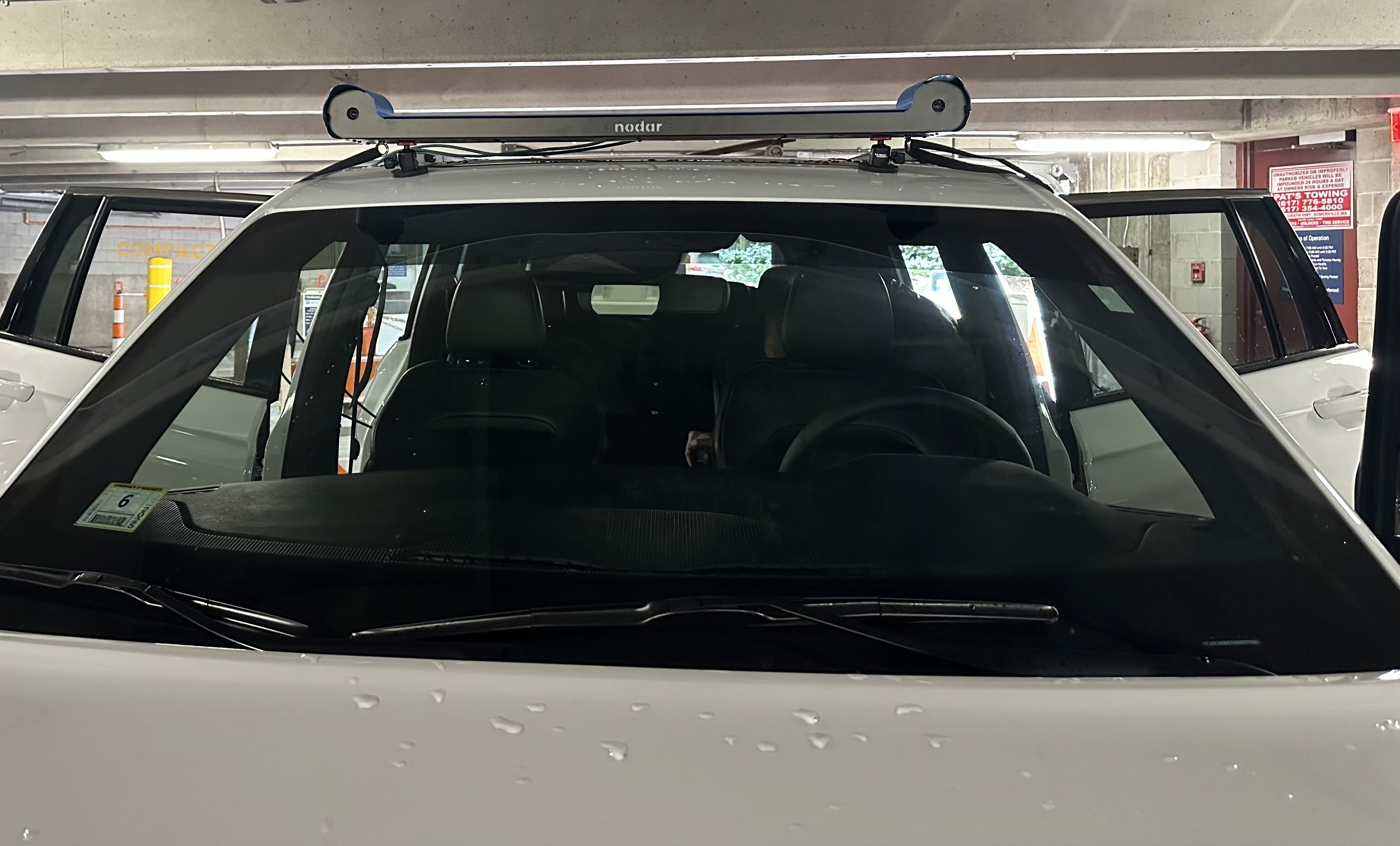
Then the real world barges in. A one-meter camera baseline amplifies range, but it also amplifies the consequences of misalignment. A pothole flexes a mount. An engine vibrates. Sunlight warms one side of a body panel. The cameras shift by a fraction, and yesterday's factory calibration starts lying about today's depth. Conventional stereo rigs solve this with a rigid bar and modest spacing. That also caps their useful range.
NODAR's enabling move was to stop treating calibration as a manufacturing event. Hammerhead estimates the cameras' relative position on every frame with subpixel precision. That lets customers mount independent cameras in mirrors, headlamps, roof corners or on a long industrial bar. It is a clean startup lesson: find the constraint everyone treats as physical, then ask whether enough compute has arrived to make it software.
The company is not really selling two eyes. It is selling the promise that the eyes still agree after the machine hits a rut.The practical wedge behind Hammerhead
From pixels to a path
Hammerhead is the foundation, not the entire stack. It auto-calibrates, rectifies the two images, performs deterministic stereo matching and emits depth. The optional GridDetect layer turns that dense cloud into an occupancy map: ground is removed, free space is separated from obstacles, and velocity and object outputs can flow into planning software. NODAR says GridDetect can process up to 100 million 3D points a second and fuse camera depth with radar or LiDAR data.
Customers can approach at several levels. The software-only SDK runs on x86 or ARM systems with NVIDIA GPUs and exposes C++ and Python APIs. The NODAR Viewer displays and records the result. Teams that do not want to assemble a rig can buy the Hammerhead Development Kit, with 5.4-megapixel HDR automotive cameras and an optional rugged NVIDIA Orin computer. ROS2 and ZeroMQ interfaces make it legible to robotics engineers. NODAR Cloud and its 3D-as-a-Service work process captured stereo data for evaluation, training and validation. Custom projects cover pilots, windshield mounting, optics and production integration.
No public price list accompanies those options. This is enterprise sensing, sold by application and integration scope rather than by a cheerful “buy now” sticker. The business model mixes SDK and feature licenses, development hardware, reference-design licensing, cloud processing, support and engineering services. One particularly reusable idea is feature-on-demand: manufacturers can ship inexpensive cameras on a tractor or truck, then activate collision warning, auto-steer or crop measurement later. Hardware becomes the installed base; software becomes the upgrade.
Who actually needs this?
The first answer was passenger-car ADAS, autonomous trucks and robotaxis. The current answer is broader. NODAR markets to mining vehicles that must see rocks in rain, farm machines crossing dusty fields at night, rail systems watching long corridors, airport equipment operating around aircraft, maritime robots interpreting rippled water and security systems trying to reject false alarms. The common job is not image recognition. It is measuring unknown obstacles far enough away for a heavy or fast machine to react.
The company says its custom systems have reached Fortune 100 organizations, but most customer names remain private - normal in long industrial programs, inconvenient for outsiders judging commercial traction. Its clearest named technical relationship is NVIDIA. Hammerhead is supported on NVIDIA DRIVE and optimized for Orin hardware. New Enterprise Associates led a $12 million Series A in 2022, with early backer Rhapsody Venture Partners participating. Supplied company data puts the team near 17 people and annual revenue near $4 million, both best treated as estimates rather than audited figures.
Where it fits
Long-range forward perception, dense depth, small or unknown obstacles, commodity camera economics, existing NVIDIA compute and machines that can support two overlapping views.
Where it bends
Obscured lenses, poor synchronization, no shared view, textureless surfaces, inadequate illumination, constrained compute or packaging that cannot provide useful camera separation.
Not a physics exemption
NODAR's marketing sometimes frames Hammerhead as a no-LiDAR alternative, but the useful buying decision is conditional. LiDAR directly measures reflected laser light and can be strong where passive imagery struggles. Radar tolerates difficult weather and provides velocity, though with different resolution. Monocular neural networks need only one camera, but estimate depth from learned patterns. Stereo offers dense, explainable geometry, provided both cameras can see corresponding texture and remain synchronized.
Water is a revealing edge case. It can be smooth, reflective, dark and constantly changing - a poor citizen for almost every depth sensor. In 2026, NODAR published controlled pool work and a Boston Harbor trial rather than claiming universal victory. Waves supplied geometry; small floating objects appeared; darkness and low texture exposed limits. The image is charming - pool noodles, a ring toy and Jiang himself in cold water - but the method is the part worth copying. Pick the surface most likely to embarrass your technology. Test from daylight through darkness. Report where the signal weakens.
The competitive list therefore changes by application: Luminar, Hesai, Ouster and RoboSense on LiDAR; automotive radar and imaging radar; monocular perception stacks; and stereo platforms from Stereolabs or Luxonis. In many machines the right answer is not a cage match. GridDetect explicitly supports sensor fusion. NODAR can replace an active sensor in one architecture and become its high-resolution companion in another.
The small-company playbook
NODAR has collected respectable hardware-industry trophies - a CES Innovation Awards mention, AutoSens gold, Best of Sensors Startup of the Year and the 2023 Grand Prix ACF AutoTech. Awards do not shorten an automaker's qualification cycle. What matters more is how the company has made its technical thesis progressively easier to try: first a striking brick demo, then NVIDIA support, then a rugged kit, APIs, sample data, viewer software and application services.
That ladder is the most portable lesson in the story. Deep-tech founders often present a breakthrough and leave the customer to cross the integration canyon. NODAR packages the same capability as software for experts, a kit for evaluators, processing for teams with data but no stack, and custom engineering for production. The product is not only the algorithm. It is the sequence of increasingly expensive commitments a cautious industrial buyer can make.
There is a second lesson in the company's steady migration beyond cars. A technical platform should follow the failure mode it solves, not the glamorous market that first supplied its vocabulary. Road debris, a mine rock, a crop row and a floating ring look unrelated on a sales slide. To a depth engine, each is an uncooperative piece of geometry that a moving machine must locate before contact.
The bet will not work everywhere. Cameras still need usable photons. Two views need overlap. Dirty glass remains dirty glass. Long baselines create packaging headaches, and high-resolution, real-time depth consumes serious compute. Safety-critical customers will demand validation far beyond a dramatic demo. But NODAR's argument has aged well: commodity optics keep improving, accelerated compute keeps getting cheaper, and software can now revisit constraints that once looked mechanical.
The brick remains the perfect mascot. It has no wireless connection, no training label and no interest in anyone's roadmap. It simply occupies space. NODAR's job is to tell the machine exactly where.