Thirty years of steering a laser with a tiny mirror. The same physics that once fit a projector in your pocket now helps cars, robots and drones see the world.
NASDAQ: MVIS • Redmond · Detroit · Hamburg
There is a certain type of company that is always about to matter. MicroVision, founded in 1993 and public on NASDAQ since 1996, has spent much of its life in that category. It has a genuinely clever core technology - MEMS-based laser beam scanning, which is the unglamorous art of aiming a laser very precisely using a mirror smaller than a grain of rice - and it has spent thirty years looking for the market that would finally pay for it at scale.
For a while the answer looked like projection. MicroVision built PicoP, an ultra-miniature scanning engine that could throw an image from something the size of a matchbook, and it showed up in pico-projectors and micro-display gadgets. That was a real business, but not a giant one. The interesting thing about a laser-scanning engine, though, is that if you can point a beam out at the world and measure how long it takes to come back, you are no longer making a projector. You are making lidar.
So MicroVision did the thing that keeps deep-tech companies alive: it aimed the same capability at a bigger problem. The bigger problem, circa the late 2010s, was that a lot of machines wanted to move by themselves - cars, forklifts, robots, drones - and cameras alone were not good enough at answering the question how far away is that thing. Lidar answers that question in three dimensions, and MicroVision already knew how to steer a beam.
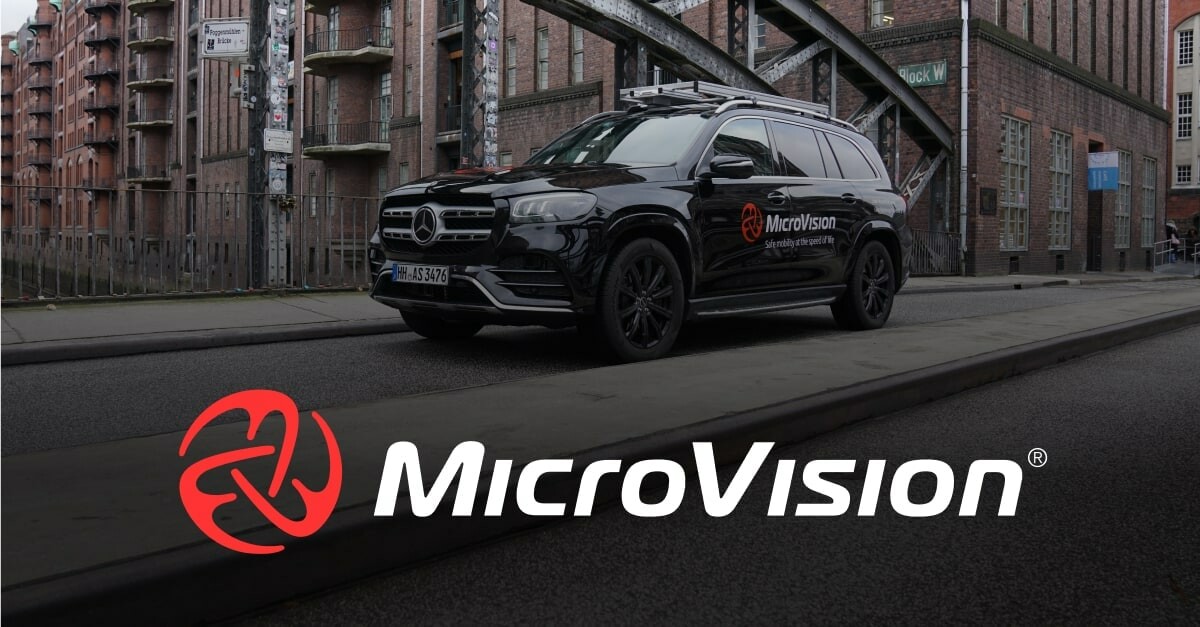
"MicroVision is defining the next generation of lidar-based perception solutions for automotive, industrial, and security and defense markets."
MicroVision's lidar catalog reads like an alphabet of code names, but the logic is simple: cover every range and every buyer with sensors that share the same DNA.
The dynamic-view flagship. Combines short-, medium- and long-range sensing in one automotive-grade unit built for high-speed highway ADAS.
A compact flash-lidar sensor that has become the workhorse - shipping in volume to industrial and defense customers, with repeat orders.
The next-generation compact sensor for robotics and AI perception, with a production launch targeted for the fourth quarter of 2026.
1550nm time-of-flight long-range sensors added through asset acquisitions, extending reach for automotive and beyond.
1550nm frequency-modulated continuous-wave lidar from the Scantinel acquisition - it measures velocity directly, not just distance.
Perception software and tools for calibration, validation, ground-truth generation and object classification - the part that turns points into meaning.
A lidar sensor by itself is a firehose of dots. What a customer actually wants is an answer: there is a pedestrian at 40 metres, moving left. MicroVision's pitch is that it sells the whole chain - the MEMS, the lasers, the optics, and the perception software that classifies what the beam finds.
For a carmaker, that means ADAS and autonomy features that work at highway speed. For a warehouse or a mine, it means forklifts and vehicles that navigate without hitting things. For a robotics or AI company, it means low-latency 3D perception in a package small enough to bolt onto a machine. And for defense, it means airborne and ground systems that build situational awareness in the dark and the dust.
The commercial tell is repeat orders. In its 2026 updates, MicroVision described a defense-industry customer that integrated more than 200 MOVIA L units, ran them through evaluation, and then ordered 200 more. In hardware, the second order is the one that counts - the first is a bet, the second is proof.
It has also shipped MOVIA sensors to a hyperscaler and a leading AI company for robotics evaluation. The quiet truth of the AI boom is that a lot of machine intelligence still depends on someone building very good, very boring sensors.
"A defense-industry customer that had been integrating 200-plus MOVIA L units recently placed another order for 200 additional units."
Lidar had a bubble. In the late 2010s and early 2020s, dozens of lidar names went public, many through SPACs, on the promise that self-driving cars were imminent. The cars were not imminent. The bubble deflated, and a lot of those companies are gone or gutted.
MicroVision's response was to go shopping. It absorbed lidar assets from Ibeo in 2023, then in early 2026 acquired technology from Scantinel Photonics and from Luminar - two names from the boom. When a hype cycle collapses, the companies with cash and patience buy the wreckage. Attrition became a product line.
The company frames its current era as "Lidar 2.0": the right portfolio at the right performance at the right price. Note the word price. The first generation of lidar answered "can it work." The second has to answer "can anyone afford it at volume." That is the wall every deep-tech company eventually hits, and it is the one MicroVision is now leaning against.
Leadership reflects the shift. In September 2025, Glen DeVos moved from chief technology officer to chief executive - a signal that the hard part left is execution, not invention. It is an unglamorous mandate: turn a 30-year patent moat into recurring revenue.
Established near Seattle to commercialize MEMS-based laser beam scanning.
Lists under the ticker MVIS.
Advances its ultra-miniature laser scanning engine for pico-projection and micro-display products.
Refocuses its MEMS scanning expertise on automotive lidar and 3D sensing.
Unveils the MAVIN lidar line for high-speed highway ADAS features.
Adds the flash-lidar MOVIA line via Ibeo hardware and software.
DeVos becomes CEO on September 30, shifting the focus to execution and revenue.
Acquires Luminar and Scantinel assets, reports growing defense orders, and targets MOVIA S production in Q4.
The physics behind a pocket projector and an automotive lidar is the same: a tiny MEMS mirror steering a laser beam.
It shares a hometown with Microsoft - and a long history of B2B optics work quietly done in the Seattle suburbs.
Ibeo, Scantinel and Luminar - three former competitors whose technology now lives inside MicroVision's catalog.
Roughly 735 issued and pending patents, frequently cited as larger than many better-funded lidar rivals.
Searches and channels where MicroVision's lidar demos and executive interviews live.
It develops lidar sensors and perception software based on MEMS laser beam scanning, used for ADAS, autonomous vehicles, robotics, industrial automation, and security and defense.
Yes. It trades on NASDAQ under the ticker MVIS and is headquartered in Redmond, Washington.
Glen DeVos, who became CEO on September 30, 2025, after serving as the company's chief technology officer.
The MAVIN and MOVIA (L and S) sensors, the 1550nm IRIS and HALO long-range sensors, an FMCW ultra-long-range lidar, and the MOSAIK perception software suite.
It combines more than 30 years of MEMS laser scanning experience, a large patent portfolio, and a diversified focus across automotive, industrial, and defense markets.