$270M Series B closed Feb 2026•Valuation hits $1.75B•65,000 cubic yards moved in supervised autonomy•4 co-founders, 3 from Waymo•Retrofit installs in under a day•CapitalG & NVIDIA join the cap table•First fully autonomous deployments slated for 2026•$270M Series B closed Feb 2026•Valuation hits $1.75B•65,000 cubic yards moved in supervised autonomy•4 co-founders, 3 from Waymo•Retrofit installs in under a day•CapitalG & NVIDIA join the cap table•First fully autonomous deployments slated for 2026•
YesPress Profile / Company
Bedrock Robotics
The San Francisco startup turning the world's existing heavy machinery into a 24-hour workforce - one bolted-on lidar rack at a time.
Founded 2024
HQ San Francisco, CA
Stage Series B
Valuation $1.75B
Team ~110
// An 80-ton excavator, minus the operator. Phoenix, Arizona.
01 / Right NowThe Site That Runs Itself
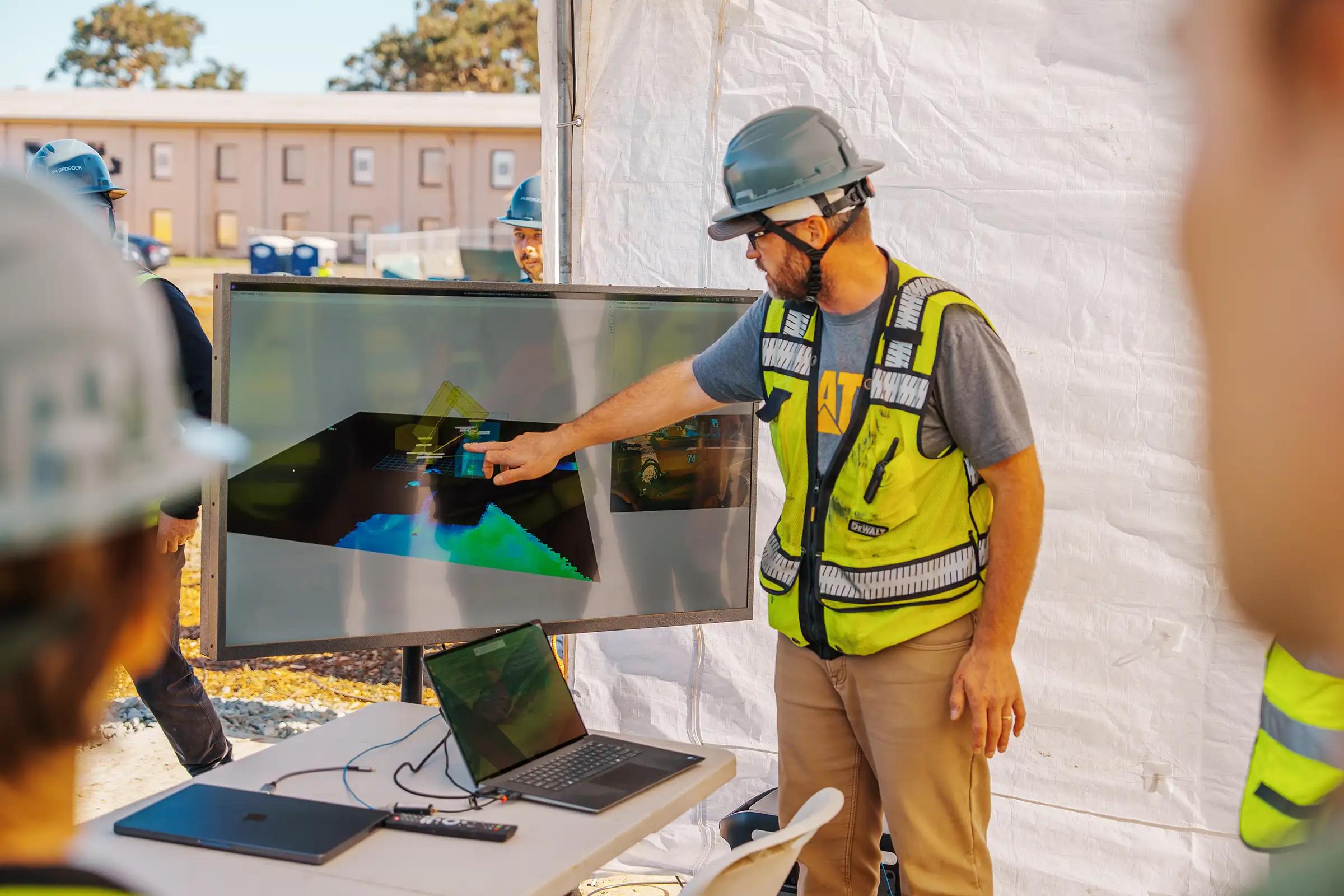
Out near Phoenix, a 130-acre patch of Arizona desert is being shaped into a manufacturing site. The excavators look ordinary - 40-ton, 80-ton, the usual Caterpillar yellow. Look closer. Each one wears a low rack on its cab roof, bristling with lidars and HD cameras. There is no one in the seat. The boom swings. The bucket drops. Dirt moves. A supervisor watches from a screen a hundred feet away, and sometimes from a hundred miles.
This is what Bedrock Robotics looks like in May 2026. Not a slide deck. Not a teaser video. Sixty-five thousand cubic yards of earth, moved by machines the company did not manufacture, on a real customer's deadline.
It is also, awkwardly for the rest of the industry, working.
The economics are compelling.
Boris Sofman, CEO — in interview, Oct 2025
Productivity in construction has barely moved in fifty years. Manufacturing's curve is a rocket; construction's looks more like a flatline that occasionally remembers it exists. The reasons are familiar: every site is bespoke, the labor pool is shrinking, the work is dangerous, the margins are thin, and the machines themselves - magnificent as they are - still need a human in the cab for ten or twelve hours a day.
That cab is the bottleneck. Skilled operators are aging out faster than schools can replace them. Job sites are short-staffed before the first pour. And the machines, which cost as much as a suburban house apiece, sit idle most of the day waiting for someone to climb in.
The conventional fix is to build a new kind of machine - autonomous from the factory floor up. The problem with that fix is that the world already owns eight million pieces of heavy equipment, and they are not going anywhere for thirty years.
You don't have to replace the machine. You have to replace the operator.
The pitch, distilled
03 / The BetFour Engineers Walk Onto a Job Site
Bedrock Robotics was founded in 2024 by Boris Sofman, Kevin Peterson, Tom Eliaz, and Ajay Gummalla. Three came from Waymo. Sofman, the CEO, had run Waymo's autonomous trucking program after Google acquired Anki, the consumer-robotics company he co-founded out of his Carnegie Mellon PhD. He had spent two decades watching autonomy harden from a research curiosity into a product, and concluded - against the prevailing humanoid-robot fashion - that the next big surface for AI was not a new body. It was every body already at work.
The bet: retrofit beats redesign. Don't ship a new excavator. Ship a kit that turns the customer's existing excavator into one. Don't fight the OEMs. Sit on top of them.
Investors, who had spent a year being pitched on robot dogs and bipedal warehouse workers, found this strange and convincing in equal measure. In July 2025 the company emerged from stealth with $80 million from Eclipse and 8VC. Seven months later, in February 2026, CapitalG and Valor Atreides AI Fund co-led a $270 million Series B at a $1.75 billion valuation. NVIDIA's venture arm came in. So did MIT. So did Tishman Speyer, which makes its money the old-fashioned way: putting buildings up.
The Founders
Boris Sofman - CEO, ex-Waymo Trucking, ex-Anki, PhD Robotics CMU. Kevin Peterson - CTO, ex-Waymo. Tom Eliaz - VP Engineering, ex-Waymo. Ajay Gummalla - VP Engineering.
The Cap Table
CapitalG. Valor Atreides AI Fund. 8VC. Eclipse. Emergence. Xora. NVentures (NVIDIA). Tishman Speyer. MIT. Georgian. Perry Creek. Incharge. C4 Ventures.
// Timeline: From Stealth to Series B in Seven Months
2024
Founded. Sofman, Peterson, Eliaz, and Gummalla incorporate Bedrock Robotics in San Francisco. The first office is mostly whiteboards and excavator manuals.
Jul 2025
Stealth, lifted. Public launch with $80M in Seed and Series A funding led by Eclipse and 8VC.
Nov 2025
Dirt, moved. Begins the industry's largest known supervised-autonomy excavation deployment - 130 acres in Phoenix with Sundt Construction.
Feb 2026
Series B. $270M led by CapitalG and Valor Atreides AI Fund at a $1.75B valuation. Total raised tops $350M.
2026
Operator-less. First fully autonomous excavator deployments with customers scheduled for later this year.
04 / The ProductA Luggage Rack Full of Lidars
The Bedrock Operator is a kit. From a distance it looks like an oversized roof rack mounted to the top of an excavator's cab. Up close, it is a small autonomy stack: lidar units, GPS, an IMU, eight high-definition cameras, and an in-cab computer running on NVIDIA Jetson hardware with TensorRT. Python and Rust on top. Some C#. ONNX for model interchange. Simulink for the controls work. Nothing exotic - which is, of course, the point.
Installation takes hours. The kit bolts on. Nothing about the machine is permanently modified, which matters because customers like to be able to give the excavator back to its human operator at the end of the week, or sell it, or repurpose it on a different site. The kit currently works across excavator models from 20 to 80 tons, spanning the major OEMs - Caterpillar, Komatsu, and friends. Bedrock is OEM-agnostic by religion.
The Operator is supervised, for now. A human watches one or several machines remotely, intervenes when the model is unsure, and accumulates the kind of structured edge-case data that makes the next deployment slightly better than the last. It is the Waymo playbook, ported to dirt.
Same machine. Same site. No driver. The kit installs in hours.
The product, in fourteen words
The autonomy bingo card. Familiar parts, unfamiliar context: most of these tools were last seen ferrying packages, not tearing up topsoil.
Capital In, Customers On
// Bedrock by the numbers, May 2026
Seed + A
$80M
Jul 2025
Series B
$270M
Feb 2026
Total raised
$350M+
cumulative
Valuation
$1.75B
Feb 2026
Dirt moved
65,000 yd³
supervised
Headcount
~110
employees
// Bars are scaled for readability, not to one another. Sources: PR Newswire, Construction Dive, The Robot Report, Equipment World.
05 / The ProofCustomers Who Actually Pour Concrete
A robotics company can survive a long time on demo videos. Bedrock is trying not to. Its first marquee deployment, the 130-acre Phoenix manufacturing site, is being built for an unnamed customer in partnership with Sundt Construction, one of the larger contractors in the American Southwest. The collaboration has produced not just visible progress but the unglamorous artifact every autonomy startup needs to grow up: hours of operational data on a paying job.
Around that anchor, Bedrock has been quietly accumulating partners. Zachry Construction. Champion Site Prep. Capitol Aggregates. More recently Austin Bridge & Road, Maverick Constructors, and Haydon Companies. None of them are buying a science project. They are buying excavator-hours.
A robotics company can survive a long time on demo videos. Bedrock is trying not to.
YesPress, on commercialization
Skeptics - and they exist - point out that supervised autonomy is not the same as autonomy. Fair. Sofman doesn't argue. The plan, stated publicly, is to convert the first supervised deployments into fully autonomous ones during 2026. The capital is there. The customers, weirdly for a robotics startup, are too.
06 / The MissionAutonomy for the Built World
The pitch deck phrase is "autonomy for the built world." The honest version is that Bedrock thinks the labor shortage in construction is permanent, the cost of housing and infrastructure is unsustainable, and the machines doing the work are already paid for. The job is not to invent a new industrial revolution. The job is to make the current one work twice as long for the same money.
This is not glamorous. It will not generate a single viral humanoid-dance clip. It might, eventually, lower the cost of a road.
What it does
Bolts an AI controller, sensors, and compute onto existing excavators and other heavy machines. The machine then operates autonomously - supervised today, unsupervised tomorrow.
Who it is for
General contractors and earthworks specialists with fleets they already own and deadlines they cannot afford to miss.
07 / TomorrowWhy It Matters
If Bedrock works at scale, two things change. First, the marginal cost of moving earth drops, because machines that used to work one shift work three. Second, the most dangerous jobs on a construction site - operating a 40-ton machine in dust, heat, and noise - get done by a robot instead of a person. Neither is a small thing. Together, they would be the largest productivity shift in construction in living memory.
If it doesn't, it will not be because the technology was wrong. It will be because building autonomy at the edge of dirt, dust, and weather turned out to be harder than the cleaner version of the same problem on highways. The competition - Built Robotics, SafeAI, Teleo, the OEMs themselves - is real. The bet is reasonable. The capital is patient.
Back in Phoenix, the rack-equipped excavator is still scooping. The supervisor watches. The bucket lifts, swings, drops. The cab, by now, is the strangest thing about the machine: it is still there, still padded, still air-conditioned. It just doesn't have anyone in it. That part of the job site has, very quietly, become something else.
The cab is still there. Just no one in it.
Phoenix, May 2026