Chris Shaw’s first production line had a fairly modest address: his garage in Subiaco, Perth. He assembled navigation devices himself. When demand increased, he built an assembly robot, still in the garage. Plenty of founders describe themselves as hands-on. Shaw had the assembly version of the job, with customers expecting actual objects to arrive.
There is something pleasingly literal about his career. The business he co-founded helps machines establish where they are. His own progress has depended on recognising where a piece of technology stands: an interesting experiment, a usable component, a product somebody will buy, or a device ready for another round of testing. Confusing those stages can be costly.
Thirty seconds in the air
Before Advanced Navigation, Shaw worked on an aerial-mobility project whose batteries lasted about 30 seconds. The experience showed him how a promising invention could be stranded by supporting technology. A vehicle might have an appealing design and an ambitious purpose; its power supply still had a vote. In this case, a rather brief one.
At the University of Western Australia, he combined engineering and commerce, specialising in electronic engineering, finance and management. He graduated with First Class Honours. His early work included research and development at Entecho, followed by Cyber Technology, which specialised in autonomous vehicles. These were useful places to encounter the unglamorous details that decide whether an idea can leave the workshop.
An engineering degree and a commerce degree offer different ways of asking whether something works. One concerns the device. The other concerns the business around it. Shaw’s subsequent career would require both: designing sensors, finding buyers, making units and building an organisation capable of doing those things repeatedly.
A garage with an assembly robot
Xavier Orr brought the other half of the founding partnership. His university research concerned artificial intelligence applied to inertial navigation. Shaw’s expertise was in sensors and microelectronics. Over lunch, they discovered they had been considering much the same business from opposite directions. Hardware had met software before either had ordered a boardroom table.
They founded Advanced Navigation in 2012. Personal loans and credit cards financed the beginning. An international sales trip brought early customers, and the founders were selling hundreds of units in their first year. Sales helped fund the next stage. Shaw’s assembly robot is a telling detail: once orders arrived, the challenge included producing the next device, and the next one after that.
“We were very capital efficient early on.”
Chris Shaw
Orr and Shaw’s different skills made the partnership more than a pair of names on company paperwork. A navigation system needs measurements worth trusting and a method for interpreting them. Weakness in either travels through the result. Their company grew around the connection between the physical instrument and the software using its observations.
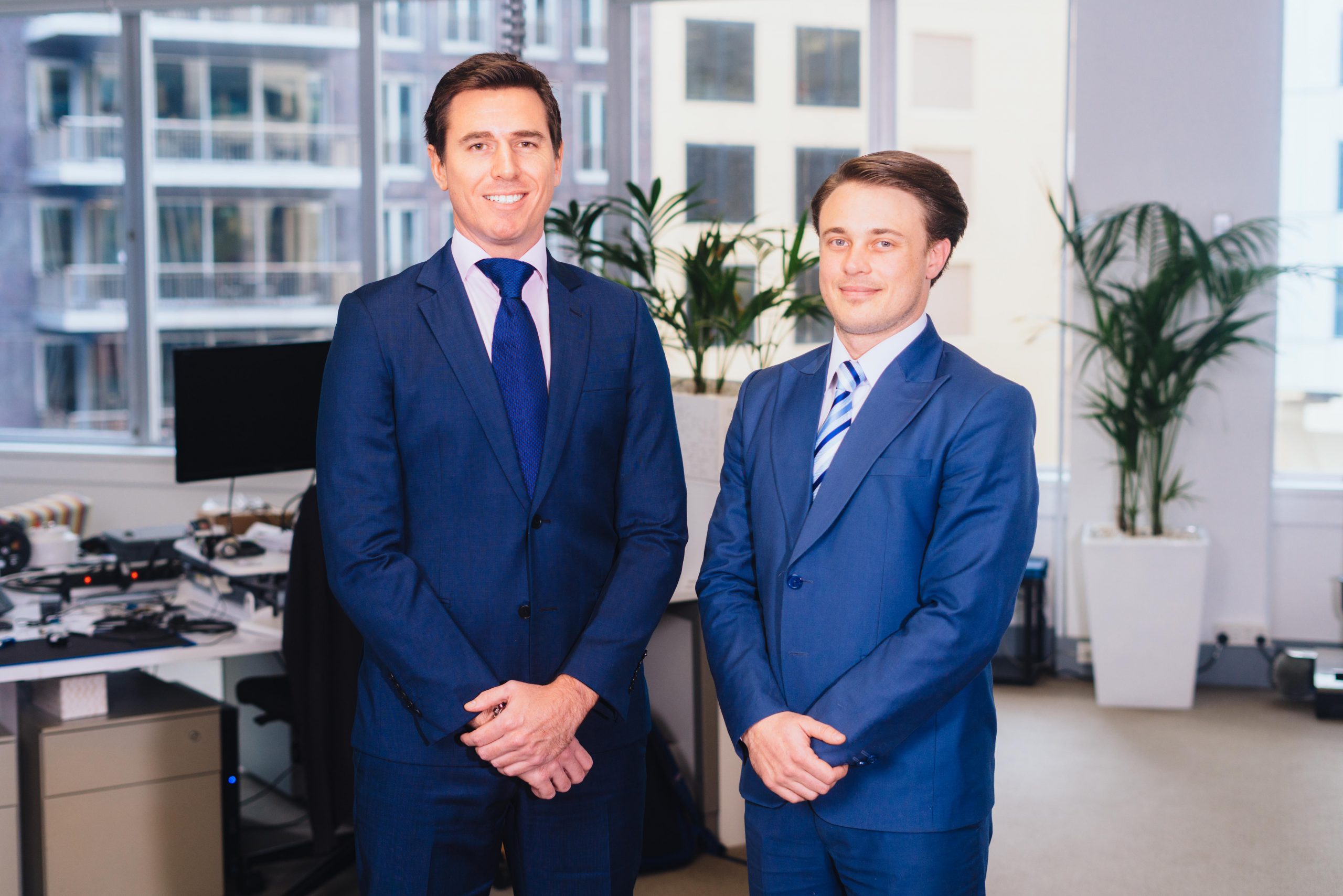
The company later established its headquarters in Sydney. Shaw has described the move in terms of export customers and the manufacturing supply chain on Australia’s east coast. It was a practical decision about access: to buyers, suppliers and the firms needed to turn an engineering drawing into a finished product.
The factory is part of the invention
A navigation instrument can look like a small box. The work behind that box is considerably less compact. Design, assembly, calibration and testing all have to agree. The customer sees a reading; the manufacturer has to account for the route by which that reading was produced. Making precision repeatable is an engineering problem of its own.
In September 2023, Advanced Navigation opened a robotics manufacturing facility at UTS Tech Lab in Botany. The facility was designed to expand production of navigation systems for environments without GPS, including the Boreas digital fibre-optic gyroscope technology. Its location also put manufacturing beside university research collaborations. A factory and a research relationship could develop together.
That arrangement gives Shaw’s belief in Australian manufacturing a concrete address. It involves equipment, processes and specialised people. A company cannot manufacture locally through enthusiasm alone. It needs the technical and commercial conditions that let a production team make a dependable device at a cost and pace customers can accept.
The research network extends beyond one university. Advanced Navigation works with CSIRO on photonic integrated circuits and partnered with RMIT on digital fibre-optic gyroscope development. Shaw’s role sits among those relationships: researchers exploring possibilities, engineers building systems and customers asking when the equipment will be available.
In 2022, the company acquired Vai Photonics, an Australian National University spin-out. Its laser-sensing work grew from years of research in precise measurement, including research connected to gravitational-wave detection. The acquisition brought the team into Advanced Navigation’s Canberra research operation. It also supplied another way to measure movement when satellite navigation is unavailable.
A small robot, a very old ship
Hydrus, launched in 2022, took the company’s work beyond supplying components. The autonomous underwater drone combined navigation with imaging and a vehicle of its own. Underwater, the familiar conveniences of a connected device fall away. Satellite positioning is unavailable, and communication has to contend with the environment. The robot needs to carry useful capability with it.
One documented survey gave that capability a wonderfully tangible subject: a 64-metre shipwreck in the Rottnest ship graveyard off Western Australia. Two Hydrus units completed three missions, surveying the wreck in under five hours. The resulting imagery became material for a three-dimensional reconstruction by Curtin University HIVE.
The wreck was identified as an old coal hulk, a reminder of Fremantle Port’s steamship era. The data went to the Western Australian Museum’s public archives and could be viewed at Curtin HIVE. A business that began with navigation components was helping turn a submerged piece of maritime history into something people could examine.
This was the work of a team and its partners. Shaw’s connection is through the company he helped build, rather than a claim that he personally conducted the dive. That distinction matters to understanding his career. As the organisation grows, the founder’s achievement increasingly involves creating the conditions for other specialists to do their work.
The Moon begins underground
The lunar work has a different destination and a related measurement problem. Advanced Navigation’s LUNA sensor is being developed to provide three-dimensional velocity and altitude information for lunar landers. The planned integration is with Intuitive Machines’ IM-4 mission. The task is exacting: tell a spacecraft how it is moving relative to a surface it is approaching.
In September 2025, the company announced completion of critical terrestrial validation. One test campaign took the technology through a six-kilometre underground route, 400 metres below the surface. The announcement described the next step as final space qualification. Successful trials on Earth and readiness for a spacecraft are separate milestones, each with its own requirements.
The mine is an arresting setting for work intended for the Moon. It also makes practical sense as a place to investigate navigation without satellite signals. The route to space runs through measurement, testing and qualification. A photograph of a distant destination may sell the ambition; the instrument still has to earn its place on the journey.
More people, more places, the same question
Shaw became the sole CEO after Orr retired from the co-CEO role in 2024. He was then discussing profitability, acquisition opportunities and a larger presence in the United States and Europe. For a business serving international customers, regional teams offer proximity to the people specifying, purchasing and integrating the equipment.
Growth also changes whom a founder needs to listen to. In 2025, the company appointed Maximilian Doemling to lead product management, connecting development with customer requirements across industries. Its American defence growth strategy included recruiting veterans with operational experience. Technical capability needs translators: people who understand both the system and the circumstances in which it will be used.
Regulation enters that conversation too. In discussing a collaboration with MBDA, Shaw described the time previously required to secure permission simply to share information. A navigation business can have working hardware and a willing partner while still needing an administrative route between them. International expansion brings calendars and permissions into the engineering story.
In March 2026, Advanced Navigation announced a US$110 million Series C led by Airtree, with Quadrant Private Equity and the National Reconstruction Fund Corporation participating. The funding supports expansion in the United States and Europe. The company said more than 80 percent of revenue came from those regions, while the investment would retain headquarters, core research and high-precision manufacturing in Australia.
By October, it had announced expanded manufacturing plans in Huntsville, Alabama, through a Positioning, Navigation and Timing Center of Excellence. The proposed operation brings research, engineering and production closer to American customers. The geography has become more complicated since Subiaco. The concern with how a device gets built and delivered remains recognisable.
For all those facilities and funding rounds, Shaw’s own descriptions of working life are refreshingly ordinary. He values time management and a useful schedule. His career advice is three words: “Listen. Communicate. Adapt.” Asked for his favourite coffee-meeting location, he chose the space in front of the office coffee machine, where spontaneous team conversations happen.
It is a small detail to end on, but a fitting one. Navigation depends on getting useful information from the world around you. Running a growing engineering company does too. Somewhere between the carefully scheduled meeting and the next coffee, someone has a problem worth hearing about. Shaw has built a career around paying attention to what happens next.
Keep exploring
- Advanced Navigation
- Chris Shaw on LinkedIn
- Founder interview: Main Sequence
- TheBridge: career advice and working habits
- The garage and manufacturing story
- March 2026 funding announcement
- October 2026 Huntsville announcement
- LUNA testing and qualification
- Hydrus launch film on YouTube
- Hydrus demonstration on YouTube
- Advanced Navigation video channel