The machine was supposed to spare the arugula. At Braga Fresh, an early encounter with Carbon Robotics’ LaserWeeder produced a more awkward result: it shot some of the crop. Different arugula varieties, at different stages of growth, had confused its recognition system. Carbon updated the model in about a day and a half. There, in a salad leaf, was the central problem of agricultural AI. A weed and a crop can look remarkably alike. One is an expense. The other is the business.
- Computer vision identifies plants; lasers target weeds’ growth points.
- The customer is a commercial grower with a recurring weeding bill.
- The financial test is cost per acre, including the hours the machine actually works.
Carbon Robotics occupies the space between those two plants. Its equipment combines cameras, plant-recognition software and precisely aimed heat to remove weeds without spraying herbicide or dragging a blade through the soil. Organic vegetable growers have an obvious reason to care. Conventional growers have reasons too: labor availability, herbicide resistance and the possibility of damaging a valuable crop while protecting it.
01 Let the tractor do the driving
Founder Paul Mikesell came from computing, with experience at Isilon, Clustrix, Uber and Oculus. He founded Carbon in 2018. The early equipment had names that sound like a vegetable drawer: Seedy, Veggie, Bud. A 2019 proof of concept was a manually pushed cart carrying one 40-watt laser. The company’s ambitions were large. Its first field tool needed someone to push.
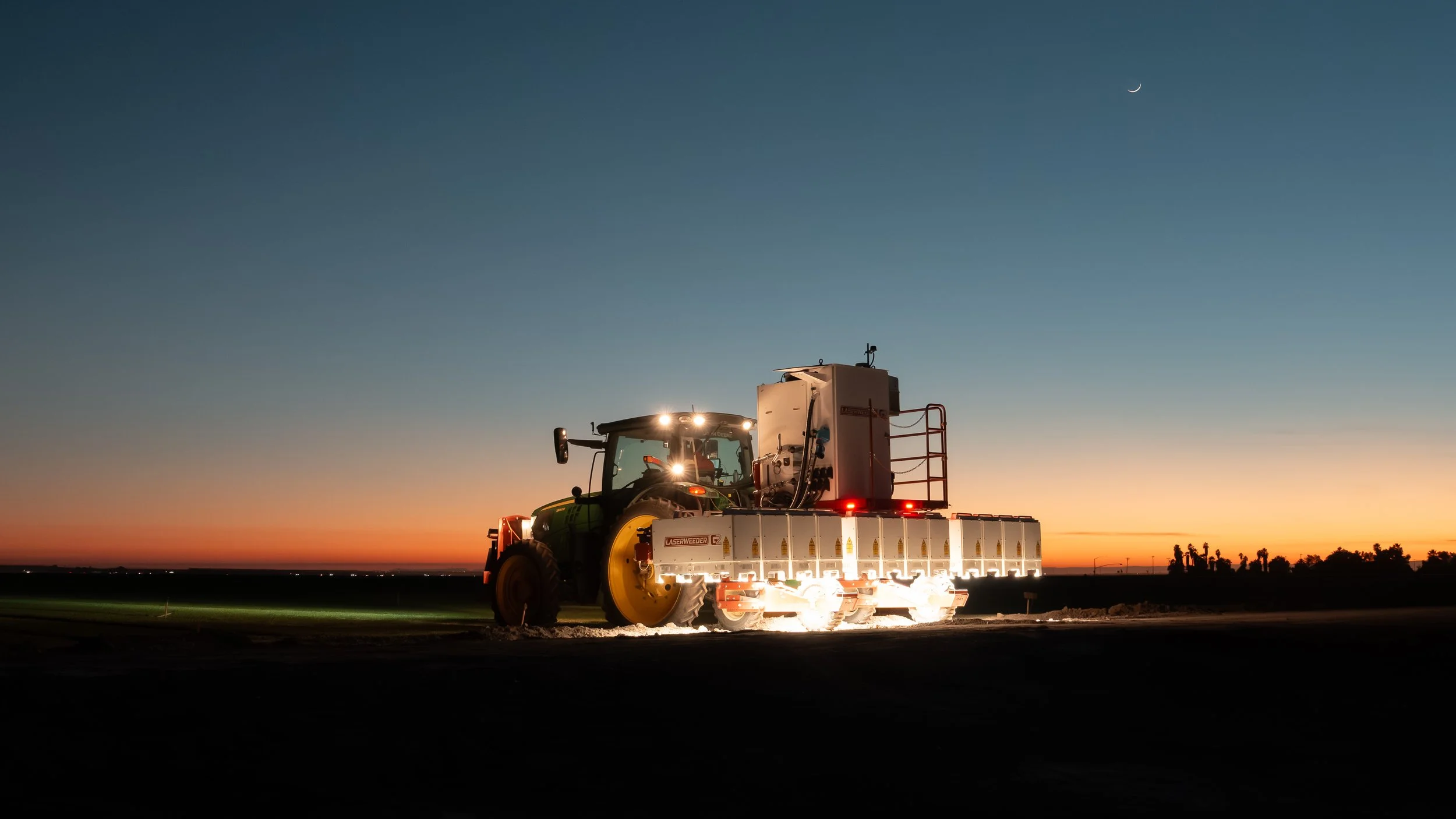
By 2021, Carbon was demonstrating a self-driving machine. In 2022 it introduced a different arrangement: a tractor-pulled implement with 30 lasers. Working with vegetable growers, it made the device compatible with familiar farm infrastructure. The tractor supplied the movement; Carbon supplied the discrimination. That change is a useful product lesson. An invention becomes easier to adopt when the surrounding workflow already makes sense.
“To best serve farmers’ needs, we’ve adapted the design of our product”Paul Mikesell · 2022 LaserWeeder launch
The G2 line, introduced in February 2025, continued that adjustment. Carbon described a lighter, modular system with stronger lasers, upgraded cameras, NVIDIA processors and liquid cooling. Its job remained wonderfully narrow: identify the unwanted plant, keep a laser on the correct point while moving, and deliver enough energy to stop growth. Recognizing a weed is only one part of that sequence.
02 The invoice has to make sense
The machine invites a science-fiction reaction. The purchasing decision belongs in a spreadsheet. In Western Growers’ 2024 case study, Braga Fresh paid $1.2 million for a LaserWeeder. Its estimated operating and ownership cost was $267.72 per acre, against approximately $900 for hand weeding. Those were historical results for a particular farm and equipment generation, rather than a current G2 price or a promise to every buyer.
About 70% lower in this case. Ownership, service, tractor, fuel, operators and logistics included in the laser estimate. Historical equipment; results vary.
The important denominator is the acreage the machine serves. A costly implement spreads its ownership expense across every productive acre. Leave it parked and that calculation deteriorates. Carbon sells machinery with financing and lease-to-own options through partners, supported by software and service. Buyers therefore need to budget for the whole operation, including the tractor, fuel, support, people and any follow-up weeding.
Carbon’s stated one-to-three-year payback is a sales claim to test against a farm’s own books. High weeding costs and sustained utilization help the argument. Cheap existing control, limited acreage or too few workable hours weaken it. The buyer can copy Braga’s method: measure a real field, count every expense, then compare the result with the current routine.
The customers make that market position clear. Carbon lists Grimmway Farms, Duncan Family Farms, Hungenberg Produce and Tanimura & Antle among its growers. Its current customer page reports more than 200 growers in 15 countries. These are businesses managing crop quality and labor schedules across commercial acreage. A more accurate weeding pass matters because the harvested product still has to meet a buyer’s standards.
03 Purslane gets a vote
The competition is broader than another laser. John Deere’s See & Spray targets herbicide applications. Garford’s Robocrop uses vision to guide mechanical weeding. Hand crews remain a flexible alternative. Carbon’s particular proposition is targeted removal without herbicide application or soil cultivation. Which method belongs on a farm depends on its crops, weed species, planting arrangement and economics.
A 2025 peer-reviewed study of trials in beet, spinach and pea gives that proposition some texture. Laser treatment performed as well as or better than selected herbicides on several erect annual weeds. But some annual grasses and purslane were harder to control. Protected growing points and successive waves of emergence mattered. Multiple passes were part of the experiment. Biology has its own release schedule.
- 01 / SeeCameras capture the crop bed.
- 02 / DecideSoftware separates crop from weed.
- 03 / TargetA laser heats the weed’s growth point.
That early arugula mistake also explains why model updates belong in a machinery story. In February 2026, Carbon announced its Large Plant Model, trained, it said, on 150 million labeled plants. Plant Profiles lets operators tailor behavior using a few field images. The intended benefit is faster adaptation to the crop actually in front of the cameras. Field support and correction speed are part of the product.
Building the machine also requires capital. A $70 million Series D in October 2024 was led by BOND, with NVentures among the participating investors. That funding supports a business whose expertise extends beyond software: it must manufacture equipment, ship it and keep it operating when a grower’s field schedule leaves little room for delay.
04 Back to the driver’s seat
Carbon has returned to autonomy through a separate retrofit kit for selected existing tractors, with sensors and remote human supervision. Initial availability is regional. In September 2026, Great Plains became the first member of its Autonomy Ready program, aimed at connecting implements to that platform. The company is expanding from a precise action behind the tractor toward coordinating more of the work around it.
Carbon reported annual revenue above $100 million for the fiscal year ended January 31, 2026. Its customers include specialty growers well beyond the United States. The appeal is concrete: fewer expensive weeds competing with crops, and more control over a repeated task. For anyone building tools for an established industry, the tractor hitch remains the instructive detail. Start with the job customers already have to finish.