A farm can be busy and still be invisible. A tractor crosses an orchard. A sprayer completes a block. A crew moves to the next job. Each action is obvious to the person beside it, yet strangely hard to assemble into one dependable account of the day. The distance between work performed and work understood is where money, time and crop quality quietly escape.
Iftach Birger has spent more than a decade narrowing that distance. His company, Fieldin, connects machines, implements, workers and field sensors so commercial growers can follow their operations while there is still time to change them. Its screens answer plain questions with expensive consequences. Where is the equipment? How fast did it travel? Was the recommended amount actually applied? Which crew has finished? What broke the plan?
Birger arrived at software by way of soil. He grew up in an Israeli farming family and studied plant science at the Hebrew University of Jerusalem, graduating cum laude in 2011. He continued into a master’s program in biotechnology and plant science, completed in 2013. That year, he and Boaz Bachar co-founded Fieldin. The chronology feels almost suspiciously tidy: learn how plants work, then build a company around all the human and mechanical work required to grow them.
The first crop was the product
Three versions, one stubborn field
Fieldin began with integrated pest management. The early product helped specialty-crop growers track crop-protection work, a narrow entrance into a large and unruly building. Spraying is particularly suited to operational scrutiny. Timing matters. Speed matters. Flow matters. Weather matters. Mistakes can be costly, difficult to spot and impossible to rewind.
The product did not stay narrow. Birger has spoken about Fieldin passing through three incarnations of its product organization before reaching a model broad enough to scale. The company moved from documenting pest-management activity toward an operating layer for the farm: planning jobs, monitoring fleets, tracking execution, comparing performance and preserving traceability. A single spray became part of a season. A sensor became part of a management system.
This is less glamorous than a robot trundling heroically through golden light, which is exactly why it matters. Growers do not operate demonstrations. They operate distributed physical systems exposed to heat, dust, labor shortages, regulations, mechanical failure and weather with a sense of humor. The product had to survive Tuesday afternoon.
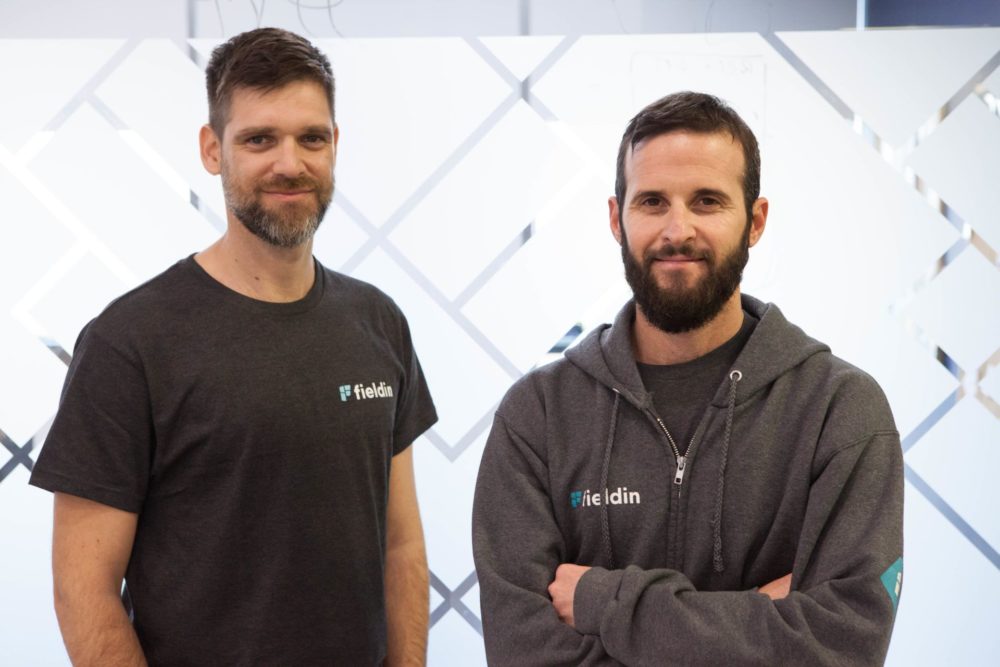
Birger spent his first twelve years at Fieldin as chief operating officer, leading product development and growth. The title suited the subject. Farming is an accumulation of operations, and Fieldin’s job was to make those operations comparable without sanding away their local reality. Almonds are not lettuce. California is not Mildura. A platform can standardize the record while respecting the field.
Observation before prediction
AI needs a truthful Tuesday
When Birger became chief executive in June 2025, succeeding Ofer Elyakim, he named deeper AI capabilities among his priorities. The phrase can make any sensible reader reach for a hoe. Yet Fieldin’s long route gives the ambition weight. Machine intelligence in a physical operation depends on a faithful account of the physical operation. Before software recommends, it must see.
Consider a hull-split spray in an almond orchard, one of the season’s consequential applications. A map may show that a machine visited the right rows. It cannot, by itself, prove that material flowed at the intended rate. Fieldin’s work with equipment company ARAG and service provider PAS brings flow readings from the sprayer into the same operational view. The grower can compare speed and gallons per acre while the job is underway, when a correction remains useful.
How a farm becomes legible
The sequence is Birger’s useful idea in miniature. Observe, organize, compare, act. An AI model may sharpen the comparison or recommend the action, but its credibility rests on everything before it. A hallucination in a chatbot is annoying. A hallucination about pesticide application is an invoice with weather attached.
This also explains the importance of trust in Birger’s public conversations. Agtech founders can admire elegant systems. Growers have to bet a season on them. Trust accumulates when the digital record matches what the operator saw, when an alert arrives early enough to help, and when the tool respects equipment and habits already paid for.
The installed reality
Do not throw away the tractor
Fieldin’s approach to autonomy follows the same logic. In 2021, soon after a $30 million Series B led by Fortissimo Capital, the company acquired Midnight Robotics. The deal added autonomous-driving expertise to a platform already collecting field data. The goal was not to ask growers to replace every useful machine. It was to retrofit existing tractors and connect autonomous execution to the operating system around them.
There is a quiet strategic intelligence here. New technology enters an old industry more easily when it acknowledges the old industry’s balance sheet. A tractor is machinery, capital, maintenance history and muscle memory. Keeping it in the barn while expanding what it can do is both a product decision and a courtesy.
By his appointment, Fieldin said it worked with large growers including Olam, Select Harvests and Taylor Farms. It reported eight-figure annual revenue and more than 80 employees worldwide. Its geography stretches from California’s Central Valley to Israel and Australia. The crops are high-value and varied: nuts, grapes, citrus, berries and vegetables. The common object is a better account of work.
That geography is part of Birger’s education as an operator. Fieldin was founded in Israel, where its research and development organization took shape, then established operations in Fresno and San Jose as California became a central market. An Australian office followed in Mildura, another place where permanent crops, large distances and compressed harvest windows make operational visibility valuable. The software crossed borders, but the sales argument stayed local: here is the machine, here is the task, here is what happened.
Capital arrived in stages alongside that expansion. Fieldin raised a $12 million Series A in 2019. Two years later, its $30 million Series B brought announced funding to $55 million and gave the company room to scale its agricultural operating system. At the time, Fieldin said its technology served five of California’s ten largest farms and supported more than 20 percent of global almond production. Those company figures offered a striking test of Birger’s product choices. Specialty agriculture may look niche from a software office, yet a single grower can manage thousands of acres, many crews and a fleet whose small inefficiencies repeat all season.
Scale changes the character of a mistake. One inaccurate pass is a correction; the same deviation repeated across locations becomes a management problem. Fieldin’s benchmarks let growers compare machines, operators and activities against their own history and broader crop-specific patterns. The ambition is not surveillance for its own sake. It is to find the place where a large operation quietly stopped behaving like the plan.
Birger has framed sustainability in similarly operational terms: doing more with less. That phrase survives because farms actually must. Better application records can reduce waste. Earlier equipment alerts can cut downtime. More consistent speed can improve coverage. Traceability supports accountability and compliance. None of these is a halo floating above the business. Each belongs to the shift schedule.
The chief operator
A CEO with dirt under the abstraction
The move from COO to CEO places Birger’s operating temperament at the center of Fieldin’s next chapter. His stated ambitions are expansive: new markets, strategic technology partnerships, stronger AI and continued work with major growers. His language stays close to practical needs. It is difficult to imagine him asking a sprayer to disrupt itself.
There is personality in that restraint. His public remarks return to collaboration, field conditions and specific constraints. When he discusses the future, labor shortages and water sit beside algorithms. When he discusses precision, he talks about what reached the dashboard from the tractor cab. The abstraction is always required to show its boots.
Startups in the SoilWatch Birger discuss grower trust, scaling agtech and the digitized farm on Between the RowsThe most interesting question is no longer whether agriculture will produce more data. It produces plenty. The question is whether that data can become a reliable shared memory: one that helps a manager notice drift, helps an operator correct course, and helps a company learn across seasons without pretending every orchard is the same.
Birger’s bet is that the answer can become intelligence, and intelligence can eventually become autonomy. The order remains essential. A farm must see the work before software can improve it. It must trust the record before it follows the recommendation. And somewhere, on a hot afternoon, a grower must look at a screen, look back at the row, and find that the two agree.