The Farmer
Who Never Farmed
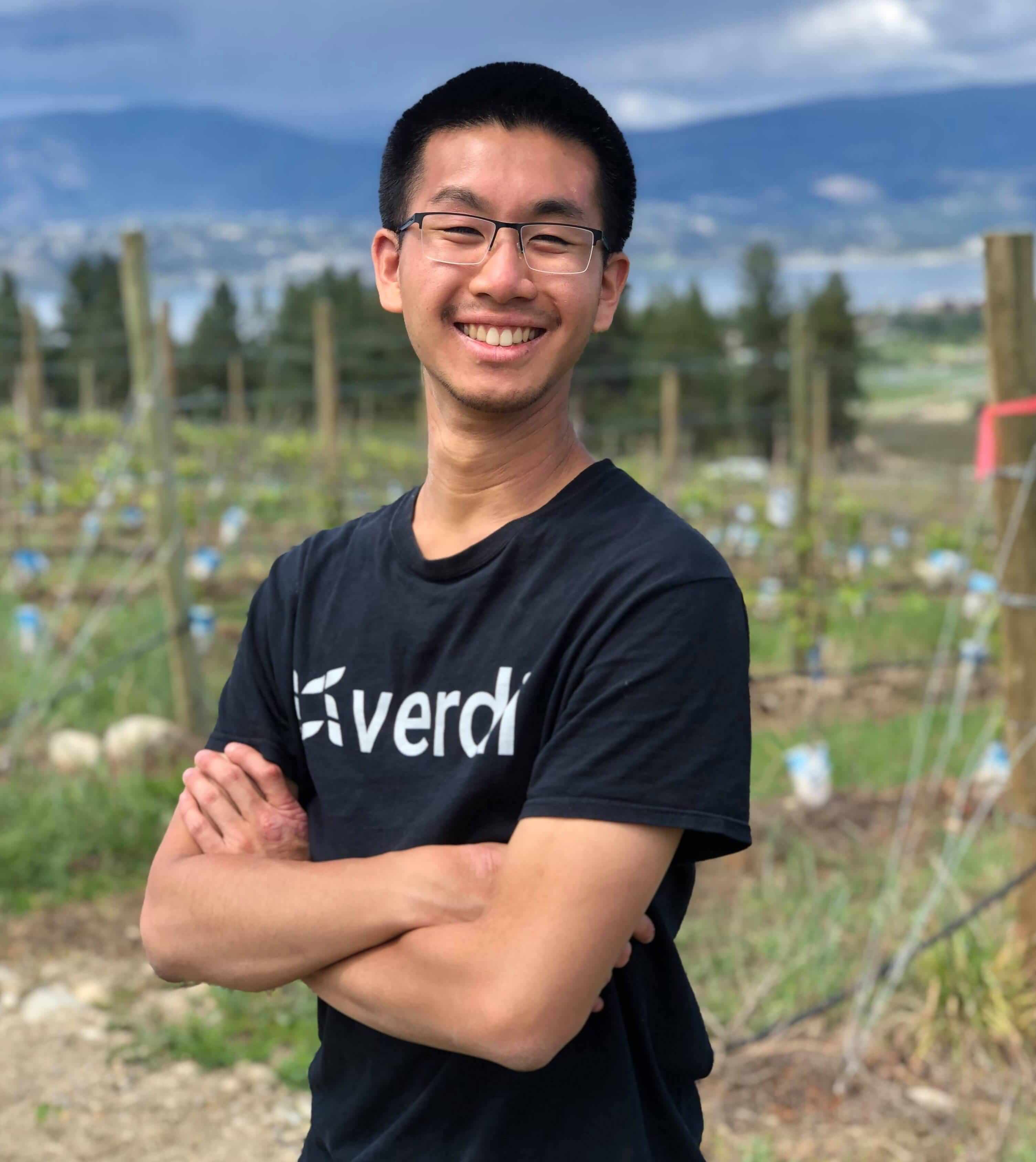
Arthur Chen grew up watching his grandparents tend rice paddies in Taiwan. His family immigrated to Surrey, British Columbia in 1995. He became the first generation in his family not to farm. Then, in a roundabout way, he became responsible for the water on thousands of farms across North America.
It started with an engineering physics degree at UBC and a capstone project that refused to stay academic. In 2019, Chen was leading precision agriculture research for a project sponsored by Google X's Mineral division - the secretive moonshot arm of Alphabet that was trying to digitize the farm. He spent months in fields, talking to growers, watching them walk row by row, valve by valve, turning water on and off by hand. The epiphany was not theoretical. It was practical, muddy, and slightly absurd: 95% of specialty crop irrigation was still happening manually, on millions of acres, in a world that had already put computers in pockets and satellites in orbit.
In 2020, Chen and his co-founders Roman Kozak and Jacky Jiang turned their UBC engineering capstone (ENPH 459) into a company called Verdi. The name evokes green - verdant fields, growing things, life sustained by water. The product was something more specific: a wireless system that could retrofit any existing irrigation infrastructure with smart controllers and soil moisture sensors, turning a dumb pipe network into a precision irrigation platform manageable from a phone.
One year later, Verdi was on the TechCrunch Startup Battlefield stage at Disrupt 2021. The company had figured out what most agtech startups miss: farmers do not want to rip and replace. They want their existing $200,000 irrigation system to get smarter, not a $200,000 replacement. Verdi's retrofit approach - attaching wireless block controllers and sensors to legacy hardware - cracked open an adoption problem the industry had been stuck on for years.
By 2024, Verdi had saved over 100 million liters of water and more than $1 million CAD in irrigation labor costs for its customers. The company's platform was live on 5,000+ acres across the United States and Canada, deployed on vineyards, orchards, and specialty crop operations run by some of the world's largest food and beverage brands. In November 2024, the wine industry gave Verdi the WINnovation Award for making irrigation automation accessible to growers who had never been able to afford it.
In May 2025, Verdi closed a $4.7 million USD ($6.5 million CAD) oversubscribed seed round led by SVG Ventures, with participation from NEC X, Ponderosa Ventures, Elemental Impact, GenomeBC, and nine other investors. The round was oversubscribed in a period when agtech funding had broadly slowed - a signal that the retrofit model, the water savings metrics, and the customer results were speaking louder than slides.
Chen describes what Verdi is building as "physical AI for farm infrastructure, starting with irrigation." The roadmap extends beyond water: climate financing tools, improved crop insurance, satellite-integrated crop health monitoring via Planet Labs data, and international expansion to Peru and Portugal - regions where drought-resilient farming is not a trend but a survival question. The team has grown from two co-founders to 24 employees, including agronomists, data scientists, and field service technicians who know the difference between a vineyard block and a sub-block.
The Schulich Leader Scholarship - one of Canada's most competitive STEM awards for entrepreneurial students - got Chen through UBC without tuition debt and the mental bandwidth to focus on building. He does not mention it often. He mentions the growers more. What drives Verdi, in Chen's framing, is a straightforward ambition: flip the ratio. Right now, 95% of farms operate without meaningful automation. He wants to make that number look embarrassing by the time he's done.