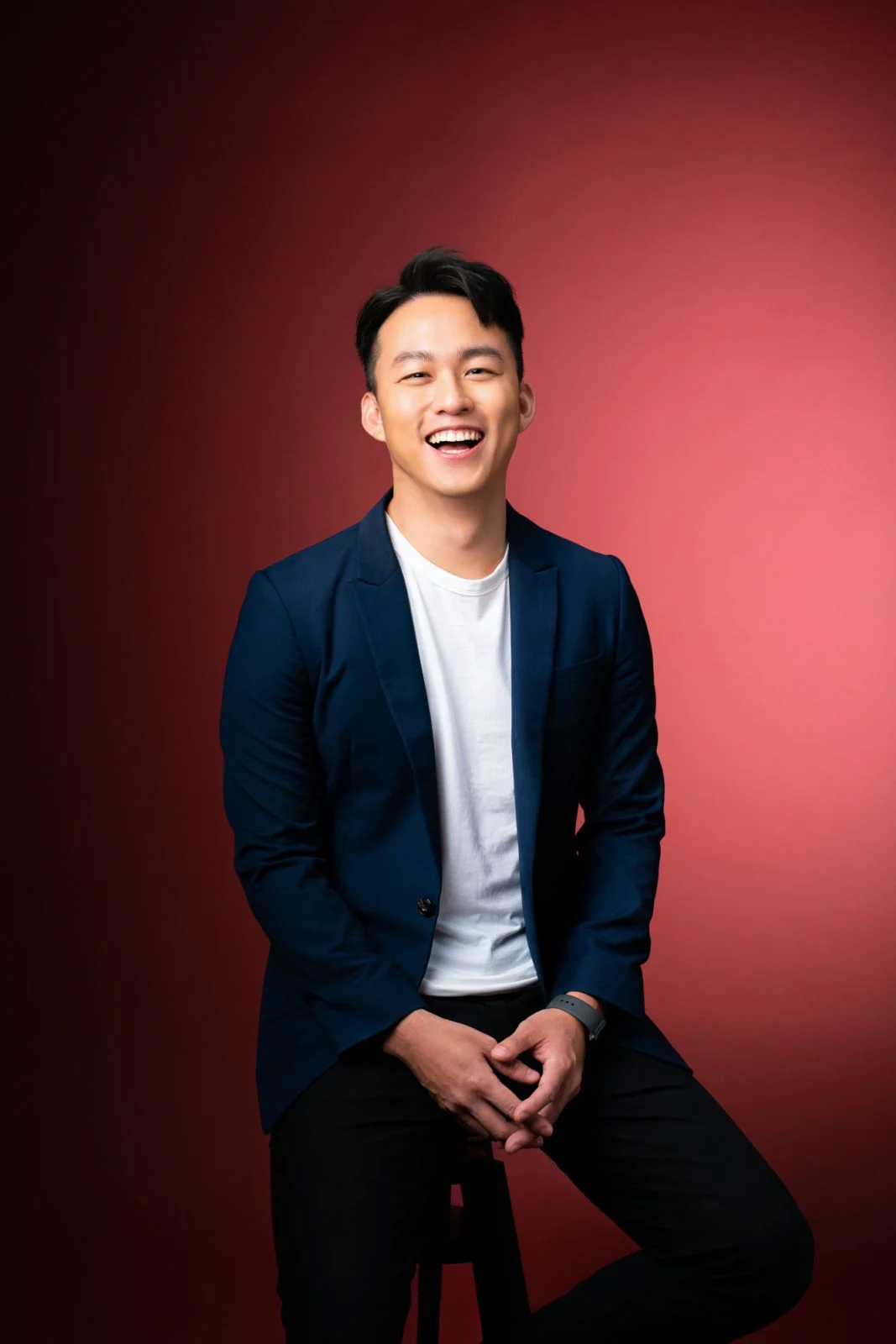
The man who turned a gas explosion in Taiwan into a company that knows your chicken's weight before you do.
It was July 2014. A series of underground natural gas explosions tore through the streets of Kaohsiung, Taiwan - the deadliest gas disaster in the country's history. Ray Chiu's relatives lived two blocks from the blast site. Communications went dark. Power cut out. For hours, Chiu - then a freshly minted UC Berkeley engineering graduate - couldn't reach anyone.
His family survived. But something changed. The gas was there the whole time - odorless, invisible, undetectable until it wasn't. Chiu had just spent a year at Berkeley's Fung Institute studying the biochemistry of sensing. He knew there was a better way.
Within months, BioInspira was incorporated. What started as a blood glucose sensor for a class capstone project had found its real calling: making dangerous things detectable before catastrophe strikes.
"I was really worried about my relatives. There was a power and communications blackout, we couldn't get a hold of our relatives to see if they were all right."
- Ray Chiu, on the 2014 Kaohsiung gas explosionsTen years on, the company has a new name (Calyx), a new focus (poultry and livestock farming), and a product that watches 17 million birds without touching a single one. But the founding conviction hasn't changed: critical information should not require a catastrophe to reveal itself.
BioInspira began as a capstone project at UC Berkeley: a non-invasive blood glucose biosensor. Professor Seung-Wuk Lee encouraged Chiu and co-founders Benson Fan and Jimmy Leu to enter Cal's Big Ideas Contest. They won first place. The prize funded the patent and incorporation.
What followed was a series of pivots driven by market reality - from healthcare to infrastructure monitoring to oil & gas to food safety - each one sharpening the technology until Calyx found its most pressing problem: a global poultry industry flying blind on flock health and harvest timing.
A team of engineering students walks into a pitch competition with a glucose sensor they built in a lab. They hadn't planned to compete. Their advisor told them to enter. They won. The prize money paid for their first patent application and the legal fees to incorporate.
- Ray Chiu, on the project that became BioInspira
Non-consumable. Heat-resistant. Reversible.
Calyx's sensor platform is built on a genuinely strange idea: using M13 bacteriophages - microscopic viruses that naturally bind to specific molecules - as the sensing element inside a chemical detector.
Traditional sensors wear out because their chemical receptors degrade with exposure. Phage proteins, coated onto silicon substrates, bind to target gases reversibly and survive conditions that would destroy conventional sensors. They're heat-resistant. They don't consume themselves. And because they're biological, they can be engineered to be highly selective - distinguishing ammonia from CO2, or detecting specific VOC signatures in complex gas mixtures.
Calyx layers AI calibration on top of this biological foundation, building a platform that Chiu argues will ultimately beat the economics of traditional sensor manufacturing: lower cost, longer lifecycle, and a proprietary phage database that grows more valuable with every deployment.
"I firmly believe that the technology our team is working on will revolutionize people's way of life and lead to a safer and smarter world."
- Ray Chiu, IndieBio interviewCalyx bundles its AI and sensor technology into a connected platform purpose-built for poultry operations - from the moment a chick arrives to the day the flock ships.
3D computer vision cameras mounted inside poultry houses continuously measure individual bird weights without a single manual weigh-in. The system predicts weight distribution across the entire flock and optimizes harvest timing.
A 4-in-1 non-consumable sensor measuring temperature, humidity, ammonia (NH3), and CO2 in real time. Unlike conventional chemical sensors, the phage-based detection layer doesn't degrade - no replacement cartridges, no periodic recalibration downtime.
A cloud-based analytics layer that aggregates data from the AI Eye cameras and Y-Series sensors into a unified dashboard. Predictive insights for flock performance, early anomaly detection, and harvest planning delivered via web app or API.
The path from Kaohsiung gas explosions to poultry farming is not an obvious one. But it makes sense when you follow the logic of Calyx's core technology rather than its applications.
Phage-based sensors can detect virtually any target molecule - it's a platform technology, not a single product. After proving the concept in infrastructure monitoring (natural gas pipelines, utility partnerships in California), Chiu and his team asked where the pain was most acute and the market least served. The answer, counterintuitively, was agriculture.
Poultry farming runs on information the industry has never had good access to: real-time flock weight, ammonia levels that spike before birds show illness, CO2 gradients that indicate poor ventilation. Conventional sensors consume themselves and require replacement. Manual weighing is slow, stressful for birds, and statistically inadequate for a flock of 40,000 chickens.
Calyx's non-consumable Y-Series sensor and AI Eye camera system solved both problems simultaneously. The result was a validation run that covered more than 17 million birds - and a product with clear, measurable ROI for integrators and growers alike.
"Do not take anything for granted... we invested most of our time to grow relationships with potential customers."
- Ray Chiu, IndieBioThe lesson from IndieBio, from the CITRIS Foundry, from a decade of pitching hardware to skeptical investors: the technology is never the hard part. The relationship is. Chiu learned this early and built his company around it.
Chiu describes a persistent challenge in the early BioInspira days: explaining biotechnology-based sensing to sensor industry veterans, while simultaneously educating biotech investors about the economics of hardware manufacturing.
Neither side spoke the other's language. Sensor engineers understood electrical signal transduction but not phage protein engineering. Biotech VCs understood molecular biology but not the hardware unit economics of industrial IoT deployment.
This translation problem - which Chiu navigated by building a team with deep expertise in both domains - is itself a competitive moat. Companies that don't understand the intersection can't replicate what Calyx builds.
I firmly believe that the technology our team is working on will revolutionize people's way of life and lead to a safer and smarter world.
The Capstone project was really the initiation of what I'm doing right now. Our company is an extension of our Capstone project. The program's flexibility lets you decide what you want to do and how deep you want to go.
I was really worried about my relatives. There was a power and communications blackout, we couldn't get a hold of our relatives to see if they were all right.
Do not take anything for granted... we invested most of our time to grow relationships with potential customers.
Calyx operates from 450 Sutardja Dai Hall at UC Berkeley - the physical home of Berkeley SkyDeck, consistently ranked as one of the world's top university startup accelerators.
Calyx maintains a parallel engineering center in Taipei - bridging Silicon Valley innovation culture with Taiwan's world-class hardware manufacturing and semiconductor ecosystem.
The company still appears online as both "BioInspira" and "Calyx." The rebrand happened around 2021 - a name change that signaled a full pivot from gas pipeline sensors to agricultural AI.
Between finishing his undergraduate degree in Taiwan (2012) and starting at Berkeley (2013), Chiu completed Taiwan's compulsory military service - a detail that underscores his cross-cultural path before Silicon Valley.
The BioInspira sensor platform originally targeted natural gas pipelines, healthcare glucose monitoring, aviation security, and oil & gas infrastructure. Poultry was not in the original pitch deck.
Professor Seung-Wuk Lee of UC Berkeley's Bioengineering department - whose lab specializes in bioinspired nanomaterials - was the first advisor to encourage Chiu's team and serves as Calyx's Chief Technology Advisor.