A car is a remarkably awkward thing to keep in a shopping mall. It needs floor space, delivery arrangements and enough companions to represent a range. Add paint colors, interiors and accessories, and the showroom becomes an expensive answer to a deceptively small question: what would this one look like if it were mine?
Metadome.ai works on that question. The company builds interactive 3D models, augmented reality experiences and virtual reality presentations for brands. A shopper can examine a vehicle, change its appearance or compare options. A dealer can show something absent from the floor. Increasingly, the same idea extends to the mechanic looking for a component inside an assembly. The object changes; the problem remains recognizable.
- For buyers: explore and configure products instead of guessing from a photograph.
- For brands: bring product ranges to websites, mobile devices and smaller retail spaces.
- For service teams: turn existing drawings and manuals into parts models and guided procedures.
- The catch: a convincing render still needs checking against the real product.
01 The showroom’s missing square meters
MG Motor supplies a concrete example. Its MG StudioZ concept puts immersive product exploration into a compact experience center. Metadome.ai’s case study describes the commercial constraint plainly: MG wanted accessible locations with useful foot traffic while limiting the real estate and inventory burden of conventional dealerships.
Virtual visualization lets visitors examine options that are not physically present. MG’s digital transformation executive Kapil Bajaj described the resulting dealership model as “light on inventory and costs.” That is a refreshingly material ambition for a business associated with the metaverse. Rent arrives every month, whether or not anyone has admired your avatar.
The company reports 32.2% test-drive conversion and 9% retail conversion for this case. These are vendor-reported results with different meanings: an intention to drive and a retail outcome. They should be read separately. Neither is a promise that another dealer will reproduce them simply by putting on a headset.
MG StudioZ case study · Company-reported outcomes · Different funnel stages
Autodome, the automotive suite launched in 2022 according to Metadome.ai’s timeline, packages that approach into presentation, configuration and comparison tools. Online customers can explore colors, accessories and specifications. Dealership deployments can add cinematic VR or an assisted experience controlled through a tablet. The product is sold to the brand; the shopper encounters it as part of the brand’s buying journey.
02 A pavilion with no travel arrangements
MGverse gives the idea a more theatrical setting. In January 2023, MG Motor announced a digital twin of its Auto Expo pavilion, built with Metadome.ai. Architectural files became a virtual environment that remote visitors could explore. The experience included product discovery, personalization and car-booking features.
Its appeal is easy to understand. An exhibition has a place and a closing date. Digital product assets can travel beyond both. A visitor can arrive from elsewhere, examine a vehicle and leave with a more useful impression than a photograph of somebody else standing beside it. Whether that visitor eventually buys is a separate question, and the sensible one to measure.
Other deployments bring the concept closer to everyday shopping. Metadome.ai’s Hero-Harley case study describes a web configurator with AR and a Google Cloud backend collaboration. Its Royal Enfield case describes viewing motorcycles in the customer’s own space, changing colors and comparing variants. Royal Enfield’s reported 1.38 million AR experiences measure use of the experience, rather than 1.38 million individual buyers.
“Consumers often have a broken experience while browsing online and offline.”Kanav Singla · Founder and CEO · August 2024
03 The drawings were there all along
The company’s live website now gives substantial space to a less photogenic opportunity: parts and aftersales. Manufacturers already possess engineering drawings, photographs and service manuals. Much of that information is perfectly useful to an expert and distinctly unwelcoming to everyone else. A parts list may identify the component while doing little to help a buyer recognize it.
Metadome.ai’s proposed answer is to turn that existing material into an inspectable 3D model. Buyers can rotate an assembly, zoom in and separate its components. Service teams can use related models for step-by-step guidance. An accessory can appear on the vehicle where it belongs. A thumbnail rarely enjoys that much responsibility.

The published workflow contains six stages: ingest, read, confirm, build, prove and studio. The important pause comes before geometry is approved. Ambiguous dimensions, materials or part information can return as questions. The resulting model is compared with its source drawing, and a person makes the approval decision.
Then reuse the model for parts discovery, service guidance and training.
That makes the output more than a marketing image. The studio offers inspection, measurement, sectioning, materials and assembly work, with GLB and USDZ exports. The practical promise is reuse: product knowledge that can move between teams instead of being recreated for each new presentation.
04 The socket that disappeared
There is a wonderful nuisance in this business: looking right and being right are different achievements. In research published on September 24, 2026, Metadome.ai illustrated a generated part whose hollow mounting socket had become a solid block. The silhouette similarity score was still 0.85 out of one.

The paper argues for checking individual features, including what is missing or invented, and comparing scores with deliberately broken models. Its reconstruction trials also reported remaining positional errors. A recognizable model, in other words, should not automatically become a manufacturing instruction.
This gives a prospective customer a useful test. Bring a troublesome drawing, a confusing revision or an assembly with a hidden feature. Watch how the system handles uncertainty. An attractive example chosen by the vendor tells you about presentation; your awkward example tells you about the workflow you are buying.
05 Who buys the machinery behind the magic?
Metadome.ai is an enterprise software business, with licensing, implementation and content work behind the customer-facing experiences. Its commercial conversations begin with demos. For a buyer assessing cost, the sensible unit is the deployment: which products need modeling, where the experience runs, what systems it connects to and who maintains it as the catalog changes.
There are alternatives. Threekit offers vehicle and auto-parts configuration, AR, VIN search and commerce integrations. A brand can also commission a specialist studio or build its own experience. Metadome.ai’s distinctive proposition is the combination of automotive deployments, immersive presentation and a growing drawing-to-3D workflow for service. That is a useful basis for comparison, rather than proof that one vendor wins every job.
The people behind it bring different responsibilities. Kanav Singla leads the company as CEO. Shorya Mahajan is co-founder and COO; Kartik Kanaujia is described by the company as co-founder and CTO. Earlier company accounts also identify Prashant Sinha as a co-founder. Management describes teams combining technical and creative specialists, a plausible arrangement for work that needs both convincing visuals and functioning software.
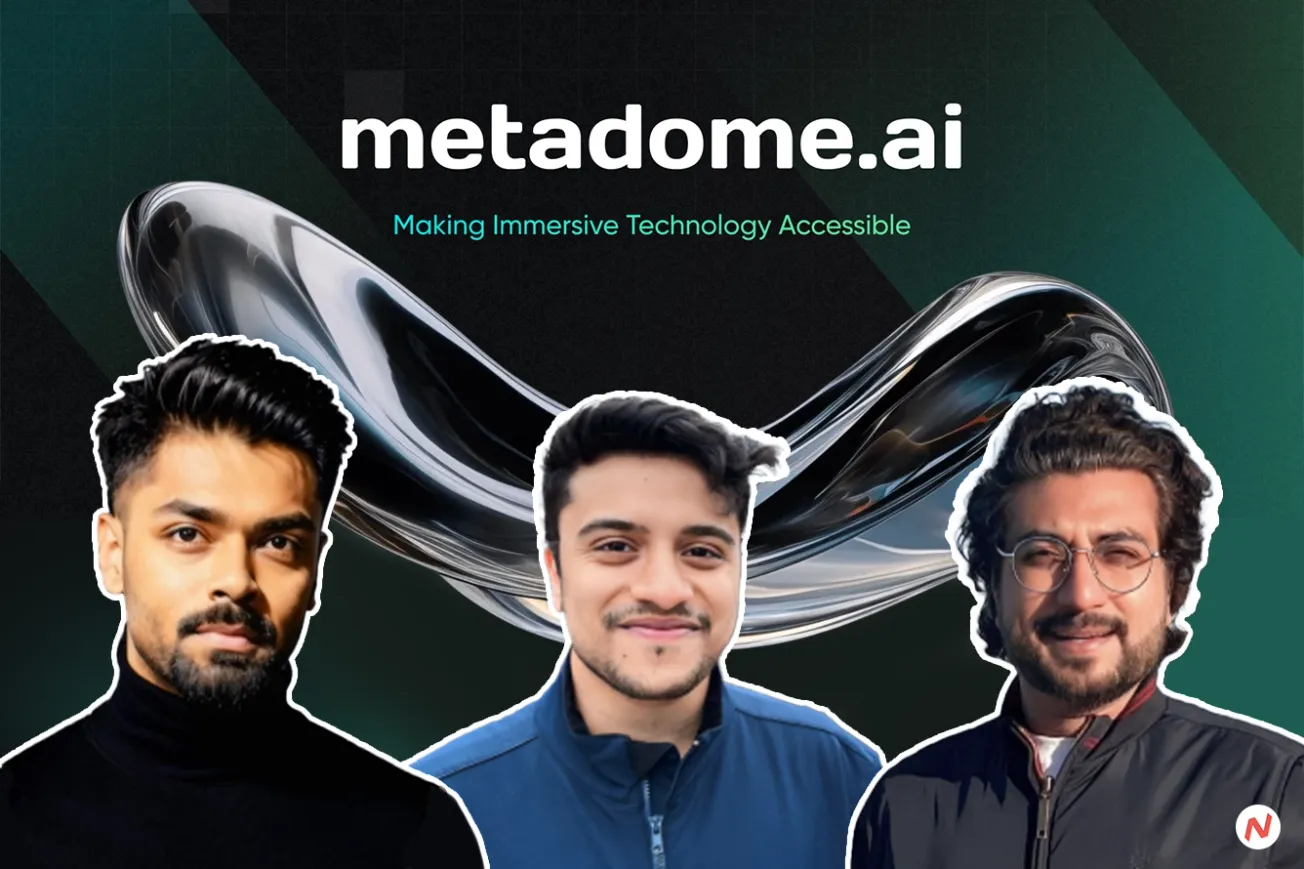
The funding supplies a sense of commitment, rather than a customer price tag. Adloid, the company’s former name, raised a reported $4 million pre-Series A in December 2021. In August 2024, Metadome.ai announced $6.5 million in Series A financing combining equity and debt, led by Siana Capital and existing investor Chiratae Ventures. Expansion and further XR-AI development were the stated uses.
06 After the customer takes the keys
The September 2025 announcement with Jameel Motors Egypt shows another route beyond product display. Its AI virtual sales assistant was designed to answer questions, compare models, arrange test drives and support delivery inquiries. The announced service functions included maintenance bookings, service records, warranties and spare-parts requests.
Here the useful lesson is continuity. A customer who understands the car still has to book something. An owner who needs maintenance still has to reach the right system. An interactive model or conversational assistant earns its place when it makes that next action easier.
For other businesses, the copyable practice is modest and specific: start with information you already own, choose a customer question worth answering, and measure the next step. Use the same approved product model wherever it helps. Sparse drawings and missing variant data demand clarification; physical driving and manufacturing tolerances demand their own checks. The photograph may begin the conversation. Metadome.ai’s opportunity is everything the customer wants to ask it afterward.
Website · Drawing-to-3D platform · Mechanical-part research · MG StudioZ case study · MGverse launch · Funding coverage · Jameel Motors announcement
LinkedIn · X · Instagram · Facebook
Watch on YouTube · Autodome product video · Virtual retail demo