The Garage That Sold Google Cardboard, Then Sold America Its Whole VR Stack
A bootstrapped LA outfit began by folding cardboard goggles in a garage. A decade and 10,000-plus headsets later, it sells the whole spatial-computing stack to hospitals, factories and defense labs.
In 2014, two engineers walked out of Google I/O holding a folded piece of cardboard. Google had just handed out its Cardboard viewer - a $10-ish contraption that turned a smartphone into a passable VR headset - and the pair went home to a garage in Los Angeles convinced they could make a better one. They started cutting, folding and shipping. Within the first few days, the orders hit 500.
That garage is now a company called Knoxlabs, and the cardboard is long gone. What replaced it is stranger and, arguably, smarter: a bootstrapped, roughly 15-person operation in Los Angeles that describes itself as the largest XR reseller in the United States. It does not chase the flashy headset. It sells you the whole shelf - and then it sets the shelf up in your hospital, your factory floor, or your defense lab.
The pitch01What Knoxlabs actually sells
Strip away the jargon and Knoxlabs is a store with a plan. It is an authorized reseller for more than 50 hardware brands - Meta, HTC Vive, Varjo, Sony, Pico, Magic Leap on the headset side; Manus gloves, bHaptics vests, Movella/Xsens motion capture and KatVR treadmills on the accessory side. It stocks that inventory in the US, ships it worldwide, and wraps services around it: procurement, device provisioning, mobile device management, training, a help desk, and full XR integration for organizations rolling out fleets of headsets.
The insight buried in that catalog is that the money in virtual reality was never only in the goggles. When a training department needs 200 headsets configured, loaded with the right software, tracked, updated and supported, it does not want a spec sheet. It wants one company to make the whole thing work. Knoxlabs turned that unglamorous need into a business.
The problems it solves are the boring ones that stall a project after the exciting demo. Which of five competing headsets actually fits the room, the budget and the software? How do you buy 300 units tax-exempt, from US stock, without a six-week customs saga? How do you keep a fleet of devices updated and locked down so a hospital's IT team will sign off? Each of those is a small headache on its own and a project-killer in aggregate. Answering all of them from one place is the service Knoxlabs is really selling.
02Ten years, in numbers
Those are the company's own figures, and they tell a specific kind of story - not a rocket ship, but a slow compounding. Ten years is a long time to survive in a category that went from euphoria to "VR is dead" and back again. Knoxlabs did it without raising outside money, which in a hype-driven market is its own quiet flex.
The customers03Who's on the other end of the box
The buyer list reads less like a gamer forum and more like a trade show floor. Knoxlabs sells into aerospace and defense, healthcare and medical training, manufacturing, education, automotive, architecture, retail, scientific research and enterprise remote work. A surgeon rehearsing a procedure, an airline training cabin crew, a university lab studying human motion, a factory teaching a new hire to run a machine without breaking one - all plausibly buying from the same catalog.
Relative emphasis based on Knoxlabs' stated focus sectors. Approximate, not audited.
That spread is the whole strategy. A single consumer trend can evaporate; a portfolio of serious institutional buyers with recurring needs is harder to kill. It also explains why the company talks about "hundreds of work and education clients" rather than millions of users - these are relationships, not impulse buys.
The difference04Why not just buy direct?
The obvious question: if Meta and HTC sell headsets themselves, why does a reseller exist at all? Because no manufacturer sells across manufacturers. A buyer who needs a Varjo headset for high-fidelity simulation, Manus gloves for hand tracking, a bHaptics vest for feedback and a KatVR treadmill for locomotion has to juggle four vendors, four invoices and four support lines - or call one company that carries all of them and has spent a decade earning authorized-reseller status with each.
That reseller trust is the moat. It is slow to build, invisible from the outside, and genuinely hard to copy. It is also why Knoxlabs frames itself around expertise rather than price - the website's primary call to action is not "Buy now" but the delightfully on-brand "Talk to a Scientist."
05A small team that ships its own boxes
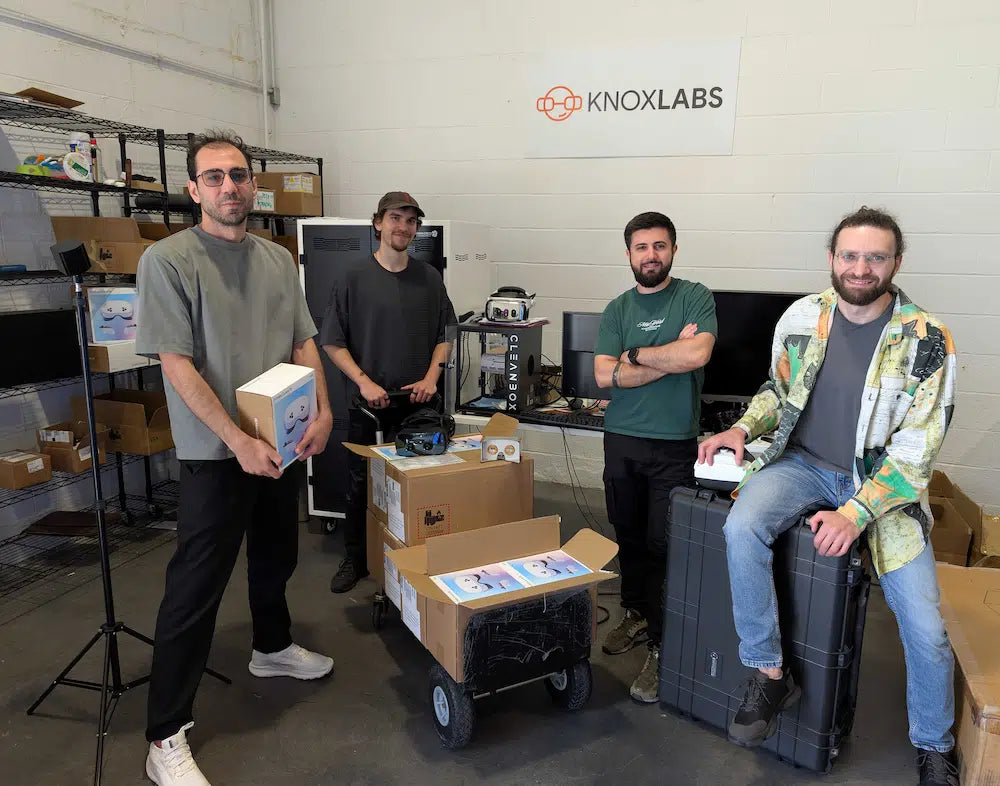
Knoxlabs was founded by Taron Khachatryan, a serial builder who had cycled through several early startups before Cardboard changed his plans in 2014. The team is small - somewhere around 11 to 15 people - and technical by design. The "scientist" framing is not just marketing polish; it is how a lean crew competes against bigger distributors: by actually knowing the difference between the headsets it sells.

06From cardboard to the next era of work
The most telling move is the newest one. In 2025 the company rebranded around "Hardware for the Next Era of Work" and started stocking robotics and wearables alongside the headsets. Read the room: robotics is arguably having its own Google Cardboard moment right now - cheap enough to be interesting, early enough to be confusing. Knoxlabs has already lived that movie once. It is betting the same playbook - be the trusted store, sell the whole stack, wrap it in expertise - works again on the next wave.
The catalog, briefly07What's on the shelf
The business model rides on two engines. One is straightforward hardware margin across that catalog. The other, higher-value engine is services - the provisioning, integration, training and support that turn a pallet of headsets into a working program. It is the difference between a store and a partner, and it is where a bootstrapped company earns the right to charge for judgment rather than just moving boxes.
The market08Where it fits in a crowded room
Knoxlabs sits in an interesting seam of the market. Above it are the manufacturers, each loyal only to its own hardware. Below it are the pure e-commerce sellers who move boxes on price and disappear once the tracking number lands. Knoxlabs plays the middle - broad enough to be brand-agnostic, deep enough to integrate and support what it sells. Early on its rivals were other cardboard-viewer makers; today the real alternatives are buying direct from a single manufacturer or wrangling a general IT integrator that treats headsets as an afterthought. Neither combines the catalog breadth and the XR-specific expertise in one shop.
There are limits to the model, and it is fair to name them. A reseller lives on other companies' roadmaps; if a manufacturer decides to sell direct to enterprise or squeezes margins, the middle gets thinner. The bet against that is depth of service - the harder Knoxlabs is to replace on integration, training and support, the less any single hardware relationship can dictate its fate. That is also why the robotics and wearables expansion matters: it widens the shelf before the current one commoditizes.
None of this makes Knoxlabs a household name, and that is rather the point. It is the kind of durable, unshowy business that outlasts the trend it was born from. The company that helped popularize a folded piece of cardboard is still standing a decade later - now quietly selling the machinery for whatever comes after the screen.