There is a particular kind of executive who arrives when the product works but the story does not. The technology has accumulated names, channels, permissions, edge cases and institutional habits. Customers understand pieces of it. Employees carry different maps. The job is to make the whole system legible without sanding away what makes it useful. Stephen Midgley has spent much of his career in that territory.
Today he is Chief Marketing Officer at MediaValet, the Vancouver company that organizes, governs and distributes the files on which modern brands run. Its category, digital asset management, is easy to mistake for a tidy cloud cupboard. Midgley’s public argument is that the cupboard metaphor has expired. Marketing now runs across a content supply chain: creation, approval, rights, discovery, distribution, reuse and measurement. Put AI into that chain and every hidden weakness gains speed.
His line is less a slogan than an operating warning: “AI tools don’t fail because of the AI. They fail because of the content foundation beneath them.” It is the sort of sentence that can only become fashionable after years of people learning the opposite lesson the expensive way.
A career in invisible machinery
Midgley’s public trail begins well before today’s software vocabulary. A 1999 Vancity annual report lists him as Director of Interactive Services, back when “interactive” carried the novelty that “AI” carries now. By 2010, he was leading marketing at Vancouver’s Absolute Software. The company made persistent technology for tracking, managing and protecting computers and their data. The product lived deep inside devices. The public questions were painfully visible.
When a Pennsylvania school district faced accusations that it had used management software to activate webcams on student laptops, Midgley became one of Absolute’s public voices. He separated professional theft recovery from do-it-yourself surveillance, saying customers should not take recovery into their own hands. Absolute moved to remove the webcam feature involved. This was marketing conducted beside policy, product design and trust, with little room for a breezy abstraction.
“We literally went to bed as Absolute Software and woke up as Absolute.”Stephen Midgley on the 2015 rebrand
Five years later, the challenge was architectural in a different way. Absolute Software was becoming Absolute in the market, while its Computrace product name was scheduled to recede. Field teams and customers tended to say Absolute. Parts of the channel said Computrace. The flagship name was competing with the company name, and both pointed backward toward device recovery while the strategy had shifted toward data and endpoint security.
Midgley helped explain the overhaul as a correction to the map. A word disappeared from the corporate name. A familiar product identity began a planned six-to-eight-month migration. Persistence technology, previously buried in product discussion, moved into the corporate story. The overnight switch made good copy, but the harder work was slow: teaching a network of customers, partners and employees to use the same language.
The shelf keeps the score
At Invafresh, where Midgley served publicly as Vice President of Marketing from at least 2022 through 2024, the machinery changed again. The software helped grocers forecast demand and manage fresh-food operations. A grocery shelf is an unforgiving interface: too little inventory loses the sale, too much erodes margin and can become waste. Inflation, supply disruption and labor shortages made every forecast more consequential.
Midgley spoke about the category at Groceryshop in Las Vegas and the 2023 IDDBA Expo in Anaheim. His pitch began with how operators behaved, not with an algorithm. Grocery companies had historically moved cautiously on technology, he observed, but pandemic-era omnichannel work changed their appetite. Automation became a practical answer to pressures that a people-heavy process could no longer absorb on its own.
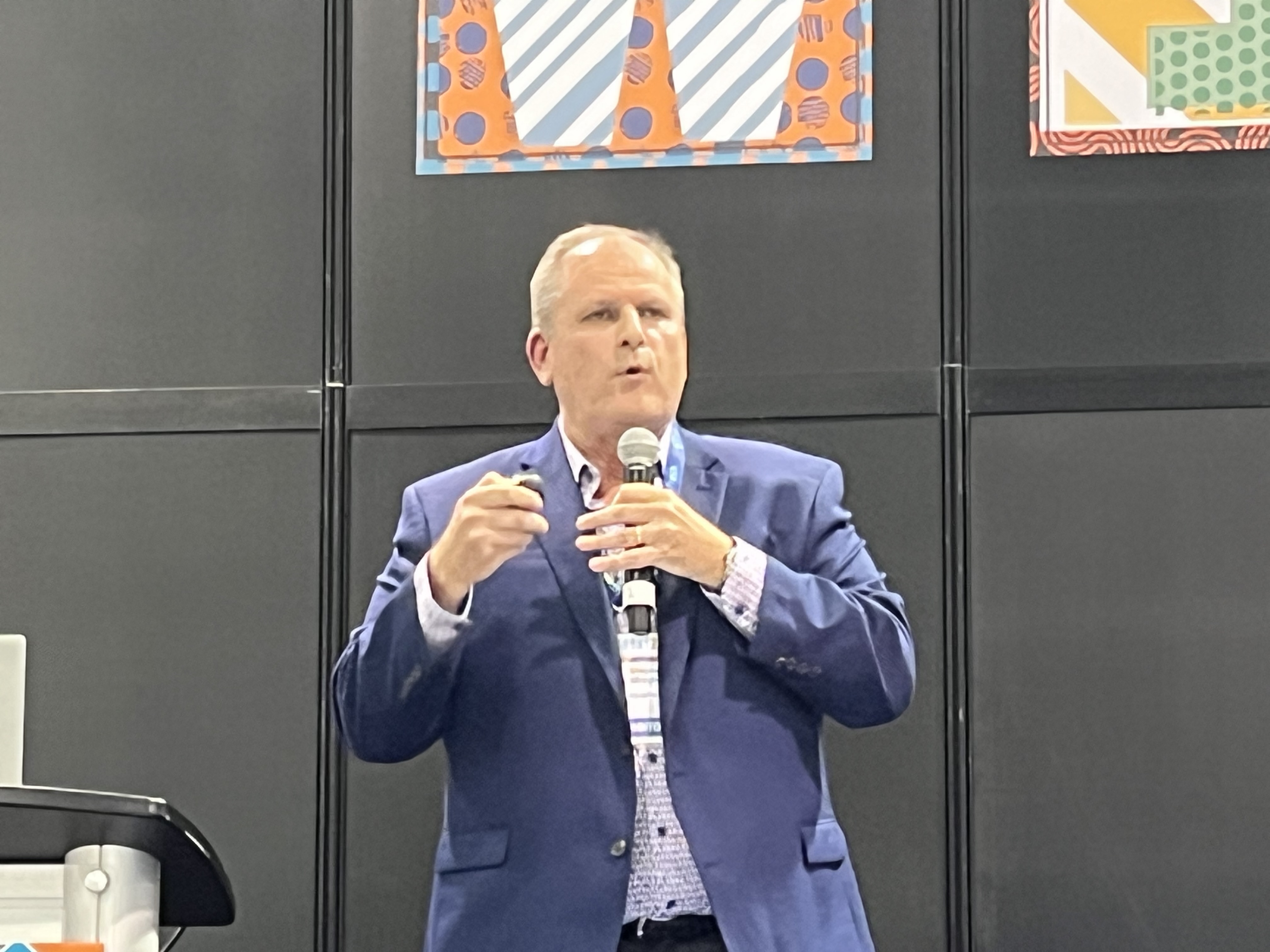
The language stayed close to the store. Visibility and control across the fresh perimeter could protect margin, offset labor constraints, improve sales and make the customer experience more personal. Sustainability belonged in the same calculation. Better data could reduce overstocking, and grocery overstock has a destination far less abstract than a cloud archive.
There is a useful marketing habit here. Start with the consequence. An enterprise feature becomes comprehensible when it changes how much food a manager prepares, whether a worker can find the approved file, or whether the police rather than a customer handle a stolen machine. Complexity remains, but it acquires stakes.
The three floors of marketing AI
Back at MediaValet, Midgley now applies that habit to the mess accumulating inside marketing departments. Generative tools made production cheap enough to expose a different scarcity. Teams can create. Their harder problem is controlling, governing and activating what they create across channels, markets and systems.
He divides AI in marketing into three layers. The categories are simple, but their dependencies are the point.
The content operations stack
AI services detect
Auto-tagging, rights detection and metadata enrichment turn files into structured material.
Assistants retrieve
People ask for approved assets, summaries or related work and receive usable context.
Agents act
Systems draft, route and move work across tools with less constant prompting.
Services detect and extract: an image enters, the system identifies objects, colors, text or rights information. Assistants help humans work: find every approved campaign asset from a particular quarter, or explain what a library contains. Agents complete workflows across systems: read a brief, draft material, route it for approval and prepare it for distribution.
The top floor attracts attention. The foundation decides whether it stays standing. An assistant cannot reliably find approved work when approval status lives in somebody’s memory. An agent cannot respect an expired license if rights data never followed the asset. Automation does not pause to admire organizational ambiguity. It carries that ambiguity forward.
Midgley’s emphasis on digital asset management is commercially aligned with the company he represents. It is also consistent with the problems he has been naming for years: competing labels, ungoverned access, data separated from decisions, technology disconnected from the way work actually happens. The category changes. The map remains the work.
“Marketing leaders aren’t struggling to create content. They’re struggling to control, govern, and activate it at scale.”Stephen Midgley, 2026
The coach’s diagram
One line in Midgley’s résumé offers a quieter view of his operating style. From September 2008 through March 2022, he volunteered as a head coach with Coquitlam Metro Ford Soccer Association. Thirteen years and seven months is long enough to outlast many product strategies, several technology cycles and a small mountain of wet cones.
Former colleagues describe a leader who sees the strategic picture, turns it into tactical projects and assembles teams with complementary strengths. Another recommendation from his Invafresh years emphasizes positivity, openness to ideas and a determination to make the work engaging. These accounts are not a personality test, but they sound like coaching: see the field, assign clear roles, leave room for invention, keep the group moving.
Interactive services at Vancity, when online channels were still the new layer.
Endpoint security at Absolute, where product, privacy and trust met in public.
Fresh-grocery software at Invafresh, tying automation to margins and waste.
Content infrastructure at MediaValet, with AI increasing the cost of disorder.
His current remit at MediaValet is broad: brand, growth, product marketing, communications, content and customer marketing. The list describes a department. It also describes a set of handoffs. A product claim becomes a campaign. A campaign becomes a collection of assets. Those assets gain permissions, versions and distribution paths. Customer experience depends on whether the handoffs keep their meaning.
That is why Midgley’s AI argument lands beyond the DAM category. Every company eager for an intelligent layer already has a content system, even if the system is a thicket of drives, inboxes, old links and private knowledge. The agent will inherit it. The assistant will search it. The model will scale what it can see.
The practical move is almost unfashionably sober: inspect the foundation before celebrating the acceleration. Decide which system owns the truth. Attach rights to the work. Make approvals visible. Preserve metadata as assets cross tools. Measure reuse rather than merely production. None of this has the theater of a prompt that generates a campaign in seconds. It has the quieter satisfaction of the right file arriving in the right place, current and cleared, when someone needs it.
Across Midgley’s career, that quiet moment has taken many forms: a recovery process handed to professionals, a company and its channel speaking one name, a grocer ordering closer to demand, a marketer finding approved work without opening four near-identical versions. The technology disappears into confidence. For an executive who has spent decades explaining invisible machinery, that is a practical story to keep telling.