The most valuable photo in sports often has a half-life measured in minutes. A photographer catches the celebration. The athlete wants it. The team wants a vertical crop. A sponsor wants its logo visible. A broadcaster wants a cleared clip. Everyone knows the asset exists, but it is marooned in somebody's camera, cloud folder, text thread, or digital asset manager while the audience moves on.
Greenfly built a business in that gap. The Santa Monica software company collects short-form photos and video from live creators, licensed libraries, cloud systems, fans, and staff. It uses metadata and computer vision to recognize subjects, then routes approved media into searchable galleries for the people allowed to use it. An athlete can open a phone, find the night's best shots, and post before leaving the locker room. A sponsor can receive branded inventory. A league can feed teams and broadcasters without asking an employee to play traffic cop for thousands of files.
That sounds like digital asset management, but at the speed and social complexity of sport. Greenfly's customers include major professional leagues, more than 500 teams, college athletic departments, networks, entertainment companies, and the constellation around them: athletes, photographers, social producers, communications staff, sponsors, and rights holders. The company says more than 45 leagues use its software. Publicly named clients include the NBA, NFL, MLB, NHL, NWSL, Big Ten, PGA TOUR, Bundesliga, Real Madrid, ESPN, Alabama, and BYU.
01 / The originThe first product asked for a clip. The market asked for a system.
Greenfly's origin is more charming than its eventual enterprise pitch. In baseball slang, to "greenfly" someone is to ask for a favor, usually an autograph. Co-founder Shawn Green, a two-time MLB All-Star who played 15 seasons, kept fielding requests about his career. He wondered why a broadcaster could not send an expert a prompt during a game and receive a phone-shot video response in time to air it. In 2014, he brought the idea to his cousin Daniel Kirschner, a lawyer and digital media executive whose résumé included the Justice Department, the FCC, and Activision Blizzard.
The first concept was a live request network: an on-field injury happens, a producer asks a doctor or former player for an informed reaction, and the expert sends back a usable clip. It worked as a job to be done, but it was too small a map of the territory. Brands, teams, and leagues needed to do more than request videos. They needed to send content back out to the people in their networks. Social platforms were turning every athlete into both a subject and a distribution channel.

The first thing that failed was not necessarily the technology. It was the frame. Investors heard the pitch and repeatedly sorted Greenfly into the influencer-marketplace bucket. Green has said that early confusion forced the company to rethink its positioning. Greenfly was not matching brands with famous people or brokering endorsement deals. It was coordination software for organizations that already had relationships, rights, and content - but lacked an efficient way to move media among them.
“We had trouble at first because investors kept thinking we were an influencer marketplace.”Shawn Green, Co-Founder and Chairman
Recurring SaaS revenue bought time for the explanation to improve. More important, customers changed the product. Greenfly began by delivering media one asset at a time. MLB needed to collect content from staff and photographers at every game and serve it to hundreds of players. A trickle had become a firehose. The team built galleries that could update continuously, with a personalized stream for each athlete. Integrations pulled files from the systems media departments already used. Automation replaced the repetitive work of identifying a player, tagging an image, checking access, and sending another link.
One moment, five operational jobs
02 / The productA camera roll with rules, memory, and a distribution engine
The current platform covers five connected jobs: create, collect, organize, distribute, and measure. Administrators can ingest files directly, connect cloud storage and media libraries, or ask creators to upload from an event. Greenfly +Engage collects user-generated content through branded pages or embedded widgets and records usage rights. Guided media briefs tell athletes or ambassadors what to shoot, with instructions and even a teleprompter. Private galleries then give each person or group the subset they should see.
The mobile app is the last mile. It can notify a player when new media arrives, preserve full-quality downloads, and pass an asset to social apps. That sounds pedestrian until the alternative is a rolling exchange of Dropbox links, WhatsApp messages, email attachments, Slack threads, and screenshots. Generic tools can move a file. They rarely know who appears in it, which sponsor matters, which rights apply, or which 700 athletes should receive separate feeds.
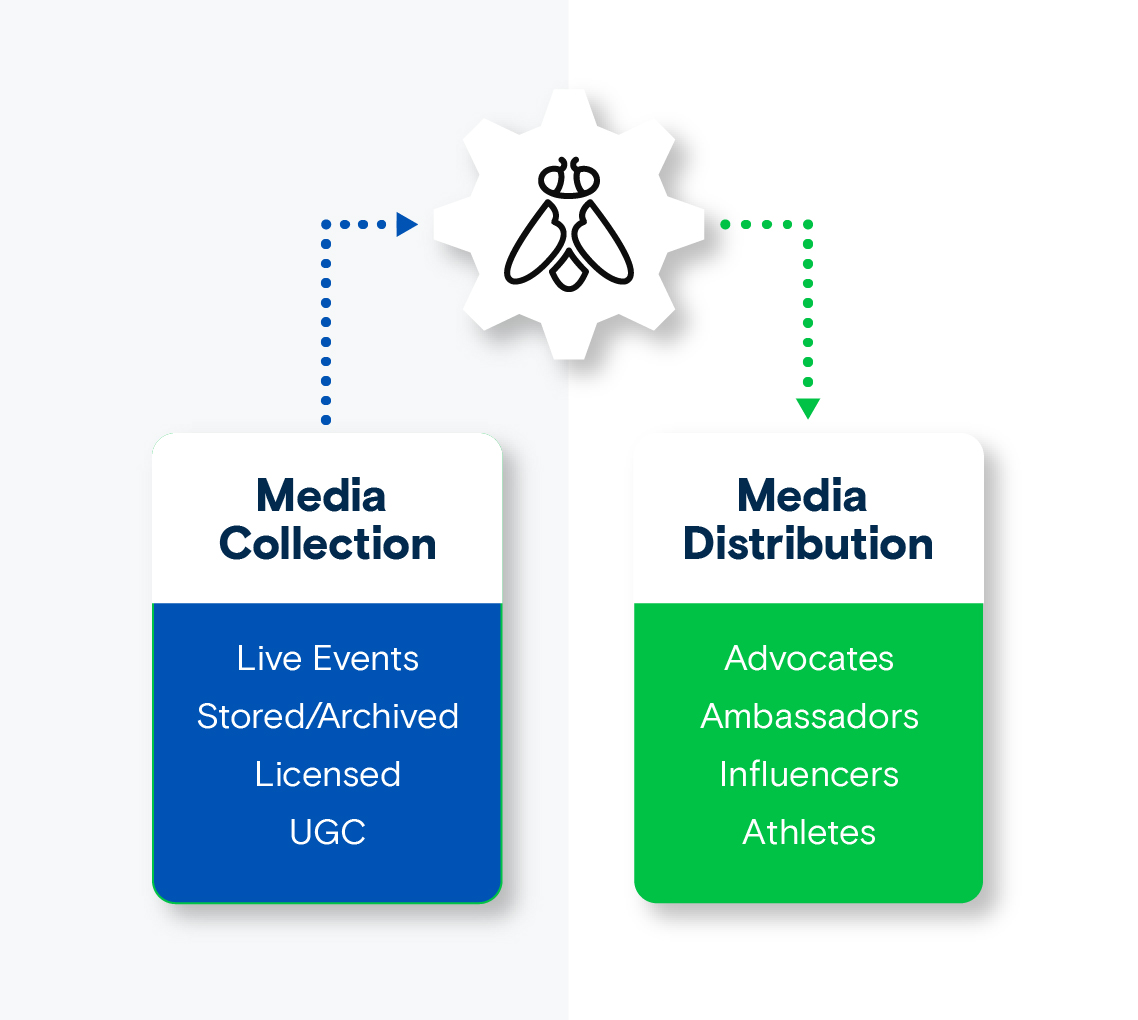
AI became more central after Greenfly acquired Miro AI in 2023, its first acquisition. Miro's computer vision and contextual sports analysis strengthened subject identification, automated curation, and search. The point is not to generate another synthetic highlight. It is to remove thousands of small classification decisions from a live operation. In Alabama's 2026 deployment, Greenfly described AI that identifies athletes across rosters, tags scenes as games happen, recognizes sponsor logos, and routes the result to athlete, creative, press, partner, and broadcast galleries.
Where the specialist earns its keep
03 / The moneyCustom-priced SaaS, sold against wasted labor and missed inventory
Greenfly sells enterprise subscriptions directly to organizations rather than consumers. It does not publish a standard price list. The company says all customers receive the platform's full power and that the base price does not cap assets, storage, bandwidth, or utilization. The pitch is financial but deliberately elastic: save the work of one or two people manually classifying and moving content; give sponsors more measurable exposure; improve broadcast promotion; and turn dormant short-form rights into packages that can be sold.
That positioning places Greenfly between several markets. Traditional digital asset managers such as Bynder, Brandfolder, Canto, and MediaValet emphasize libraries and governance. PhotoShelter handles visual media archives and is also a Greenfly integration partner. Opendorse and other athlete-marketing products focus on deals and NIL activity. General-purpose tools handle communication and storage. Greenfly's differentiation is the end-to-end, sports-specific sequence: live capture, high-volume ingestion, subject recognition, rights-aware access, personalized galleries, mobile delivery, social activation, and measurement.
The company raised $8.5 million in a 2018 Series B, followed by an $8.4 million strategic growth round in 2021 that included NBA star Chris Paul. Paul had used the product before becoming an investor. In 2024, ADvantage led $14 million in equity financing, joined by Ryan Sports Ventures, Mercato Partners, NBA Equity, and existing backers. The NBA relationship is unusually revealing: the league has used Greenfly since 2018, expanded to a global multi-year agreement, and invested through its equity arm.
“Greenfly simplifies digital media creation and distribution through a single platform and app.”Chris Paul, strategic investor and former power user
04 / The expansionThe athlete gallery has become college and entertainment infrastructure
Recent partnerships show where Greenfly is pushing next. Access by Getty Images, launched in January 2026, gives approved talent real-time access to licensed red-carpet and event photography. SportsPro began using Greenfly across its events. BYU rolled it out across 21 varsity programs and more than 760 student-athletes. Alabama followed with all 21 sports and more than 700 athletes, connecting creative requests, NIL obligations, sponsor work, press access, and gameday capture.
College sports is a logical expansion because NIL transformed the athlete's personal feed into both a recruiting asset and commercial inventory. The workflow resembles pro sports, but with larger rosters, more sports, thinner creative teams, and frequent turnover. Greenfly's pitch is that a department should not solve that multiplication problem by hiring more people to rename files. It should route the media automatically.
The company itself is remote-work friendly, with headquarters in Santa Monica and operations across the United States, Europe, and Asia. Its published values lean hard on collaboration, intuitive product design, customer service, and fandom. LinkedIn listed 91 employees in August 2026. That is small enough to make the scope of the customers notable and large enough to suggest that service and integration work matter alongside the code.
What builders can steal from Greenfly
- Start with a painful handoff you understand from the inside.
- Watch what customers do immediately before and after your feature. That surrounding workflow may be the larger product.
- When volume changes the job, redesign the interface. A firehose needs galleries and rules, not a faster inbox.
- Integrate with the systems customers already trust. Replacing every tool is usually a worse wedge than connecting them.
- Make the category legible. If investors and buyers keep calling you a marketplace, the problem may be positioning, not comprehension.
05 / The limitsThis works when urgency, volume, and rights collide
Greenfly is most compelling when media volume is high, time matters, many outsiders need controlled access, and the content carries rights or sponsor obligations. A league with hundreds of players and games produces exactly that combination. So does a college department with 21 sports, or an awards show juggling photographers, talent, publicists, and partners.
When the playbook does not travel
It is a poor fit for a small team with a few assets, no urgent distribution window, simple permissions, and little sponsor or rights complexity. In that setting, a shared drive and a chat thread may be cheaper and perfectly adequate. Automation only earns its keep when repetition and coordination costs are real.
The harder long-term question is whether Greenfly remains the specialist layer or gets squeezed by broad DAM vendors, media production suites, and league-built systems adding similar AI. Its defense is depth: years of integrations, athlete adoption, sports-specific workflows, and a network of customers that includes both users and strategic investors. The acquisition of Miro AI and partnership with Getty suggest it would rather deepen the operating system than become another generic content library.
The small insight inside Greenfly remains the useful one. Content is not scarce. Coordination is. The winner may not be the company that creates the clip, owns the camera, or publishes the post. It may be the one that knows, in the few hot minutes after a moment happens, exactly where the file should go.