A chocolate chip cookie is an excellent argument for buying chocolate chips. Warm, slightly undone, with chocolate threatening to escape its edges: the photograph practically writes the shopping list. At Ghirardelli, that sort of “taste” image had a natural place near the front of a product’s image carousel. A photograph of the wider product family usually came later. Then the company gave an algorithm a vote.
- Vizit predicts how product imagery will appeal to particular audiences.
- Ghirardelli reported an average 10% Amazon conversion lift from rearranging images.
- The practical starting point: test existing assets before paying for another shoot.
The family portrait moves forward
Vizit recommended moving some range photographs earlier. Ghirardelli changed the order and, according to its content operations manager Pam Perino, saw that average conversion improvement. The recommendations varied by product. A seemingly minor editorial decision became something the team could investigate rather than inherit.
There is a pleasing indignity here for anyone who has spent an afternoon debating a cookie photograph. The asset needing attention may already exist. The expensive part is sometimes the conviction that everything must be made again. Vizit sells software for finding those opportunities: scoring images, comparing alternatives, and helping ecommerce teams decide what deserves a better position.
Reported average Amazon conversion lift at Ghirardelli after image reordering.A customer-reported result, not a forecast for every catalog.
The burger that defeated the rulebook
Founder Jehan Hamedi arrived at this problem through consumer intelligence. Earlier work at his Adhark consultancy developed technology for modeling perception; Vizit followed in 2020. The company’s subject was familiar, but its ambition was unusual: make an image’s likely reception measurable before publishing it.
In a 2026 interview, Hamedi recalled trying basic rules first: count colors, measure empty space, recognize objects. These features could describe a photograph without explaining its appeal. Recognizing a cheeseburger does not tell you which photograph makes somebody hungry. The team moved toward custom models of an audience’s visual behavior.
He also described an early LIFEWTR assignment. Asked to evaluate bottle designs for active female shoppers, the model favored a dark, geometric option that seemed contrary to expectations. Hamedi says PepsiCo’s conventional consumer survey selected the same design. That agreement helped persuade him to trust the approach. The useful detail is the second measurement: a surprising prediction earned credibility by meeting evidence outside the model.

Who gets to judge the photograph?
Vizit’s Audience Lenses model the visual preferences of particular groups. In a Digital Shelf Institute interview, Hamedi described defining audiences through demographics, consumer characteristics, and markets. This matters because the brief “make it appealing” conceals a missing noun: appealing to whom?
His examples extended beyond groceries. Harley-Davidson used the technology in product-development decisions, including how design choices might resonate in other markets. The expertise is a combination of computer vision, audience modeling, and commercial research. The point is to give a creative decision a specified audience and a repeatable method of evaluation.
Mars Petcare offers a closer digital-shelf example. A Petfood Forum presentation described a 30% Amazon conversion improvement for one set of SKUs using Vizit. It also described differences in image preferences across countries. That makes localization a research question, with consequences for packaging and imagery, rather than merely a translation job.
A score inside the workflow
The customers are enterprise teams responsible for large amounts of content: ecommerce managers, designers, marketers, and insights specialists. Publicly named users include Mars, L’Oréal, Unilever, Colgate-Palmolive, and Ghirardelli. Their problem is partly organizational. An image can pass through several departments while nobody has a shared way to discuss whether it will help a shopper choose.
The Visual Brand Performance Platform supplies predictive scoring and benchmarking. Vizit’s current platform adds product-page diagnostics, category research, reporting, and Spark, an image-generation and optimization tool. A team can inspect a catalog, prioritize weak assets, investigate alternatives, and generate variants. The commercial attraction is the connection between evaluating content and doing something about it.
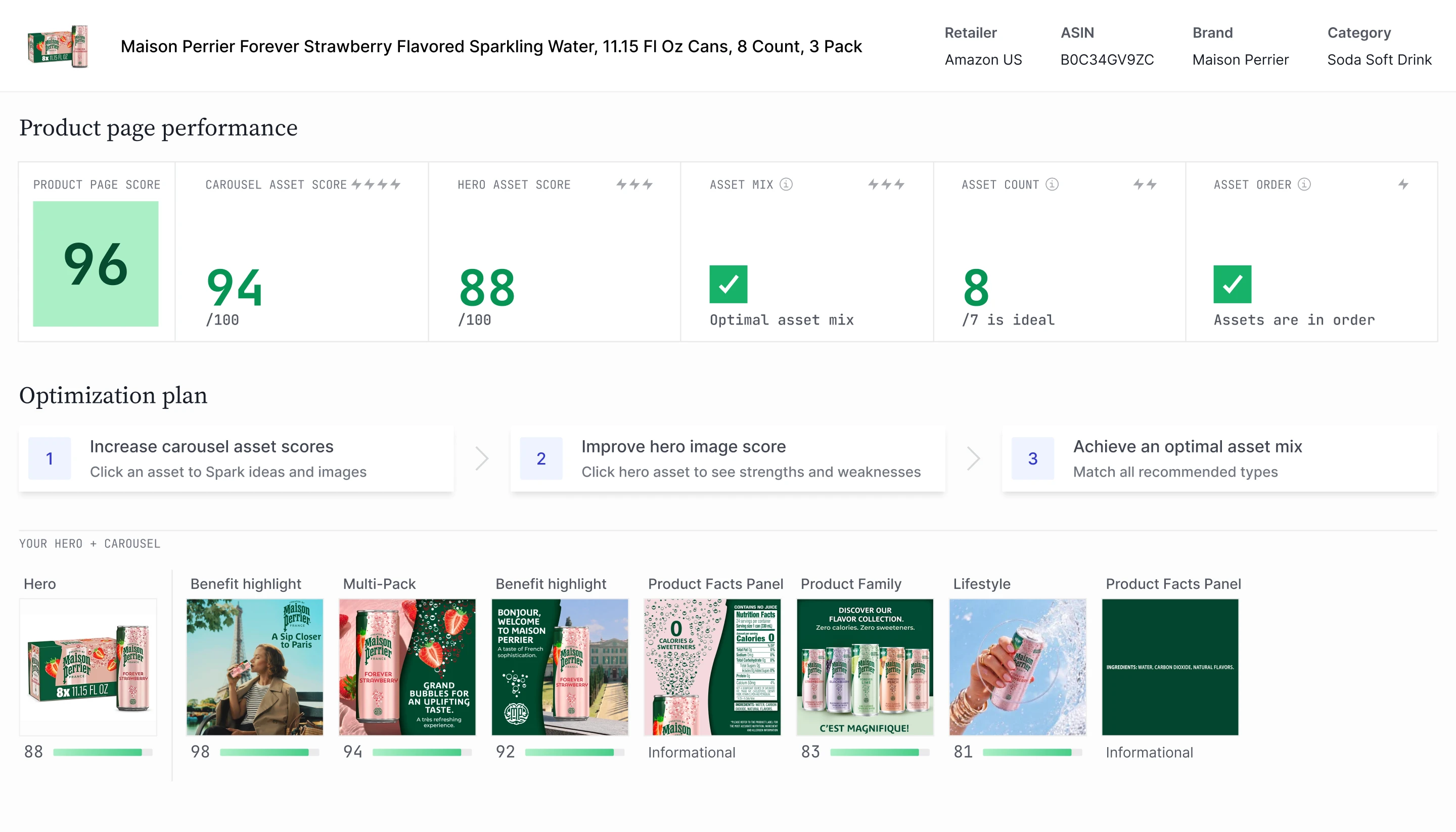
Distribution matters, too. Vizit’s Conversion Optimizer integrates with Salsify, the product-experience platform Ghirardelli already used. Consumer Goods Technology documented the brand applying visual analysis within its catalog workflow. An evaluation is more useful when the person receiving it can change the listing without beginning an expedition through another department’s software.
“We’re still using some traditional methods, but this is helping determine things quicker and faster.”Pam Perino, Ghirardelli · July 2024
Vizit sits in a market that includes predictive creative-testing tools such as Dragonfly AI and EyeQuant, alongside consumer research and live experiments. Its distinctive emphasis is audience-specific visual evaluation tied to ecommerce content. Competitors use different methods and sell overlapping promises. Buyers should compare the decision each tool helps them make, then test the outcome that matters to their business.
The capital behind the picture
Vizit’s business model is enterprise SaaS, with a demo-led sales process. The purchasing conversation should account for the subscription, integration work, and the people required to act on recommendations. A prettier dashboard has little economic value if nobody changes the pictures.
The capital supporting the company is more concrete. Infinity Ventures and Brand Foundry Ventures led its $10 million Series A in 2022. Industry Ventures led a $25 million Series B in October 2024. Those are financing amounts, distinct from customer spending or revenue. In 2025, Vizit announced an AI Breakthrough award for Overall Computer Vision Company of the Year.
Try the order before the reshoot
The transferable lesson is modest. Choose a product with meaningful traffic. Inventory its existing images. Question the inherited order. Use scoring to develop a hypothesis, then compare the revised listing against a control. Keep other major changes steady so the result can tell you something useful.
A high predicted score does not solve an unavailable product, an uncompetitive price, or poor delivery terms. Nor does one audience’s preference settle another’s. The software is most useful when a team can specify its market, change its content, and measure what happens. The delightful possibility is that the next improvement costs less production effort than expected. Sometimes the family portrait simply needs to move forward.