A goal goes in. The crowd has already decided what matters. Somewhere in the production chain, however, a person still has to find the footage, choose its beginning and end, crop it for a phone, add the right words and send it out. For that person, the exciting part of the match is the beginning of a queue.
VideoVerse built a business around that queue. Its best-known product, Magnifi, takes live or recorded video and helps turn it into short clips and highlights. The proposition is pleasantly unromantic: make useful footage available while people still care about it. In sports, yesterday’s astonishment has a habit of becoming today’s scrolling thumb.
- The job: detect moments, create clips, adapt formats and distribute them.
- The buyer: leagues, broadcasters, rights holders and streaming services with footage to publish.
- The difference: sport-aware automation fitted into a production workflow, with human review available.
- The twist: Minute Media bought VideoVerse in 2025. SI bought Magnifi in 2026.
The moment is over. The work is beginning.
Consider the difference between watching a match and publishing one. A viewer follows a single stream. A media team may need a match summary, a player-specific clip, a vertical social edit and a version for another language. Each output begins with the same footage. Each adds another task. The camera has done its work; the multiplication happens downstream.
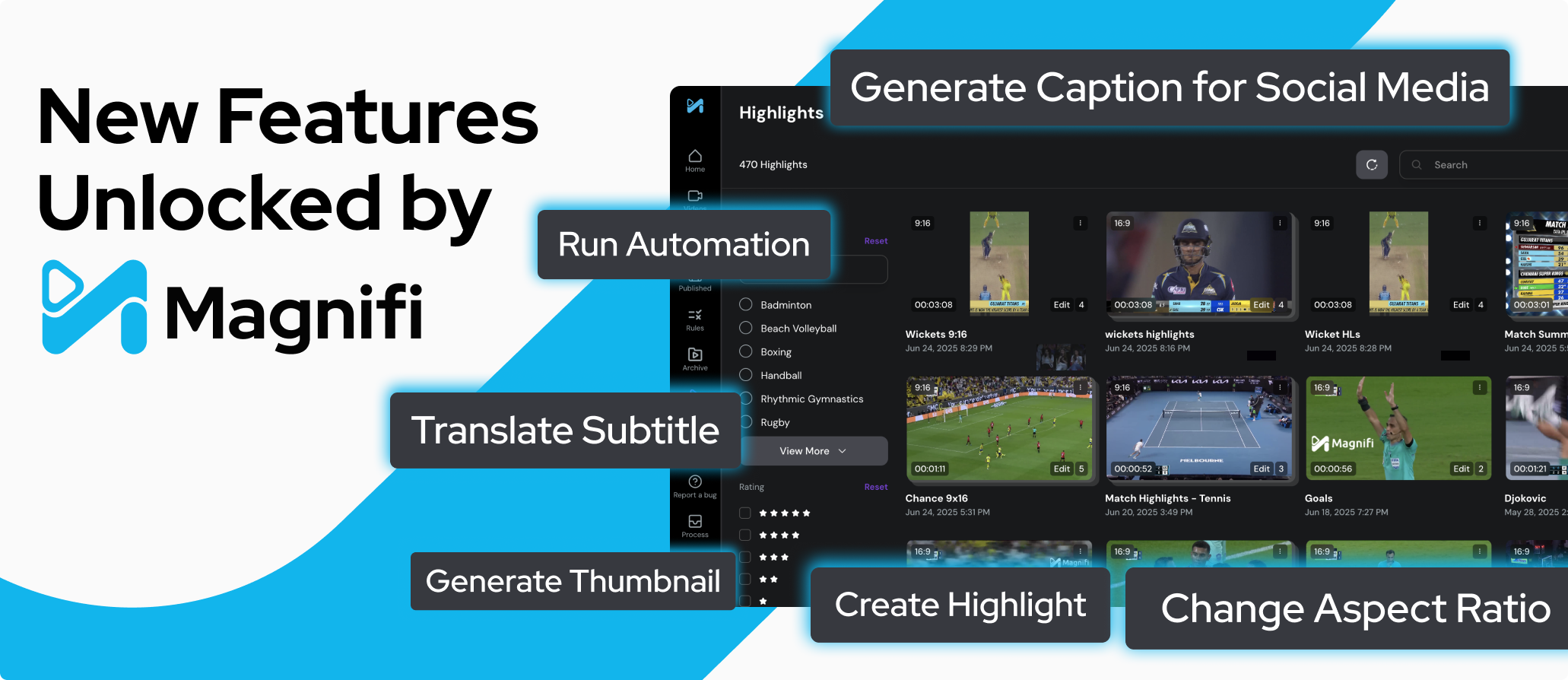
Magnifi’s approach is to put detection and packaging into the same workflow. Computer vision, language processing and machine learning analyze visual and audio signals to identify moments. Clips can be tagged, edited, resized and sent to digital channels. The user is buying a shorter route through production, rather than simply another place to move an edit point.
That distinction explains its place in the market. A general-purpose editor offers creative control over footage you have chosen. Magnifi helps with the earlier problem of choosing footage at scale, then carries it toward publication. Its value is easiest to understand when there are more matches, more destinations and more deadlines than an editing team can comfortably handle.
Bring a live stream or recorded file into the workflow. The footage is the raw material; the publishing rights still belong in the brief.
Conceptual workflow, not a measured speed comparison.Teach the machine what counts
A cricket boundary and an emotional television scene are both moments, but they require different definitions. Magnifi’s Digital Highlight Pro describes tagging footage against predefined parameters. That is the important bit: automation needs a brief. A highlight is a decision about relevance, dressed up as a video file.
The company also describes a human-in-the-loop approach. A person can review and adjust the result. There is room for that person because the scoreboard rarely tells the whole story. A disputed decision, a reaction from the bench or a sequence that explains a comeback may deserve attention even when it is inconvenient for a tidy event label.
Auto-Flip handles another part of the brief: the shape of the screen. A television image is usually wide; a social clip may need to stand upright. Magnifi offers multiple aspect ratios. Reframing sounds like housekeeping until the important player disappears outside the crop. Good automation has to preserve the thing the audience came to see.
The customer owns the clock
The named customers make the proposition concrete. VideoVerse publishes testimonials from Mountain West, FanCode and the ECHL. The hockey league’s account covers its 28 member teams during the 2024-25 season. Those are organizations with recurring footage and recurring reasons to publish, rather than occasional creators searching for an interesting effect.
The Danish League offers a useful glimpse of actual adoption. In a testimonial published by VideoVerse, business development head Esben Halding describes clips arriving during play and highlights being generated automatically. He reports that Magnifi-generated highlights became the official highlights for 11 of 12 matches in the round he described. It is a customer’s account of a particular outing, not a universal accuracy score.
“matches were ingested correctly, clips appeared on the fly”Esben Halding / Danish League
Customer testimonial published by VideoVerse
In February 2025, Formula E selected Magnifi for replay and social-content automation. The announced work included adding driver and circuit information and adapting aspect ratios. This is a useful example of the buying problem: the race generates the footage, but the media operation must make that footage intelligible and useful on several screens.
These examples point to a specific kind of expertise. VideoVerse’s attraction lies in connecting event recognition with the practicalities of an editorial desk. The user can spend less time looking for routine moments and more time deciding what those moments mean. That is an editorial opportunity, provided the saved time actually reaches the editor.
A wider menu, a narrower argument
VideoVerse began in 2016 with Vinayak Shrivastav, Saket Dandotia and Alok Patil. Earlier known as Toch.ai, it developed a broader family of video tools. In August 2022, it introduced illusto in beta: a cloud editor for individual creators, professionals and beginners, launched with a subscription proposition. Styck addressed live streaming. VideoVerse was testing several doors into the same building.
Its subsequent portfolio expanded in other directions. Reely.ai, acquired in April 2023, brought esports and gaming highlights. Magnifi’s product menu also includes sensitive-content detection and Google Web Stories. These share an underlying concern: once a video exists, how do you identify, adapt and reuse what is inside it?
The closest specialist alternative is WSC Sports, a competitor named in coverage of VideoVerse’s acquisition. Conventional editing remains another option. The distinction is partly about volume and repetition: how much material needs processing, how predictable the requested moments are and how many outputs each moment must become. No single tool wins every version of that problem.
The core business is enterprise SaaS, sold through demos, trials and partner channels. That suits a buyer with recurring footage and production demands. A sensible purchasing question is what the service costs for that buyer’s workload, and how much editing and support remain after automation.
Partnerships complicate the neat competitor chart. Magnifi lists an Adobe Premiere Pro extension and a relationship with Grabyo, whose live-production tools complement automated highlights. A customer need not abandon an existing edit suite to add detection upstream. Fitting into the room can be more useful than insisting on replacing all the furniture.
The money followed the workflow
VideoVerse’s financing reflects the effort required to build and sell that system. It raised $11.75 million in October 2021, followed by a $46.8 million Series B in April 2022 led by A91 Partners, Alpha Wave Global and Binny Bansal. The stated uses included hiring, technology, new products and expansion. Capital raised is a measure of backing, not a receipt for customer savings.
US dollars. The 2023 figure was reported by Sports Business Journal; Bluestone’s announcement did not disclose financial terms.
Bluestone Equity Partners announced a growth investment in December 2023, with founder Bobby Sharma joining the board. Sports Business Journal reported an approximate $45 million investment. The investor brought sports, media and entertainment connections as well as capital. For a software company selling into those industries, a useful introduction may have a rather respectable conversion rate.
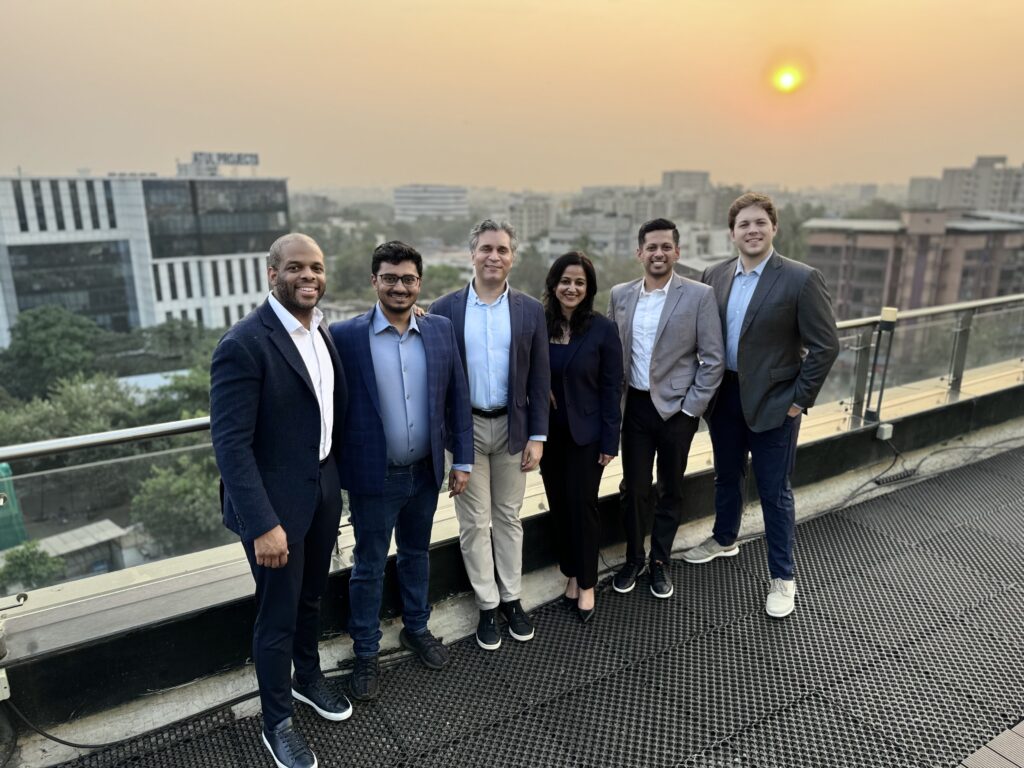
Minute Media acquired VideoVerse in September 2025. The buyer described a plan to connect creation with distribution and monetization, including its STN Video platform. The commercial logic is easy to follow: a clip needs an audience, and a rights holder needs a business outcome. Detecting the goal answers only the first question in that chain.
A second transaction followed in August 2026, when SI (Sportz Interactive) acquired Magnifi for its FanOS Media offering. Magnifi’s current website confirms the SI relationship. The distinction matters: the 2025 announcement concerned VideoVerse; the 2026 announcement concerned Magnifi. Reading them as identical transactions would erase a consequential chapter of the story.
Copy the deadline, then measure the queue
The transferable lesson is a useful inference from this history: find a repetitive task whose delay has an obvious consequence. VideoVerse’s sports focus makes the consequence visible. A clip published during a match serves a different purpose from one buried in a production backlog. Start with that customer problem, then choose the automation.
For a team evaluating a tool like Magnifi, a sensible trial would use its own footage and count the steps left afterward. Track useful clips, corrections, publishing time and the ability to produce each required format. An attractive output counter is poor consolation if somebody must quietly repair every caption before publication.
The economics also depend on volume, access to appropriate footage and working connections to publishing systems. A team with occasional bespoke films may get more value from a conventional editor. A rights holder processing repeated live events has a clearer case. Automation helps when the input, the required moments and the destination are understood; editorial judgment remains part of the cost.
VideoVerse’s most useful insight was to look past the sporting spectacle and notice the unfinished work behind it. There will always be another match. The business question is how much of the last one is still waiting to leave the desk.
Keep watching
Explore the products, the conversations and the next chapter.