The modern power-grid inspection begins in the sky and ends in a very ordinary place: somebody’s queue. A drone can photograph tens of thousands of poles, towers, insulators, crossarms and conductors without asking for lunch. Then those images land in front of engineers and line workers who may spend one or two minutes reviewing each frame. The aircraft has moved at machine speed. The analysis has returned to the pace of a careful pair of eyes.
Buzz Solutions exists because that mismatch got worse as drone programs got better. The Palo Alto company’s PowerAI software ingests visual data from drones, helicopters, fixed-wing aircraft, field cameras and existing CCTV. It matches imagery to grid structures, applies utility-specific computer-vision models, lets inspectors review the findings, prioritizes problems and sends the result into systems such as ArcGIS or a work-order platform. The pitch is not “replace the inspector.” It is “stop making the inspector stare at every normal bolt.”
The first idea did not survive customer discovery
Buzz’s origin is refreshingly specific. Vikhyat Chaudhry had used drones and predictive models around wind turbines in graduate research. He and Kaitlyn Albertoli met through Stanford’s Launchpad course in 2017 and started exploring turbine inspection as a business. Then they spoke with 35 power utilities. The interviews pointed to a more urgent and much larger problem: critical power infrastructure was aging, inspection imagery was multiplying, and the process of turning pictures into maintenance was painfully manual.
That changed their minds. The wind-turbine concept became a grid-inspection company. For the first two years, Buzz concentrated on accurate, retrainable algorithms that could fit into a utility’s existing systems. PowerAI entered the market in August 2019. Development and field tests occupied 2017 through 2019; pilots with prospective customers dominated 2020 through 2022; commercial sales began in 2023. In consumer software, six years can sound glacial. In electric utilities, it sounds like procurement, safety review, cybersecurity, evidence and trust.
“Image analysis is the Achilles heel of aerial programs. With PowerAI we can eliminate this bottleneck.”Patrick Rackley, AEP Texas
What the software actually does
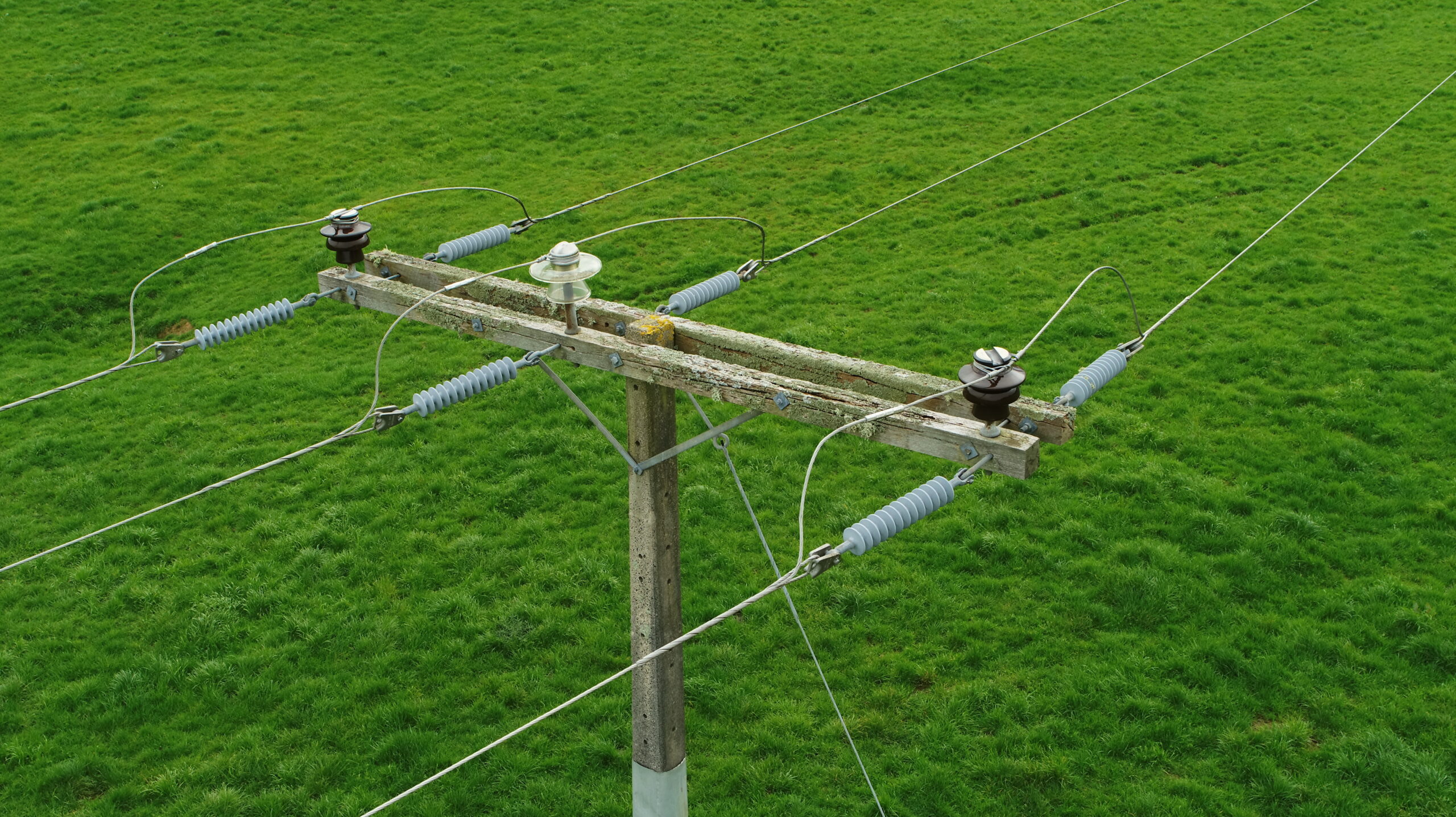
The product’s useful unit is not a bounding box around a damaged insulator. It is a maintenance-ready finding. PowerAI first manages a large visual dataset, then uses geospatial metadata or GIS records to associate images with the correct pole, tower, substation component or solar panel. Its models examine RGB and thermal imagery for defects and conditions: damaged hardware, corrosion, hot connections, vegetation encroachment, nests, transformer or bushing anomalies, solar hotspots and cracks. A human reviewer can accept, reject or refine the result. Priority findings can then move into reports, asset systems and work orders.
That full chain separates Buzz from a generic vision model and from a drone manufacturer. The company does not need to own the image-capture device. It works with whatever a utility already flies or installs, while its Skydio integration can pull data directly from the drone platform. Its Esri relationship puts findings inside the maps asset teams already know. New York Power Authority’s implementation connected with Esri, IBM Maximo and a media repository. In infrastructure software, the last mile is often the whole race.
The tempting demo
- Find a defect in one clean image
- Celebrate the accuracy score
- Export a spreadsheet
The utility product
- Organize millions of mixed images
- Map each result to the right asset
- Review, rank and route the repair
Customers buy time before they buy AI
Buzz sells to utility asset managers, inspection leaders, engineers, security teams and IT groups. Named customers and deployment partners include Dominion Energy, American Electric Power’s AEP Texas, the New York Power Authority, Southern California Edison, Ameren and the City of Troy, Alabama. The company also works with DRIFT Enterprise on Caribbean utility inspections and has tested through Electric Power Research Institute programs.
The case studies make the economics tangible. Dominion’s program covers 47,000 structures; Buzz reports processing 74,000 images in 3.5 hours and reducing analysis time by 70 percent. AEP Texas processed more than 88,000 images at 0.6 seconds per frame and says the work shaved six months from its inspection program. Troy, a city utility serving 7,800 customers, faced an estimated 1,118 hours of manual review each year across 33,538 images. Those are not abstract “productivity gains.” They are chunks of a skilled worker’s calendar returned to actual maintenance.
Pricing is enterprise and demo-led. PowerAI’s public packaging is more revealing than a sticker price: Standard organizes data and supports manual analysis; Essentials adds workflow automation, GIS and Skydio Cloud integration; Pro adds the full RGB and thermal AI library, advanced analytics and work- or asset-management connections. This stair-step design lets a utility fix its data plumbing before it asks a model to make consequential judgments.
The product expanded after the wedge held
Transmission and distribution were the beachhead. Substations added a different rhythm: continuous video instead of periodic aerial images. PowerGUARD, now folded into the broader PowerAI story, analyzes existing RGB and thermal camera feeds for intrusion, person-down, smoke, fire and equipment-condition events. An EPRI project with NYPA produced seven alert types without requiring new cameras. Southern California Edison has also used the system for substation security and condition monitoring.
Solar arrived next. PowerAI now scans drone-captured RGB and thermal images for hotspots, string outages, cracks and other signs of underperformance. An Ameren case study reports more than 75 percent time savings per site and estimates 20 to 40 percent lower outage-related operations and maintenance costs. Its published labor-saving estimate is $175,000 to $285,000 for analysis supporting 500 megawatts, based on the manual work required for a seven-megawatt site. The point is not that every solar farm will produce the same number. It is that the inspection bottleneck repeats wherever visual assets multiply.
The moat is a decade of unglamorous context
Competitors such as Norway’s eSmart Systems and Sweden’s Arkion also analyze utility imagery. Drone and robotics companies including Skydio, Zeitview and Percepto occupy adjacent territory. A utility can also build internally or continue manual review. Buzz’s argument is that its model library has been tuned on a decade of real utility imagery, can start with more than 50 pre-trained models, and arrives with the workflow pieces that turn detection into action.
That is a more defensible claim than simply saying “we use AI.” Grid components vary by geography, age, manufacturer, camera angle and weather. Defects can be nuanced. False confidence carries real cost. Buzz keeps a human in the loop and improves models with customer feedback. It also meets buyers where they are: imagery already collected, cameras already installed, maps already maintained. The company says users can process existing data on day one, tune accuracy over the first two weeks, and integrate results into operating workflows by the end of the first month.
“Utilities are generating more inspection data than ever before, but data alone doesn’t improve reliability.”Vikhyat Chaudhry, co-founder and CTO
What changed, what cost, what founders can copy
The first thing to break was the original market thesis. Thirty-five interviews showed the founders that power lines offered a larger problem than wind turbines. The second thing to break was the old inspection workflow: more cameras produced more data than manual review could comfortably absorb. Buzz did not respond by building another camera. It occupied the layer after collection, where images become decisions.
The cost was time. The company spent roughly two years building and testing before launching PowerAI, about three more in pilots, and only then moved into commercial sales. It financed that patience with early notes and venture rounds, a $5 million growth round in 2024, and a $20 million Series A led by S3 Ventures in August 2026. The latest capital is earmarked for product development, go-to-market hiring and deeper deployments. Its 2024 update reported 100 percent year-over-year revenue growth, a 50 percent increase in U.S. customers and a 40 percent larger team.
What can another founder steal? Interview enough customers to let the answer damage your first idea. Enter through a narrow, painful queue. Accept the customer’s existing hardware. Make human review a product feature. Integrate with the database where action already happens. And do not call a detection successful until someone can use it to schedule work.
Where the playbook stops working
Visual AI is a poor fit when imagery is blurry or inconsistent, asset IDs are unreliable, inspection volume is too low to repay automation, or nobody owns the handoff from finding to maintenance. It also cannot substitute for engineering judgment, physical inspection, cybersecurity controls or a crew able to make the repair. A model can shorten the queue. It cannot fix the grid by itself.
A sober bet on a very large machine
Buzz has taken the long enterprise route: specific industry, patient pilots, measurable deployments, then broader asset coverage. Its mission language reaches for wildfire prevention and grid resilience, but the day-to-day product is more modest and more useful. It sorts pictures. It finds suspicious details. It remembers which tower they belong to. It hands a human a shorter, better list.
That may be exactly what useful industrial AI looks like. Not an oracle. Not a robot lineman. A disciplined assistant standing between a camera and a maintenance crew, asking the grid’s most overworked eyeballs to look only where it matters.