Deep in the machinery of a modern office tower, something small is always going wrong. A valve sticks. A sensor drifts. An air-handling unit runs through the night for a floor that has gone home. None of these errors looks dramatic enough to make the evening news. Together, they become a fat utility bill, a warm meeting room, an impatient tenant and a chiller asked to retire before its time.
Buildings usually know more about these problems than their operators do. Their management systems stream temperatures, pressures, setpoints, meter readings and alarms. The trouble is translation. Different manufacturers name the same equipment differently. One portfolio can contain a thicket of old controls, new sensors, spreadsheets and contractor reports. An alarm is not a diagnosis, and a diagnosis is not a repair.
CIM, founded in Sydney in 2013, has built its business inside that gap. Its core product, PEAK, connects to existing building systems, cleans and normalises their data, applies fault-detection rules and machine learning, then gives property teams a workflow for acting on what it finds. The pitch is not that a building needs more data. It is that the building needs a short, intelligible list of what matters next.
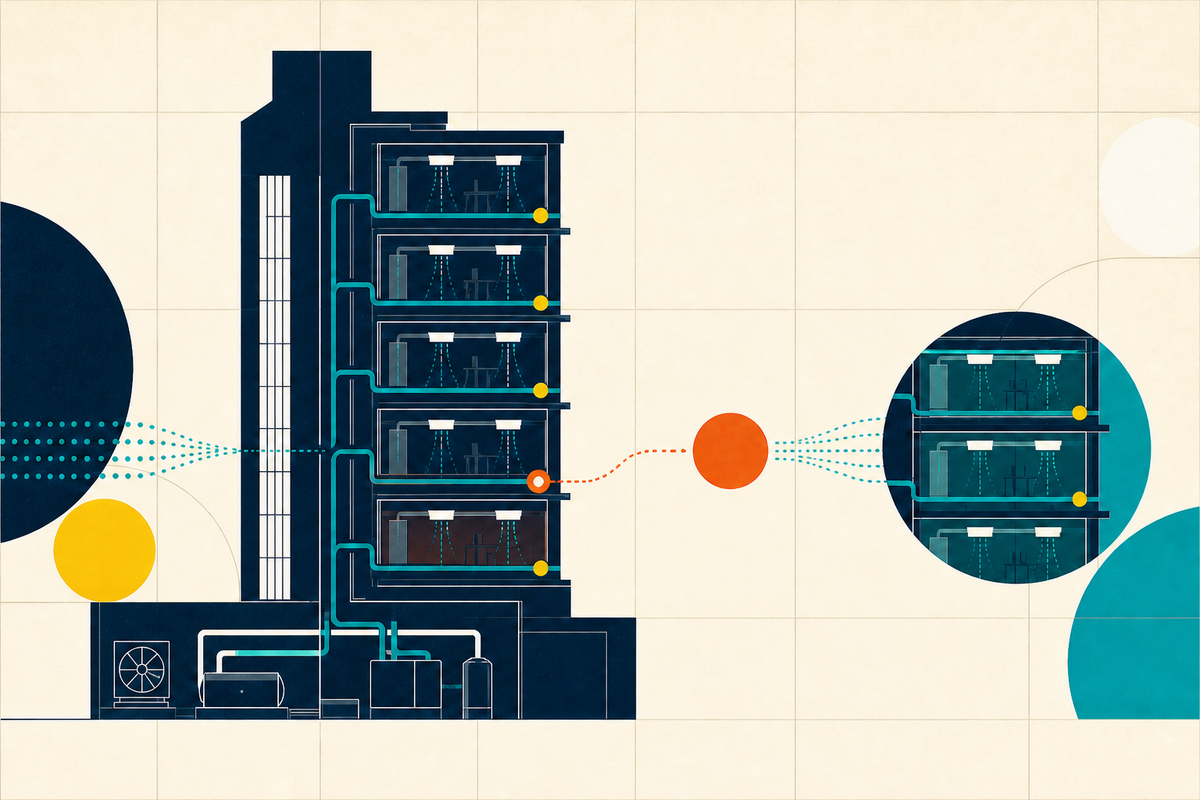
The black hole in the plant room
Founder David Walsh arrived in Australia from Ireland in 2009 after working with SAP, Intel and in property services. In commercial buildings he found what he later called a black hole: owners had granular energy and equipment data but little ability to find the root cause of waste. In 2013, he started CIM with a reported AU$1,300. The company now has teams in Sydney, Boulder, Dublin and London, and is led by Walsh and Co-CEO David Wright.
That origin explains PEAK’s unusually practical shape. It is part analytics layer, part engineering expert system and part work queue. CIM describes a four-part AI stack. Machine learning and language models help discover equipment and label BMS points. A rules engine applies thousands of fault templates. Workflow automation prioritises, assigns and follows up jobs. Predictive models convert the growing record into equipment-health and portfolio benchmarks.
Collect and normalise live equipment, utility and indoor-environment data.
Apply engineering rules to identify root causes and rank likely impact.
Give the right person a prescribed action, evidence and deadline.
Check the data after the work. Reopen the alert when the fix did not fix it.
The last step is the one to notice. Plenty of dashboards can show a red dot. PEAK tries to close the operational loop: detect, diagnose, direct and verify. If performance does not improve, an alert can reopen. That turns a stream of technical observations into an accountability system shared by facilities managers, contractors, asset managers and owners.
“Distilling a large number of data sources into the one platform has broken down various data silos and minimised data loss.”Ben McCluskey · Charter Hall
Software for buildings that already exist
CIM sits between two familiar categories. A building-management system controls equipment. A maintenance or work-order system organises people. PEAK does not replace either. It reads across BMS equipment, utility meters and indoor-environment sensors, explains the engineering consequence, and attaches the evidence to the work. Through Zapier and webhooks, selected alerts can reach Teams, Slack, Outlook or Google Drive.
The system is deliberately vendor-agnostic. CIM says it can connect to almost any commercial building without a wholesale BMS replacement or a new forest of sensors. That matters because most of the world’s 2050 building stock is already standing. Climate targets will not be met only by constructing perfect new towers. Existing properties must stop wasting energy on avoidable faults.
PEAK covers utility monitoring, equipment health, indoor-environment quality, NABERS and other sustainability tracking, automated fault detection, portfolio dashboards, digital workflows and capital-planning support. CIM adds dedicated engineers and optimisation services. That blend is a competitive choice: the software automates observation, while people help site teams decide which intervention is sensible.
The numbers live in the ordinary details
Charter Hall offers CIM’s clearest portfolio-scale example. The relationship began with two Sydney offices in 2017 and expanded to 58 properties covering 1.45 million square metres. Its published case study describes 13 data providers consolidated into one view, nearly 243,000 streaming points from more than 28,000 pieces of equipment, and 244 people using the platform. By the study date, teams had closed 2,978 actions at an 82 percent rate.
The examples are refreshingly mechanical. At a QIC shopping centre, equipment age suggested that five of six chillers should be replaced. PEAK’s performance analysis indicated that only one needed immediate replacement; altered control strategies reduced chilled-water consumption and allowed the other five to remain in service for an expected additional five years. This is data science expressed as machinery that does not have to be bought.
In a 2026 case study, an unnamed US energy provider deployed PEAK across five public schools with mixed legacy automation systems. The first site went live about two weeks after the purchase order, and all five were operating within 60 days. CIM reported 417 HVAC assets, 3,451 fault-detection rules and 157 million data points captured annually. Correcting issues such as overnight operation and faulty CO2 sensors contributed to a reported 29.5 percent energy reduction, with expansion planned toward 27 schools.
Who buys it, and why
CIM sells to organisations for which buildings are operating businesses, not backdrops: office and retail owners, asset managers, universities, airports, hotels, hospitals, life-sciences sites and manufacturing facilities. Facilities managers use PEAK to find and assign problems. Asset managers compare sites and challenge capital plans. Sustainability teams track energy and ratings. Contractors see the evidence behind a callout and, crucially, whether the repair worked.
The commercial model is enterprise subscription software, generally priced by the number of monitored data points. CIM says edge hardware, hosting, onboarding and training are included, with commissioning and optimisation available as additions. It also recruits engineering consultancies, retro-commissioning specialists and mechanical or BMS contractors as partners. They can use PEAK to turn a one-off audit into an ongoing monitoring service, creating recurring revenue while covering more floor area with the same engineering team.
That partner route is also CIM’s answer to international scale. In Australia, it can point to owners including Charter Hall, GPT, QIC, LaSalle and Centuria. Abroad, a partner already trusted by a school district or commercial owner can carry PEAK into the account. The platform supplies the repeatable first layer of analysis; local engineers retain the judgement and relationship.
A crowded market, with a narrow wedge
Building analytics is not an empty field. Global controls companies offer connected-building suites. Specialist fault-detection vendors analyse HVAC data. Maintenance platforms manage technicians and work orders. The fashionable vocabulary includes digital twins, autonomous controls and AI agents, sometimes all in the same brochure.
CIM’s wedge is narrower and more credible: use what is already installed, onboard it quickly, filter the alarm flood through engineering knowledge, and make the repair visible from first symptom to measured result. Its customer-success staff are qualified mechanical, electrical and mechatronic engineers, not merely software trainers. Users rated PEAK 4.7 out of five across 75 Capterra reviews as of mid-2026, with customer service its highest listed category.
“Scheduled maintenance is now a thing of the past as PEAK helps us determine precisely when and where maintenance is needed.”Damien Stacey · QIC
There are limits to the promise. Software cannot repair a valve, negotiate a contractor’s scope or make an old chiller young. Savings depend on teams completing the work, sensible baselines and the condition of each property. CIM’s own design acknowledges this: workflow, verification and engineering support are not decorations around the analytics. They are the mechanism by which a finding becomes money, comfort or avoided carbon.
Recent product releases lean further into that mechanism. Alert priorities distinguish a critical failure from a deferred item. A portfolio map shows where live faults sit. Reports track whether issues are being fixed, by whom and how quickly. Meter-gap filling protects energy reports when a device drops offline. Auto Cost Savings estimates the cost attached to an energy alert so a busy manager can choose the work with the clearest return.
The useful version of a smart building
Walsh began with an observation that remains uncomfortable: many sophisticated properties are data-rich and information-poor. CIM’s answer is not to make buildings appear futuristic. It is to make their existing systems legible, their faults ranked and their maintenance conversations harder to dodge.
The most persuasive CIM story is therefore not a glowing digital twin. It is a facilities manager arriving before a tenant complains. It is a contractor receiving the right evidence on the first call. It is five chillers staying in a plant room because their performance, rather than their birthdays, shaped the capital plan. The building already knew. PEAK’s business is making sure the people responsible know what to do next.