The first thing that failed at Xeal was not a cable, a breaker or a battery. It was the invisible chain between a charger and the internet. In 2019, co-founders Nikhil Bharadwaj and Alexander “Zander” Isaacson began selling commercial EV chargers. If a device lost its connection, or a remote server went dark, it could not process a payment. A driver standing beside a perfectly good source of electricity was effectively locked out.
The complaints arrived with impressive voltage. Isaacson later recalled customers sending messages wishing bankruptcy, and worse, on the young company. Many startups call this “feedback.” Most feedback does not threaten the life of the CEO. Yet it clarified the product brief: electricity was locally available, the customer was locally available, and the charger was locally available. Why should a server somewhere else have veto power?
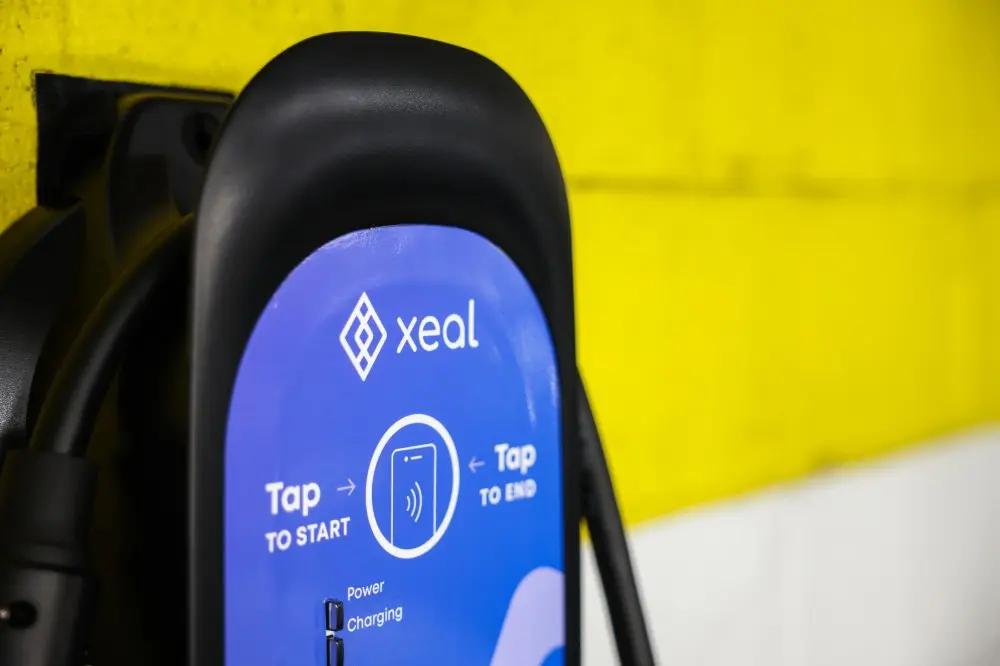
Xeal spent roughly two years rebuilding that moment. Its answer, introduced in 2021 as Apollo and now presented within the Xeal Protocol and Helix Computing platform, lets the driver’s phone and the charger authenticate a session locally. A time-limited cryptographic token moves from phone to charger. Session details move back. The records synchronize later, when connectivity returns. The cloud still matters for management and reporting. It simply no longer gets to strand the driver.
01The charger is only the visible part
Xeal is a New York climate-tech company wearing several uniforms at once. It sells Level 2 charging hardware. It supplies a driver app and a management dashboard. It handles access, saved-card payments, dynamic pricing, billing, utilization data and energy reporting. Its implementation group manages site planning, design, permitting and a nationwide installation network. Then support stays on call around the clock.
That bundle matters because commercial charging is not a gadget purchase. It is a construction project attached to a payment product attached to an amenity strategy. A landlord deciding where to put 40 plugs must consider trenching, panel capacity, parking rules, utility incentives, resident access and the awkward fact that concrete is very good at defeating radio signals. Xeal sells the whole headache, not merely the plastic object on the wall.
The buyer is usually a property owner or operator. The user is the resident, employee, student, hotel guest, shopper or fleet driver. That distinction shapes the product. Drivers want one tap and a charged car. Property managers want rate controls, permissions, revenue and a quiet inbox. Asset owners want an installation that does not become an obsolete monument beside the recycling bins.
“Residents do not evaluate whether a charger is installed. They evaluate whether it works.”Xeal, on the difference between an amenity and a nuisance
02The cloud loses its casting vote
Conventional smart charging can involve a phone, cellular or Wi-Fi service, a charger modem, a cloud network, a payment processor and the site’s electrical equipment. Every handoff is useful. Every handoff is also a place to say no. Xeal’s local token exchange removes several of those live dependencies from the instant a driver starts a session.
This is edge computing with a practical haircut. The system does not need a lecture about decentralization to be useful. It needs to start charging in level B3. Xeal says public-key encryption protects the data carried between app and charger, and that software and configuration updates can travel through the same asynchronous system. The chargers also support OCPP, the industry protocol intended to preserve interoperability with other management systems.
The guarantee needs careful reading. Xeal markets 100 percent uptime as long as power reaches the charger. Network independence removes a large class of failures, but no architecture can repeal damaged hardware, vehicle settings, tripped breakers or a utility outage. Xeal’s own support material tells drivers to check delayed-charging settings and notes that some faults require a breaker reset or site visit. The product claim is strongest when it is narrow: a bad signal alone should not stop the session.
03Why apartments beat the highway
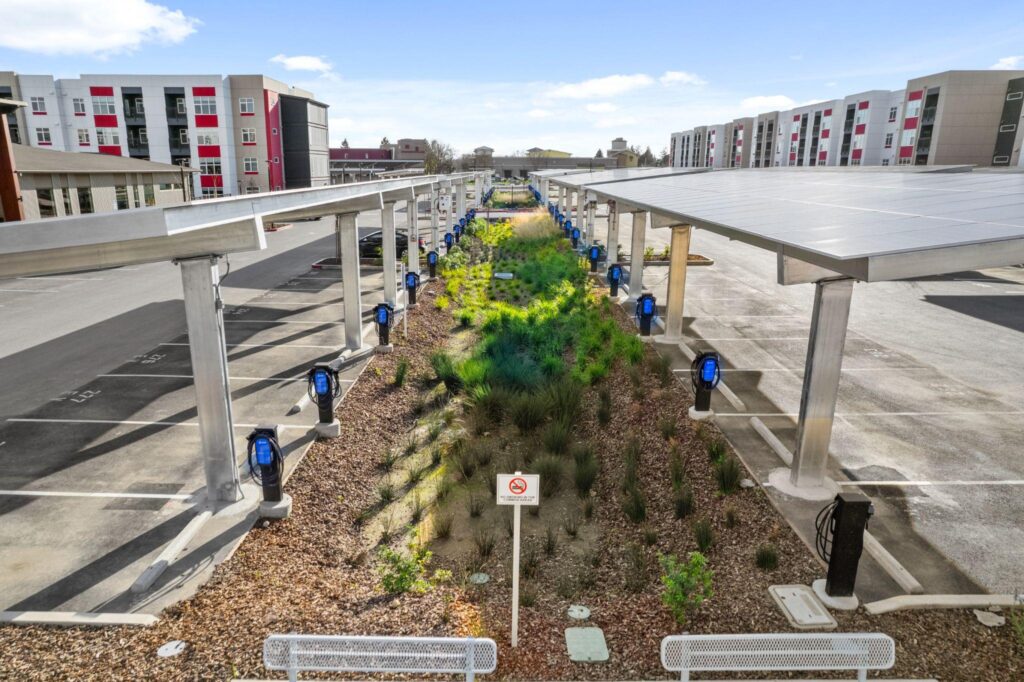
Xeal fits the “where cars sleep” side of the market. Highway plazas need expensive DC fast chargers that can add range during a coffee stop. Apartments, offices, hotels and campuses have something cheaper: time. A car sits for hours, so Level 2 equipment can deliver useful energy at lower power and cost. That makes Xeal a closer competitor to ChargePoint, Blink, SWTCH and Envoy than to a pure roadside fast-charging network.
Real estate also creates distribution leverage. One agreement can unlock an entire portfolio. The NRP Group announced more than 200 chargers in 2022. Harrison Street planned more than 300 across four states. In 2024, Valiant Residential expanded its relationship with Xeal tenfold; hundreds of stations went into central U.S. properties in about 90 days. Some locations saw roughly 200 unique drivers register within weeks. Demand stopped being a slide in a sales deck and became a line at the plugs.
The university market offered the same arithmetic. By 2024, Xeal had placed more than 500 chargers across ten campuses through development partners. In June 2026, the company said it worked with 300-plus partners in more than 500 U.S. cities, naming UBS, AvalonBay, Lincoln Property Company, Brookfield, Princeton, the University of Texas at Austin and Pfizer. Canada became its second national market that month.
04What it costs, and who gets paid
Xeal does not advertise a universal installation price, sensibly. A clean surface lot and an old underground garage are not the same product. The quote depends on charger count, available electrical service, cable runs, trenching, permitting and local incentives. Xeal argues that removing networking equipment, cellular plans and IT upgrades cuts both installation and maintenance expense. Its dynamic power optimization is designed to fit more plugs onto existing capacity, although a constrained building may still need an electrical upgrade.
The company makes money through a B2B package of hardware, implementation, software and ongoing services. Property owners can control who charges and what they pay, while charging revenue can be shared with the site host. For drivers, the displayed rate is set at the location and appears in the app near the charger. This is less like buying a vending machine and more like operating a tiny utility on private property.
The corporate rebuild had its own cost. A $3 million seed round preceded the protocol launch. An $11 million Series A arrived in October 2021, followed by a $40 million Series B in November 2022. Those publicly announced equity rounds total $54 million. ArcTern Ventures, Moderne Ventures, Keyframe Capital, Alpaca VC, WIND Ventures, Harrison Street and Lincoln Property’s venture arm were among the backers. Capital paid for engineering, deployment and the unglamorous operational machinery required to make a charger appear in a finished building.
05The playbook hiding in the garage
Xeal’s most reusable idea is not the token ledger. It is the sequence. The founders began with a broad promise, watched a specific dependency wreck it, and rebuilt around the customer’s worst environment. They then chose buyers who could distribute the fix across many locations and bundled enough services to prevent implementation from swallowing the value.
List every outside service that can block the customer’s critical action. Start with the least reliable one.
Test in the ugliest real environment, not beside a perfect router in the office.
Find a buyer whose single yes can become fifty installations, then make rollout repeatable.
If permitting and training can kill adoption, those are product features even when they do not ship in a box.
Use registration, utilization and revenue at early sites to earn the larger portfolio commitment.
Name the failure mode you remove. Precision earns more trust than pretending physics has retired.
The company’s culture carries the same bias toward practical input. Xeal says ideas can come from engineering, support or installation teams. That is sensible in infrastructure, where the person taking a midnight call may understand the product gap better than the person presenting the roadmap. Its founding phrase, “Stop climate change without bothering people,” is playful but also demanding. The clean option must become the uneventful option.

06Where the trick stops working
Xeal’s approach is not a universal charger recipe. It is a poor fit for highway stops where drivers need DC fast charging, or for short-dwell retail where speed dominates economics. A property that needs one free, unmanaged plug may not value a payment and portfolio layer. A site with abundant connectivity but inadequate electrical service still has an electrical problem. Offline authorization cannot create amperage.
Use the Xeal playbook when...
- The customer’s critical environment has predictably weak connectivity.
- Users stay parked long enough for Level 2 charging.
- One owner controls many spaces or properties.
- Access, billing, reporting and support matter after installation.
There is also a human constraint. A phone is part of the transaction, and apps can introduce their own friction. Public app-store reviews include complaints about setup, pricing visibility and session state. Those do not disprove the architecture, but they are a useful warning: removing three dependencies does not make the remaining interface irrelevant. Reliability is experienced end to end, from account creation to the moment the cable unlocks.
That makes Xeal more interesting than a tidy triumph story. Its early product failed loudly. The redesign removed a real class of failure. The business then followed the physical logic of its technology into garages, campuses and portfolios. Now, with Bharadwaj serving as CEO, recognition from Fast Company and Deloitte, and a new Canadian market, Xeal has to prove that a local transaction can support international scale.
The company’s contrarian bet remains clean and copyable: the internet is excellent infrastructure until it becomes a permission slip. In the moment an apartment resident needs enough power to drive to work, Xeal would rather let the charger make up its own mind.