The meeting room is taken. At least, that is what the calendar says. In a three-month study for a multinational coworking operator, Freespace found meeting-room booking at 89% and actual utilization at 49%. The diary was telling one story; the people in the building were telling another. For anyone paying to provide those rooms, the difference was a business problem hiding in plain sight.
Freespace, a British workplace technology company, makes that difference measurable. It combines occupancy sensors with analytics, booking software, hybrid scheduling and digital signage. Property teams can examine where people actually work. Employees can find a desk and see when colleagues plan to come in. Facilities managers can use the same underlying evidence to reconsider cleaning or building controls.
Its proposition starts with an awkward observation: having an office, assigning its desks and reserving its rooms does not tell you how much of it anyone uses. The interesting question is what happens once somebody counts.
The first thing to fail was the proxy
In that coworking project, ceiling-mounted thermal sensors supplied people counts while Freespace brought the operator’s reservation data into custom dashboards. The analysis separated booked-and-used rooms from no-shows and unbooked use. It also examined how closely the number of occupants matched room capacity. A room can be busy and still be much too big for its meeting.
The study identified unbooked presence averaging about 5% of the time in two example rooms. That gave the operator a potential charging issue as well as a design issue. Freespace recommended reconsidering room sizes and investigating missed reservations. The lesson is to measure the behavior behind a complaint before assuming the building needs more space.
For corporate real estate teams, that changes the brief. “We need more meeting rooms” becomes a set of answerable questions: which sizes, at what hours, and for how many people? A reservation system can capture intention. It needs another kind of evidence to describe attendance.
From counting workstations to running the working week
The company’s origins predate the pandemic arguments about office attendance. Workplace Fabric Limited, the legal entity behind Freespace, was incorporated in April 2011. An early company history describes occupancy measurement through thin-client agents for financial institutions. In 2015, Raj Krishnamurthy became CEO and redirected the business toward internet-connected sensors, associated software and analytics. Freespace’s current company page uses 2015 as its founding year.
That history helps explain the mix of expertise. Freespace has to deal with physical installation, sensor behavior, software integration and the decisions property teams make afterward. Its early deployment model emphasized preconfigured equipment that outside installers could put into offices with little disruption. Selling a measurement system across a global estate requires it to survive the mundane realities of buildings.

Today its product range reaches from physical presence to the planned working week. Hybrid Space Manager considers business rules, team relationships and individual preferences when allocating attendance and space. The practical objective is recognizable: get the right colleagues into the same office, with somewhere suitable to sit.
A bag on a desk is not a person
One revealing product choice concerns the colleague who claims a desk with a bag and disappears. Freespace says its sensors do not detect this “passive occupancy.” They measure people using a space. Desk-release rules can be configured around periods without detected occupancy, giving the customer a policy decision to make rather than treating every abandoned possession as attendance.
Its sensor range serves different layouts. Single-occupancy devices monitor desks or phone booths; multi-occupancy sensors cover rooms and shared areas. Ceiling height and obstructions affect the choice. The company also accepts existing sources such as badge, Wi-Fi and booking data, which offer different levels of detail.
Privacy needs the same specificity. Freespace describes its sensing as non-optical, using passive infrared or thermal technology without cameras that record identifiable images. That does not make the whole platform anonymous. Booking tools handle user information, and the company separately describes encryption, access controls and limits on that data’s use.
The employee gets a map, not a spreadsheet
A property dashboard is little consolation to an employee wandering around with a laptop. Freespace’s app handles reservations for desks, parking and lockers. Its My Circle feature helps colleagues coordinate attendance; My Teams supports managers arranging space for a group. Preferences can include the equipment or location a person wants at their desk.
Digital signage turns availability into something visible on the office floor. Freespace supplies the signage software, while the customer provides the display hardware. PAL indicators make individual workspace status visible through color. Microsoft’s app information directory also documents Freespace Portal inside Teams, placing office planning in software employees may already use.
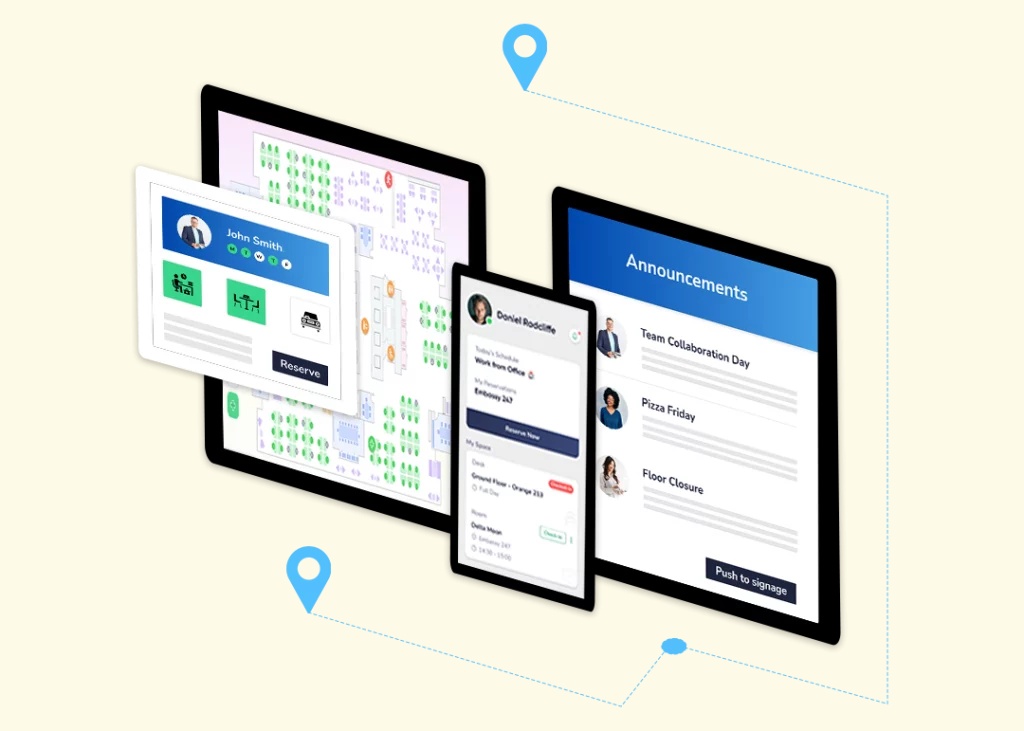
Those conveniences matter to adoption, and execution deserves scrutiny. Some public Google Play reviews describe slow loading, login problems and unreliable reservations. Individual reviews cannot establish how every deployment performs, but they identify useful pilot checks. Employees should test the actual booking journey before a procurement team treats a feature list as a finished experience.
Sage asked a better second question
At Sage Publishing, an initial occupancy benchmark found 40% utilization before a redesign. The publisher surveyed staff and changed the layout within the same 13,000-square-foot floor. NFS supplied room booking; Freespace installed sensors across more than 250 spaces.
Initially, the displays showed whether rooms were occupied. Sage then decided that showing how many people were inside was more useful. Global IT manager David Barnard praised the ability to change “what data is visible” without disruption. That is a small but instructive revision: occupied or vacant was too blunt a description for the question the team wanted answered.
An occupied room can still be the wrong-sized room.What the occupancy-count distinction means for office design
The reader can copy the sequence: establish a baseline, ask staff what they need, change the space and keep measuring. The sensor belongs in a design process that can respond to what it finds.
The money arrives at the lease decision
Freespace sells to organizations for which workplace decisions extend across buildings and countries. Its website names customers including AXA, WTW, Nasdaq, DLA Piper, Adobe and Mastercard. Its published cases also cover law firms, financial services, public-sector organizations and coworking. The buyer may be a property or facilities leader; the daily user is often someone who simply needs a seat.
Its largest advertised real estate result concerns an unnamed global insurance firm. Freespace reports more than $100 million in savings from optimizing over 65 offices covering 2.4 million square feet. The work combined occupancy evidence, booking and signage with redesign and consolidation. These are the company’s reported results from a particular engagement, not a savings forecast for the next buyer.
A separate brokerage case explains the timing: changes were pursued around lease breaks and divestment points. That is where evidence can become an actionable property decision. Discovering surplus capacity does not itself cancel a lease. The contract, the layout and the organization’s willingness to change determine what can happen next.
What the buyer actually buys
Freespace’s commercial model is modular: customers can buy separately priced products and combine them. Installation, integrations, analytics expertise and ongoing support sit alongside the software and sensors. Its partner program includes workplace consultants, property and facilities businesses, systems integrators and AV specialists, with referral and reseller arrangements.
One concrete historical cost appears in Transport for London’s procurement records: a January 2020 purchase order lists £8,636 for a Freespace extension through February 29. It is a narrowly described extension, not a current platform price or the cost of a complete rollout.
The current entry offer is easier to describe by scope. A three-month trial includes 50 single-occupancy sensors, 10 multi-occupancy sensors, analytics and insight reviews. Equipment, software and reporting are included; a one-time setup fee applies. The buyer keeps the reports with no obligation to continue. It provides a defined opportunity to test both the data and the decisions it would support.
The next customer is the building itself
In early 2024, a public-sector customer asked Freespace to connect occupancy and air-quality readings to its building management system. Working with a building automation partner, the company used those signals to moderate ventilation, heating and cooling. It reports a further monthly energy reduction of more than 25% beyond an already optimized operation, and a 50% overall reduction.
Those two percentages describe different baselines and should not be added together. The broader practical point is the connection between measurement and control. This use requires compatible building systems and attention to comfort, including feedback from occupants. An occupancy dashboard alone cannot turn down a ventilation system.
Security has become part of the enterprise proposition, too. On August 20, 2026, Freespace announced ISO/IEC 27001:2022 certification, with a certificate issued July 14. Its stated scope includes product delivery, cloud infrastructure, internal IT, software development and customer support.
The office still needs somebody to decide
Freespace competes in a market where sensing, analytics and workplace management increasingly overlap. XY Sense and VergeSense offer occupancy intelligence; OfficeSpace and Kadence address booking and workplace planning. Freespace’s pitch is the breadth of its connected products and deployment service. Buyers should compare the specific combination their buildings require.
Its own careers page offers a modest glimpse of the organization behind that service: global all-hands meetings, mentoring and employee groups called Natures Crew, Career Crafters and the Culture Committee. The emphasis is on participation and learning, according to the employer’s account.
The appeal of the business ultimately comes back to an ordinary office frustration. A room looks unavailable. A team cannot sit together. Another floor seems necessary. Freespace can put evidence in front of those assumptions. Someone still has to change the reservation rule, the floor plan or the lease. At least the empty room gets a vote.