Reading the Room - Literally
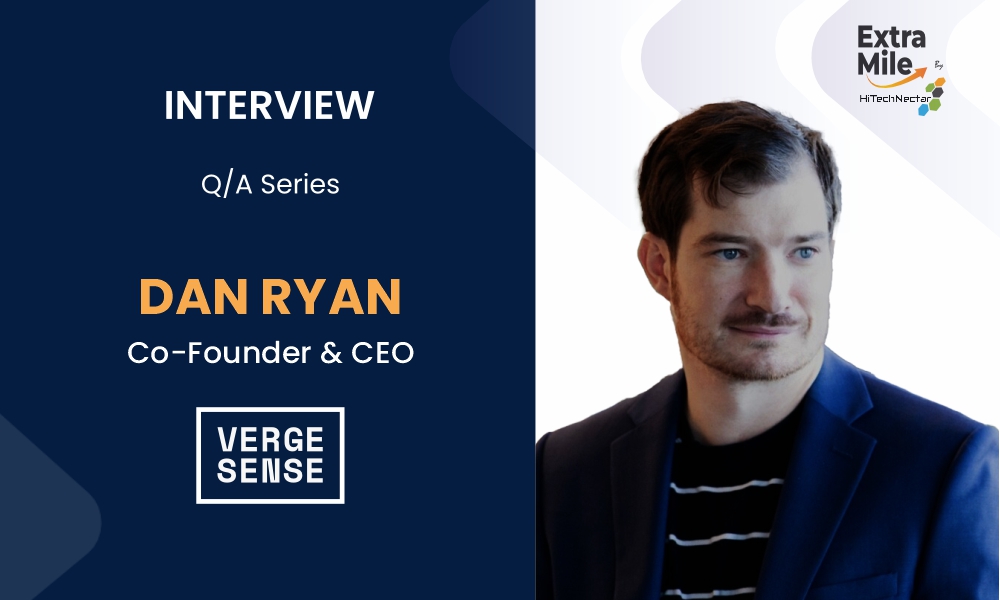
There's a conference room somewhere right now - booked for 2pm, reserved for twelve people, completely empty. Someone set a recurring calendar invite, forgot to cancel, and a chunk of real estate worth $18,000 a year is hosting no one. Dan Ryan built a company around that specific kind of waste.
VergeSense is the occupancy intelligence platform that tells you - in real time, without cameras, without tracking individuals - exactly how your offices are being used. It monitors more than 140 million square feet across 50+ countries. Its sensors see anonymous bodies in space, not faces. Its software translates that data into decisions: consolidate floors, renegotiate leases, redesign neighborhoods, justify a $60 million reduction in headquarters footprint.
"The price of real estate being $60/ft a year - if you've got a 300sq ft conference room, that's an $18,000 a year asset. Every empty conference room is a very expensive ghost."
- Dan Ryan, CEO, VergeSenseRyan didn't arrive here by accident. He's a Boston University electrical engineer who spent his early career at Bloomberg writing financial software, then co-founded ByteLight in 2011. ByteLight used LED lighting to create indoor positioning systems - a GPS for inside buildings, navigating stores and airports using light pulses invisible to the human eye. Fast Company named it one of the world's most innovative companies in 2014. Acuity Brands acquired it in 2015.
After the acquisition, Ryan stayed on at Acuity to build their entire IoT division - Atrius - from scratch. Then, in 2017, he left to start again. VergeSense launched through Y Combinator in May 2017, co-founded with Kelby Green who serves as CTO. The thesis was straightforward and enormous: enterprises had no reliable data on how their offices were actually being used. They were making billion-dollar real estate decisions based on gut feel, head counts, and calendar booking data that bore no resemblance to physical reality.
The average office space sits at 40% utilization. Companies pay for 100% of it.
The early product was simple - sensors that detect presence, software that visualizes patterns. But the category Ryan was building was something more ambitious: a data layer for the physical workplace. JLL Spark led a $1.5 million round in 2018. A $9 million Series A followed in 2020. Then a $12 million Series B from Tola Capital. Then, in November 2021, Scale Venture Partners led a $60 million Series C - bringing total funding to $82.6 million. The pandemic had turbocharged everything. Companies couldn't return to offices without understanding their offices first.
Ryan's timing was precise. Hybrid work - which he'll tell you was already happening before COVID simply accelerated it - made occupancy data a boardroom-level concern. When a company doesn't know which days people are coming in, which floors are full, which neighborhoods are dead zones, it can't design a space that functions. VergeSense became the instrument for that design work. Shell, Cisco, Roche, Quicken Loans, Telus. The customer list reads like a cross-section of global enterprise real estate.
One client, Fresenius Medical Care, used VergeSense data to consolidate their headquarters and generated $60 million in savings over a decade. Another consulting firm cut $50,000 per month in real estate costs. A financial services firm saved $2 million annually through workplace automation triggered by occupancy data. These aren't projections - they're outcomes Ryan regularly cites to illustrate why this data layer is infrastructure, not software.
"The true power of occupancy intelligence is about more than just data and analytics from sensors - it's about the decisions you can make with that information."
- Dan Ryan, September 2024Privacy as Architecture, Not Policy
One consistent thread through Ryan's decade-and-a-half in physical sensing: he builds privacy into the hardware, not the privacy policy. ByteLight tracked location via light pulses, not cellular data. VergeSense sensors count people without identifying them. "We're not getting any personally identifiable information about anybody. It's all anonymous counts," Ryan has said. In an era when the word "sensor" sets off every employee's antenna, this isn't just ethical design - it's a sales argument. Enterprise procurement for workplace technology requires compliance, legal review, and HR sign-off. VergeSense was built to pass all three with a clean conscience.
Hardware for the Long Game
In March 2025, VergeSense unveiled the Infinity Area Sensor - a sensor with a 10-year battery life covering 1,000 square feet wirelessly, with a carbon footprint 25 times lower than previous generations. No wiring. No electricians. Drop it in a ceiling tile and come back in a decade. For enterprise real estate teams managing hundreds of locations, this is the difference between a pilot and a global rollout.
The product roadmap reflects Ryan's belief that occupancy data should be the foundation layer of every physical workplace decision. Meridian, VergeSense's AI-powered predictive planning tool, uses occupancy patterns to model future space needs. The Workplace Assistant launched in 2024 as an AI-powered analytics interface. Breakpoint Analyzer, released in beta in June 2025, identifies floor plan inefficiencies before a single desk gets moved. And in January 2026, VergeSense announced the Large Spatial Model (LSM) - an AI foundational model for predicting workplace utilization, the physical world's answer to a large language model.
"The rise of hybrid work fundamentally changed the way organizations need to think about their spaces."
- Dan Ryan, VergeSenseThe Founder's Throughline
What connects LED positioning systems in 2011 to AI occupancy sensors in 2026 is a single obsession: the gap between how physical spaces are designed and how people actually inhabit them. Buildings are expensive, fixed, and profoundly misunderstood by the organizations that occupy them. Ryan keeps building instruments to close that gap.
He runs VergeSense from the Miami-Fort Lauderdale area - a geographic embodiment of the hybrid work model his company was built to enable. Mountain View headquarters, distributed team, data-driven decisions about where and how to work. The circular logic is intentional. Ryan isn't just selling occupancy intelligence to enterprises. He's living the thesis.
"An entrepreneur with a passion for disrupting the intersection of the physical and digital worlds" - Ryan's own framing. After two startups, one acquisition, $82 million raised, and a customer base spanning five continents, the disruption seems to be working.