The modern office contains a small absurdity. Companies pay for every square foot, every day, while employees arrive on an irregular schedule and still manage to collide over the good conference room. A facilities manager may know the Tuesday crowd by instinct, but instinct does not survive a budget meeting. The chief financial officer wants a number. The employee wants a desk near the people worth commuting for. The real-estate team wants to know whether Floor 14 is essential or merely expensive.
OfficeSpace Software sits in the middle of that argument. Its platform turns floor plans into live interfaces where people reserve desks and rooms, find colleagues, welcome visitors, request repairs and track equipment. Behind that friendly map is the more consequential machinery: bookings, badge swipes, Wi-Fi signals, sensors, moves, assets and utilization reports. The promise is less “book a chair” than “stop managing a multimillion-dollar physical operation by anecdote.”
Origin story / The spreadsheet on fire
A move too complicated for the tools
The company began in 2006, before “hybrid work” became a permanent panel-discussion topic. Childhood friends Shamim Sahba and Ashkon Sabet were a design-and-engineering pair known for making complex enterprise processes easier to use. A group of space and occupancy planners at a Fortune 100 telecommunications company had a nasty assignment: coordinate a multi-city move involving thousands of employees. Their choices were pen and paper, spreadsheets, PowerPoint and specialized systems so cumbersome that using them could require certification.
Sahba and Sabet built the simpler tool. That first job supplied an unusually good wedge. Moving people through buildings touches floor plans, headcount, departments, equipment and timing. Solve it well and the adjacent problems introduce themselves. The floor plan becomes a directory. The directory becomes a booking interface. Booking activity becomes utilization data. Utilization data becomes evidence for a lease or renovation decision.
“It’s a slam dunk. More standardization and a platform that’s much easier to manage.”Medtronic client quote published by OfficeSpace
The company’s timing could have been terrible. Software for offices met a pandemic that emptied offices. Yet the office did not vanish; it became unpredictable. Assigned seating gave way to hoteling, attendance shifted by day, and “who is in?” became a product requirement. OfficeSpace changed with the problem. The static map widened into workplace management: desks, rooms, neighborhoods, visitors, wayfinding, service requests, communications and mobile access.
The OfficeSpace loop
The product is a loop, not a menu
A feature list makes OfficeSpace sound like a busy hardware store. There is desk booking, room booking, Visual Directory, move management, visitor management, facility tickets, workplace announcements, preventive maintenance, portfolio reports and integrations with Microsoft, Google, Slack and Zoom. Its Essentials Plus and Pro Plus plans are sold by quote, with asset-management plans alongside them. Public list pricing is not posted. This is enterprise SaaS, sold to organizations whose deployment may involve identity systems, calendars, badges, Wi-Fi, sensors and several internal owners.
The loop is the differentiator. An employee books a desk in Teams. A badge or sensor confirms that the desk was used. A facilities leader sees the pattern across a floor. A planner tests a new team layout. An executive receives a portfolio view rather than another spreadsheet. Point products can perform pieces of this chain, and legacy integrated workplace management systems can cover much of it. OfficeSpace’s position is that the chain should feel coherent and usable, with a typical desk-booking implementation it says takes 35 days.
That story explains who buys. Facilities and workplace-experience teams handle the daily operation. Corporate real estate cares about the portfolio. IT connects identity, calendars and presence data. HR has a stake in policy and employee experience. Everyone else sees the approachable surface: where should I sit, who else will be there, and is a room free? OfficeSpace says more than 2,000 teams use the platform globally. Public customer names include OpenAI, HubSpot, DocuSign, Asana, Medtronic, SiriusXM, Earthjustice, PacificSource and HUB International.
The 74-day test
What the AI story gets right
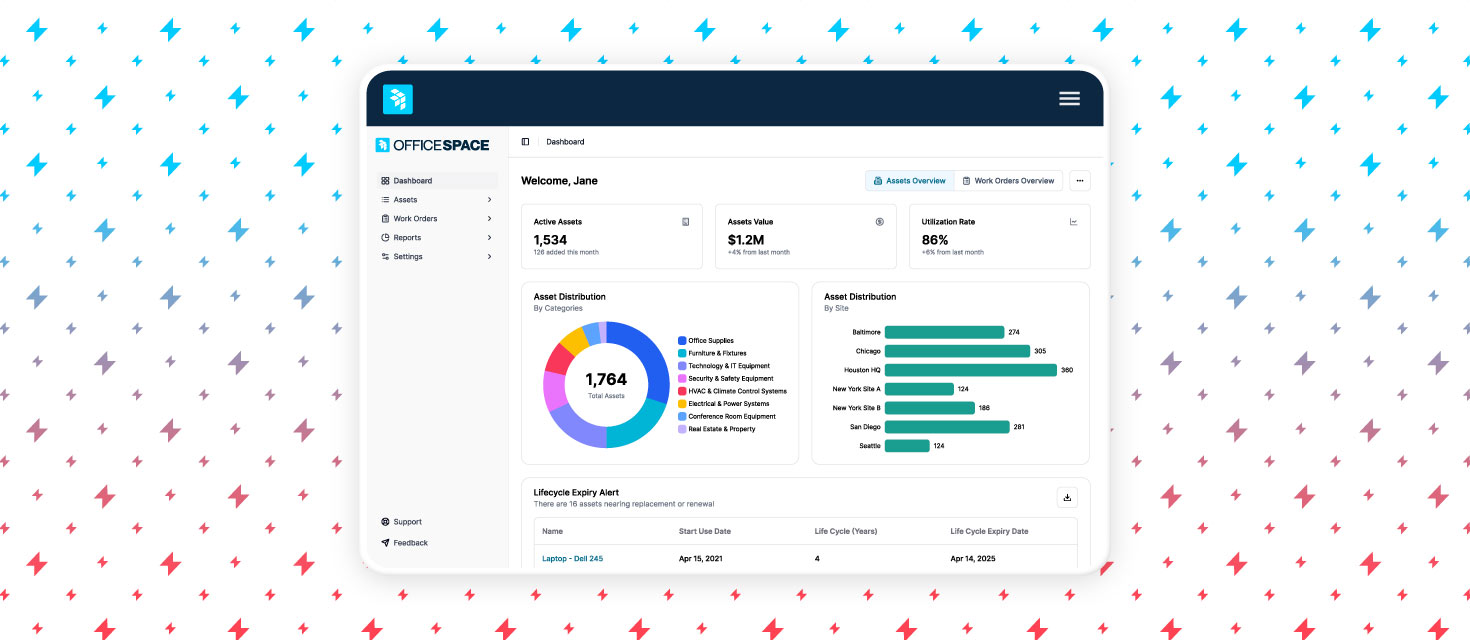
In 2025, OfficeSpace pushed beyond people and rooms into enterprise asset management. OfficeSpace Assets tracks laptops, monitors, furniture, HVAC equipment and capital assets, linking them to locations, people, moves, work orders and maintenance. The company says a two-developer strike team delivered the product in 74 days. A separate launch account described the work as three months, compared with the several years and five engineers such a product might historically have required.
What did it cost? The public, copyable cost was two focused engineers, 74 days, experienced product and workplace specialists, and direct access to clients. AI assisted research, prototyping and testing. Winware.ai helped the team gather fast feedback from facilities and IT practitioners. Chief Product Officer Andres Avalos said those insights led to almost immediate changes in the user experience.
“AI didn’t replace our team - it supercharged them.”Andres Avalos, Chief Product Officer
What failed first was not a dramatic server crash. It was the old process: spreadsheets, disconnected asset tools and product assumptions made too far from the user. The team changed its mind in small increments as client feedback arrived. That is a more useful AI case study than a miraculous prompt. The model accelerated the mechanical work; domain experts decided what belonged in an enterprise system, where security mattered and which rough edges would ruin adoption.
Then OfficeSpace made a larger bet. In October 2025 it acquired Dojo AI, adding patented optimization technology that can generate workplace scenarios and use collaboration signals from tools such as Slack, Teams and Zoom. By 2026, the company was presenting AI Canvas as a team of agents: one for space planning, one for workplace experience and one for insights, with facilities and visitor agents announced. The language is fashionable. The underlying jobs are reassuringly dull: recommend a useful desk, flag a utilization pattern, draft a stack plan, prevent a work order from waiting in a queue.
What you can steal
First, hunt for an operational workflow with an ugly source of truth. OfficeSpace did not begin by inventing a category. It found planners coordinating thousands of people with tools that did not match the job. Second, make the daily action feed the executive decision. A booking button alone is easy to copy. A booking that improves occupancy evidence, scenario planning and capital allocation compounds in value.
Third, expand along the customer’s workflow, not across a random software map. Moves naturally touch floors, employees and assets. Reservations create utilization data. Visitor and facility workflows share locations, identity and notifications. Fourth, use AI where the task is repetitive but the judgment remains visible. The 74-day build worked because a small team had 18 years of domain context and live users to correct it. “Use AI” without that feedback loop is merely a faster way to misunderstand a market.
When the model works
A multi-site organization has costly space, reliable identity or presence data, recurring moves, an owner for workplace operations and permission to act on what the analytics reveal.
When it does not
A small office needs only a calendar, employees will not adopt the workflow, badge data is unreliable, or leadership wants a dashboard but will not change policy, leases or layouts.
Those limits matter. Software cannot make a commute worthwhile if a company has no reason for colleagues to meet. It cannot produce trustworthy utilization from ghost bookings and missing signals. It cannot resolve a return-to-office argument disguised as an implementation project. An integrated platform can also be too much for a 40-person office with one floor and a shared calendar. OfficeSpace competes not only with Envoy, Robin, OfficeRnD, Skedda, Eptura and Appspace, but with the perfectly rational decision to buy less.
The market underneath the map
OfficeSpace received strategic backing from Resurgens Technology Partners in 2019. Vista Equity Partners invested approximately $150 million in January 2022, with Resurgens remaining an investor. The company is private, does not disclose a valuation, and has roughly 240 employees by the supplied company data and LinkedIn’s public range. Its culture story emphasizes a distributed team across the United States, Canada and Costa Rica, client co-creation and 24/7 support. The company has also worked publicly with IFMA and customer OpenAI on practical AI for facilities teams.
The opportunity is bigger than desk booking because commercial real estate is expensive, long-lived and full of disconnected evidence. OfficeSpace’s 2026 market report analyzed more than 20.4 million desk bookings and 12.8 million room bookings. In July 2026, Silverstein Properties began offering OfficeSpace-powered workplace analytics to tenants as a building amenity. That arrangement hints at the next layer: workplace intelligence supplied not only by an employer, but by the building itself.
The company’s most ambitious phrase is “operating system for the built world.” It is also a useful test. An operating system earns its place by coordinating resources and making other work easier. OfficeSpace will succeed to the extent that a reserved desk, an HVAC work order and a lease decision become parts of the same legible system. If they remain attractive tabs that nobody trusts, the old spreadsheet will be waiting. It always is.
Continue exploring