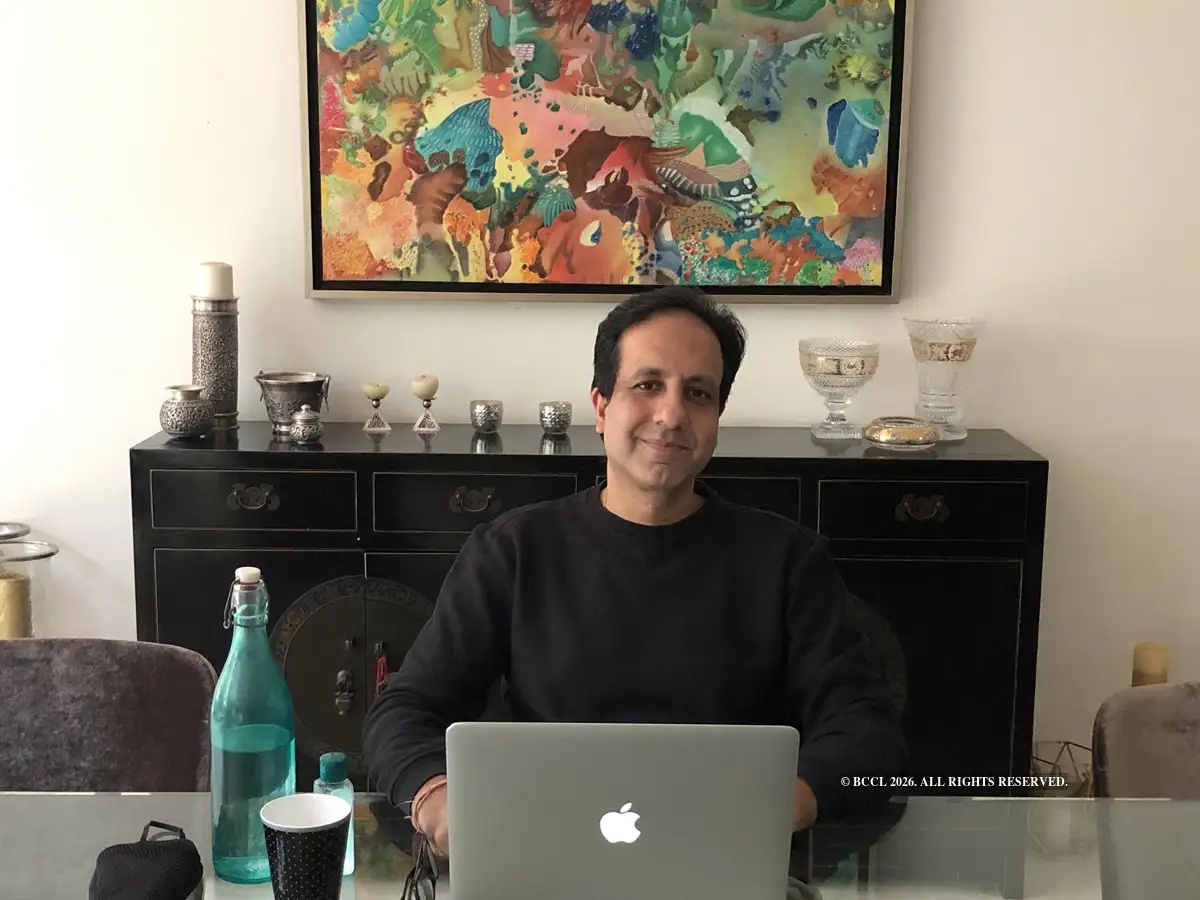
Dinesh Malkani assigned different jobs to different rooms in his home. Webinars belonged at the dining table, where the background looked better. Client calls went to the home office, with its bookshelf. Internal team calls could happen in the bedroom. In 2020, the founder of a company devoted to managing workplaces was managing a workplace of his own, one camera angle at a time.
There was a wardrobe system, too: casual clothes for the day, a shirt for the client call, shorts below the frame. The video conference had introduced a rather selective definition of business dress. Malkani’s arrangements were practical, but they also supplied a miniature version of the question running through his career. What should a space do for the people using it?
He had spent years in enterprise technology before helping build Smarten Spaces in 2017. By then, he had led Cisco’s business in India and SAARC and worked across Asian markets. He knew the vocabulary of connected businesses. His next company would bring that vocabulary down to the scale of a room, a booking, and a colleague trying to find somewhere useful to sit.
Before the desk, the connection
Malkani’s professional route passed through research and development, systems engineering, and sales. His earlier leadership experience included China and Korea. Those are useful particulars in a career that can otherwise disappear into titles: he had encountered technology from the side of the people building it, the people explaining it, and the people buying it.
At Avaya, he held country leadership roles in China and South Korea. At Jabra, he led in Asia Pacific, Japan and China. In 2010, he joined Cisco to head collaboration technologies in that same broad region. The subject was already close to his eventual startup: tools that help people work together, across the inconvenience of geography.
In June 2014, Cisco announced him as president for sales in India and SAARC, succeeding Jeff White. His assignment included senior external engagement with government and industry associations. The announcement placed him alongside engineering leader Amit Phadnis and strategy and operations leader V C Gopalratnam. It was a shared leadership arrangement spanning the functions a large technology business needs to connect.
The scale was national as well as corporate. In September that year, Malkani participated in the inauguration of Cisco’s Smart City demonstration at its Bengaluru campus. The project presented connected communities as a working blueprint for Digital India. Buildings and their services were part of a larger argument about what connectivity could make possible.
There is a continuity here that the change in business card can obscure. Collaboration technology concerns how people reach one another. Space management concerns where and when they meet. Malkani’s later work would keep the people in the equation while adding the physical constraints of buildings. A network has capacity. So does a meeting room.
A company built around the building
Smarten Spaces was founded in April 2017. That October, it announced Malkani as founding partner and worldwide CEO, together with an experience development centre in Bengaluru. The company was headquartered in Singapore. Its early proposition combined artificial intelligence and the Internet of Things to help real estate developers manage spaces and the experiences within them.
“Space design and management today is hungry for new ideas,” Malkani said at the time. The phrase is revealing in its choice of subject. He began with design and management, the familiar responsibilities of anyone looking after a building. Technology entered as a way to improve those activities. The starting point was an existing place with existing frustrations.
The founding group brought several kinds of experience. Anushka Verghese came from Cisco; Prithvi Shergill had been a chief human resources officer at HCL Technologies. Smarten Spaces’ current leadership page identifies Verghese as co-founder, chief product officer and chief marketing officer, and Shergill as co-founder responsible for talent enablement and workplace design. Product, people, and property have all had a seat in the company’s story.
In November 2019, the business raised US$12 million in Series A funding from Symphony International Holdings. The intended uses included expanding its development centre and AI engineering teams in Singapore and India, increasing local presence in several markets, and supporting its partner network. Expansion required people who could build the software and people close enough to customers to help it work.
The early range of spaces extended beyond conventional offices to coworking, coliving, and other properties. A building manager might need to reduce administrative work; a tenant might simply need to book a room. Both encounters belong to the same building, even if they arrive with different budgets and very different levels of patience.
Investor: Symphony International Holdings.
The calendar has other ideas
By November 2020, Malkani was talking about workplace deployments across 43 cities in 14 countries over the preceding four months. “We had the technology at the right time,” he said. The interesting part of his explanation lay in the customer requests: seating allocation, employee choice, automated assignments, and workforce rostering. Companies wanted those tasks to fit together.
Consider his example of a workforce of 3,000 people. Some employees need to be present on the same day as particular colleagues. Others change their availability. A schedule prepared manually has to absorb the changes and still produce something useful. A roster can look tidy while arranging a thoroughly unhelpful day for the people on it.
Malkani described companies wanting data on how their workplaces were actually used before making decisions about how much space to retain. That distinction matters. A floor plan records what could happen. Attendance and usage show what does happen. Managers deciding what to keep need some relationship between the two.
“We had the technology at the right time.”Dinesh Malkani, November 2020
In a later discussion of hybrid offices, he observed that, before the shift, workplaces could use only 50 to 60 percent of their space. That was his description of an inefficiency, rather than a universal measurement of every office. His underlying question was straightforward: why preserve a fixed arrangement without checking whether people still use it as expected?
Hybrid work gives that question a calendar. The same team can require different amounts of space on different days. An organisation can offer flexibility and then find that its physical arrangements make collaboration awkward. Malkani’s business sits in the decisions between those two conditions: booking, scheduling, finding colleagues, and understanding demand.
Culture, with a side of pizza
Malkani also had to keep his own team connected. The remote rituals he described included virtual Antakshari, recognition days, regular all-hands meetings, and pizza video calls. Antakshari is a singing game; its place beside an all-hands meeting is a welcome reminder that a company contains people with more to contribute than agenda items.
The home-working photograph captures another small adjustment: a laptop at a table, household objects around it, the formal office elsewhere. His choice of backgrounds gave different calls different settings. He made the room serve the conversation. That is a modest experiment, but a recognisable one for anyone who has briefly rearranged a room because a camera was about to turn on.
Those details make his workplace argument easier to understand. Coordination reaches beyond allocating furniture. People need reasons to encounter one another and ways to remain part of a group. Software can arrange a booking. A leadership team still has to decide what will make the time together worthwhile. Sometimes the answer can include singing.
What the building knows next
The company’s newer work uses the SpaceOnAI name. Recent demonstrations describe prompt-based space planning, occupancy analysis, and recommendations. Malkani has also written about using signals from sensors and building systems to anticipate operational problems and get the appropriate team to act. He presents that as a direction the company is building towards. It extends his interest from arranging space to responding to what happens inside it.
His public writing on India’s global capability centres adds a local qualification. Organisations arriving from overseas, he argues, need to treat India as a distinct operating environment. Space decisions, shift patterns, and other operational responsibilities require local understanding. Experience across markets can be useful precisely because it exposes the limits of assuming that one arrangement will travel intact.
In May 2025, Page Industries appointed him an additional independent director, initially subject to shareholder approval. Its biography records a computer engineering degree from the University of Pune, an Executive MBA from the State University of New York, and further programs at MIT and London Business School. It also records his role in founding the Singapore chapter of Akshaya Patra. His support for education includes an advisory connection with Parikrma Humanity Foundation.
There are interests beyond the operating schedule: golf and travel appear in his professional biography. A fellow co-founder, Shergill, once described a conversation with him about workplace trends during a flight, a founders’ meeting at 30,000 feet. Even while looking down at buildings, they were talking about their use. The floor plan seems to follow them.
Malkani’s story returns to an ordinary test. Can the place help people do what they came to do? At home, he answered by changing rooms. At Smarten Spaces, he answers with a product and a team. The scale changes. The person with a call to make, a colleague to meet, or a desk to find remains the reason to bother.