The lobby television is easy to ignore until somebody needs it. A storm closes the office. A factory shift changes. A visitor arrives. The chief executive records a video that should reach a software engineer at home, a nurse between rounds and a machinist who has never received a company email. Suddenly the screen on the wall is not decoration. It is infrastructure.
Appspace understood that earlier than most. Founded in 2002 by Brandon Miles and Stan Stephens, the company began in digital signage, but with a useful constraint: its screens were for the workplace, not the shopping mall or the roadside. The job was internal. Make enterprise video and messages appear where employees could see them, then give administrators one place to control the machinery.
That narrow start matters because Appspace now sells something much broader. Its four named products - Intranet, Signage, Workspace and Visitors - cover company news, employee communities, mobile access, rooms and desks, maps, reception and thousands of managed displays. Analytics and AI-assisted publishing run across the set. The tidy promise is “start anywhere, scale without starting over.” The less tidy reality is that four departments may need to agree before anyone can scale.
The first thing to fail was the category boundary
When offices scattered in 2020, a signage company had an obvious problem: fewer people were walking past signs. Appspace’s response was not to defend the old category. It followed the message. If the employee was at home, information had to appear in a mobile app or intranet. If attendance became optional, people needed to reserve a desk and know who else would be there. If visitors returned under new safety rules, reception needed a cleaner check-in flow.
This is the closest thing to “what failed first” in Appspace’s public history. It was not a notorious product collapse. It was the assumption that the physical workplace could be managed separately from the digital one. The pandemic changed the company’s mind about how wide its product needed to be. By its own account, Appspace expanded into visitor management, unveiled space reservation and introduced an employee app and intranet. The screen remained, but it became one endpoint among many.
Two 2021 acquisitions made the strategy concrete. The Marlin Company brought ready-made workplace content and a strong position in industrial settings, where a break-room screen may outperform another unread email. Beezy brought an intelligent intranet built around Microsoft environments and proven at large enterprises. Appspace later added Igloo Software. Rather than spend years inventing every adjacent feature, it bought distribution, expertise and installed customers.
Appspace’s cleverest product is not a screen or an intranet. It is the sentence: create once, publish everywhere.
What the customer actually buys
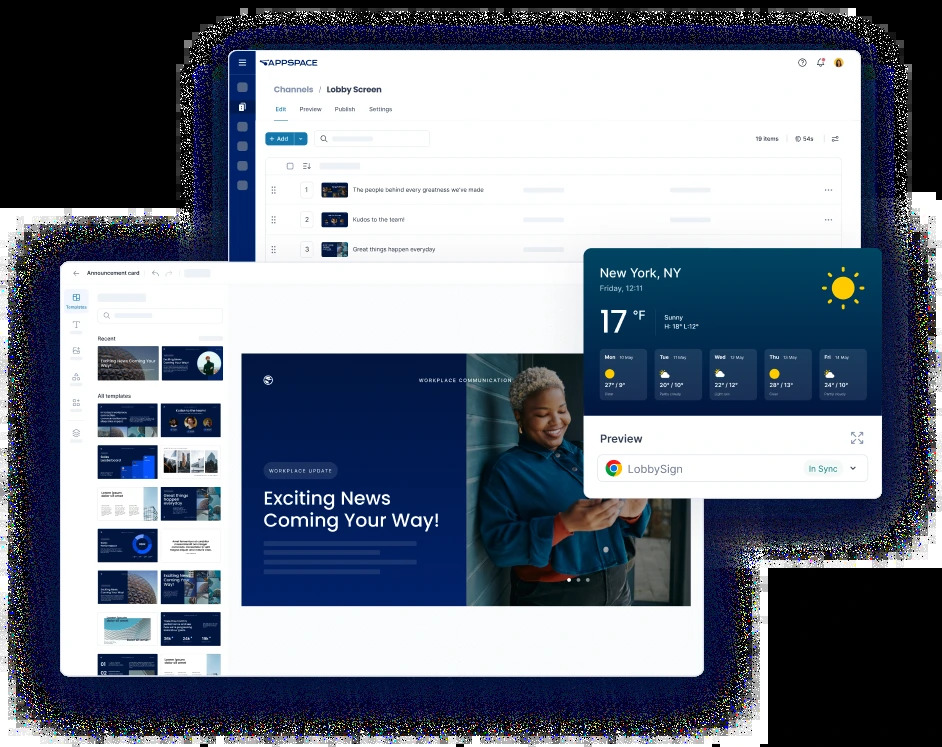
Consider an ordinary safety notice. In a fragmented stack, communications writes it, a designer turns it into signage, an intranet manager republishes it, somebody pastes it into Teams, and a local office manager checks whether the lobby display updated. Every handoff adds delay and a chance for versions to disagree. Appspace’s orchestration pitch is to create, approve, target and measure the message once, then distribute it across the intranet, employee app, chat tools and physical screens.
The workflow Appspace wants to compress
The workplace half solves a different but related irritation. Employees can reserve desks or rooms, find spaces, see availability and navigate an office. Facilities teams can study utilization. Visitors can register, check in and notify a host. The combined argument is that communications and place are not separate experiences to the person arriving on Tuesday morning. The welcome message, room panel, map and visitor badge all belong to the same trip.
Appspace sits between several established markets: employee experience platforms, modern intranets, workplace management, visitor systems and digital signage. Its competitors therefore arrive as a crowd. A buyer could combine SharePoint, Viva and Teams with Envoy, Robin or Skedda, then add ScreenCloud, Yodeck, Poppulo or Korbyt. Specialists may go deeper in one category. Appspace counters with breadth, centralized administration and a large device ecosystem spanning Microsoft, Google, Cisco, Crestron, Samsung, LG, BrightSign and others.
The bill is a stack question
Appspace makes money through SaaS subscriptions and related implementation, content, consulting, support and maintenance. Enterprise pricing is usually quoted, with cost shaped by users, administrators, devices, modules, storage and bandwidth. A 2024 UK public-sector price list illustrates the machinery: separate platform, bandwidth and device charges, including a private-cloud base subscription listed at £654 per month and an Express cloud package for 25 devices at £850 per month. Those figures are historical list prices in one procurement channel, not a universal 2026 quote.
The better way to judge cost is not “Is this cheaper than one signage tool?” It is “Which contracts, integrations and repetitive jobs disappear?” Appspace also advertises a flat-fee small-business intranet bundle covering up to 500 users and 25 screens, but large deployments remain an enterprise sale. The economic case improves with many locations, many channels and expensive coordination. It weakens quickly when a company needs one screen, one office or one capable SharePoint administrator.
Private backing has helped fund the expansion. LLR Partners invested in 2019. Accel-KKR joined in September 2023 through an undisclosed strategic growth investment aimed at product development, AI, IoT links and deeper partner integrations. Supplied company data estimates annual revenue at $78.5 million and headcount around 490, but Appspace does not publicly report audited revenue or a valuation. The defensible public measures are operational: it says it serves more than 2,700 subscription customers, reaches 12 million workers and is used by more than 170 Fortune 500 organizations.
AI enters a workplace full of permissions
The latest layer is Appspace Intelligence. Assistants can help create and translate content, answer employee questions, search connected knowledge and surface analytics. In 2026, Appspace announced Bring Your Own Model, allowing customers to connect preferred AI models rather than accept a single mandated provider. That is a procurement-aware move. Enterprises already have model agreements, security reviews and data rules; asking them to restart that work would make an assistant less helpful before it answered anything.
AI also magnifies the old governance problem. Faster content creation is valuable only when brand rules, source permissions, audience targeting and review rights are clear. An assistant connected to stale intranet pages can return stale answers at machine speed. Appspace can supply the pipe and controls. It cannot decide who owns the employee handbook or whether the London office should see Tampa’s hurricane alert.
What another company can steal
- Win one recurring surface before claiming a platform.
- Follow the customer’s workflow when a market shock breaks your category.
- Buy adjacent expertise when speed and installed trust matter more than purity.
- Sell consolidation with deleted work, not a longer feature checklist.
- Integrate with the systems customers already defend in budget meetings.
The four-department problem
Appspace’s advantage is also its sales complication. Internal communications owns messages. HR worries about engagement and onboarding. Facilities controls rooms and occupancy. IT and AV manage identity, security, devices and integrations. Security may own visitors. A unified platform crosses budgets and political borders that remain stubbornly un-unified.
That is why the product can fail without technically failing. One team buys signage while another renews a separate intranet. Room booking launches, but employees keep using Outlook. Every module works, yet the “one workplace” benefit never appears. The prerequisite is an executive owner or operating group willing to simplify the stack, assign governance and measure adoption across departments.
It fits when
The organization has many sites, remote or frontline workers, duplicated publishing, a mixed device fleet and real appetite to consolidate ownership.
It does not when
The need is a single channel, specialist depth matters more than breadth, or departments will keep every incumbent tool and merely add another login.
The customer list shows where the thesis travels: Appspace publishes stories involving Costco, Paramount, Milliman, the American Chemical Society, universities, manufacturers, utilities and public bodies. These are organizations with locations, shifts, compliance needs and audiences that do not live in one app. They have enough operational mess for consolidation to be interesting.
The company’s evolution also explains its culture story. Appspace describes its values with the inevitable acronym SPACE: service excellence, principled, adaptable, camaraderie and empowerment. Adaptable is the revealing one. In 2022, Miles moved from the CEO job to the board after roughly 20 years and Tony DiBenedetto took over. Pete Schmied, previously close to customer operations, became CEO in 2025, with Holly Grogan promoted to president. The leadership path mirrors the product: from founder-built technology toward customer adoption and operating scale.
A platform with a very physical test
Software companies enjoy abstract nouns. Appspace now speaks of intelligence, orchestration and experience. Yet its test remains wonderfully concrete. Did the visitor get in? Was the room free? Did the factory worker see the alert? Did the employee find the policy? Was the screen blank when the network dropped?
That physical accountability gives Appspace’s platform story more credibility than a diagram alone. It spent years learning that a message is useless if it does not arrive on the right rectangle at the right moment. The company’s bigger bet is that the same lesson can organize the entire workplace. Buyers should copy the logic, then apply one unforgiving rule: if the platform does not remove tools, handoffs or uncertainty, it is simply the newest item in the pile.