The short version
- Gable manages company offices and outside coworking space in one system.
- Employees book desks, rooms and gatherings; operators set budgets and study actual use.
- Its published entry price is $4 per bookable resource a month; flex-space usage costs extra.
- The best fit is a distributed company with enough locations, vendors and invoices to feel the mess.
There is a small absurdity at the heart of the modern office. A company may know, to the millisecond, how much computing power it consumed yesterday. It may know which ad produced which customer. Yet ask how many desks it will need next Tuesday and the answer often arrives as a shrug with a lease attached.
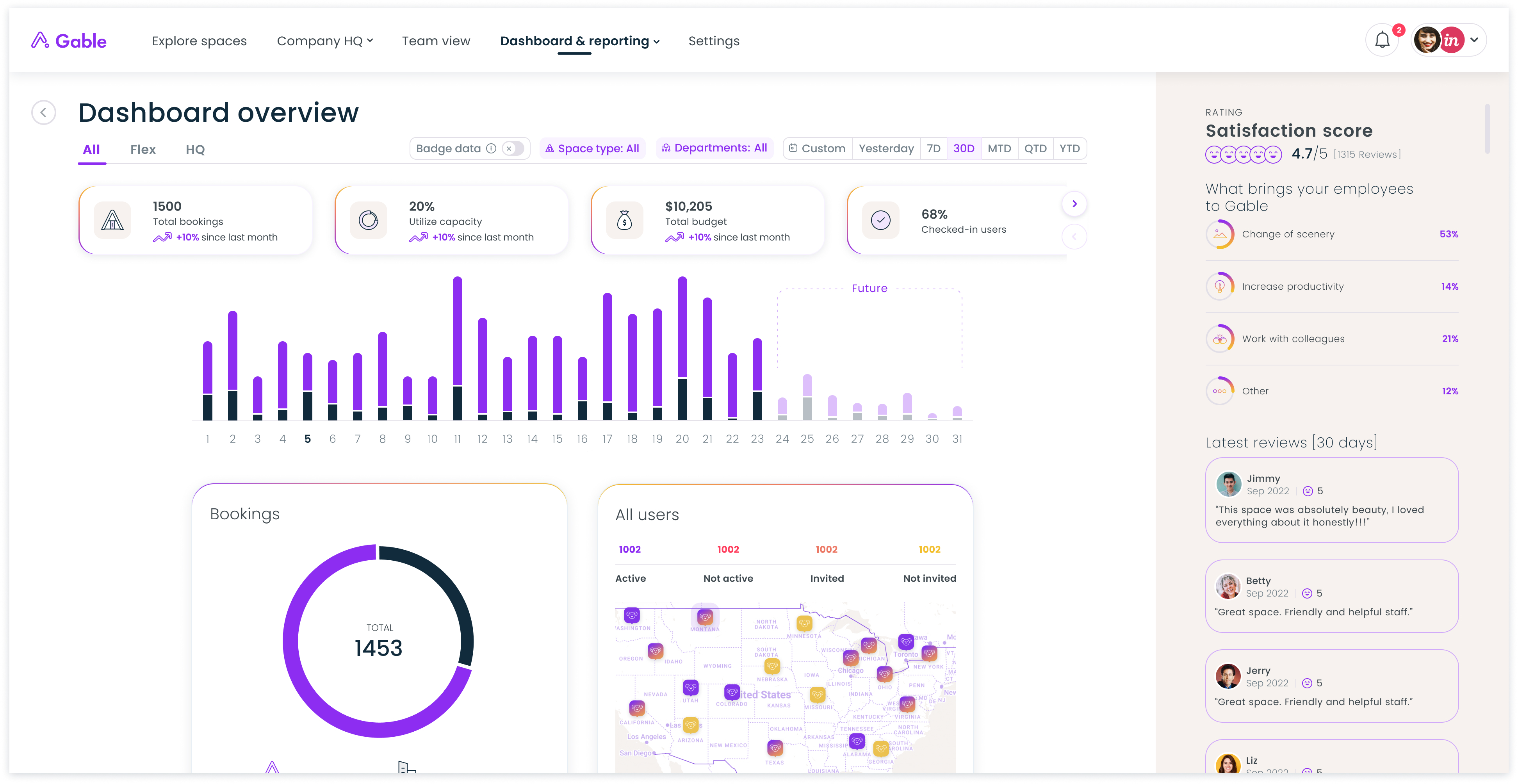
Gable exists inside that shrug. Founded in 2020 by former Microsoft colleagues Liza Mash Levin and Omri Haviv, the San Francisco company makes software for deciding where people work, where they meet and what all of it costs. To an employee, it can look pleasantly ordinary: open an app, find a desk or room, see which colleagues are coming, and book. To a workplace operator, the same click becomes evidence - a demand signal tied to a person, a team, a city and a budget.
That distinction matters. Desk booking is a feature. Gable's larger proposition is that the physical workplace can become an observable system. It combines reservations inside a company's own offices with visitor check-in, event planning and access to more than 17,000 on-demand workspaces in more than 900 cities. Slack, Microsoft Teams, HR systems, calendars, badge readers and Wi-Fi presence can feed the same machine.
The headquarters became a query
Levin's interest in distributed work predates the emergency that made everyone else interested. She had managed teams across time zones at Microsoft, then studied at Stanford, where Gable began as a project shaped by another curiosity: why do useful spaces sit empty while people nearby need somewhere to work? She and Haviv formed the company just as the pandemic turned a speculative question into an operating crisis.
The first version of the answer was “workspace as a service.” Instead of opening a branch office for a handful of employees, a company could give them controlled access to existing coworking spaces. Instead of handing out a universal subscription and discovering overages later, managers could set allowances and approvals. The employee got choice; finance got a circuit breaker.
“Most employees want flexibility, but they also want the ability to meet with coworkers and connect.”Liza Mash Levin, co-founder and CEO
Then the market complicated the neat remote-work story. Offices did not disappear. Companies kept headquarters, reduced some footprints, added hubs and asked people to gather with intent. The troublesome part was no longer merely finding a spare desk. It was managing every species of desk at once: owned, leased, shared, temporary, nearby and three time zones away.
What failed first was visibility
The customer stories make the failure mode unusually plain. Checkr had used WeWork All Access for part of its remote population. The problem was not that the spaces lacked chairs. It was cost and access: the program did not scale equitably to roughly 700 distributed employees, and overages became clear only when the monthly bill arrived. With Gable, Checkr says it expanded access worldwide, gained real-time oversight and cut workplace costs by 51%.
Upwork describes a similar pre-Gable arrangement: limited network reach, thin analytics and inflexible economics. It wanted teams without a corporate office to gather, but also wanted the bill assigned to the right business unit. Gable's self-service bookings and controls shifted some event administration away from the workplace team. Upwork reports 360 gatherings, 66% adoption and estimated savings of 56%.
New Relic offers the clearest picture of what changed minds. Its workplace team had one vendor for coworking and another for desk reservations and visitors. Billing reviews meant cross-checking statements line by line. Vendor turnover meant repeatedly explaining the account. After an extensive evaluation, New Relic consolidated eight offices and its coworking program on Gable. It now reports 60% employee adoption and 40 hours of reporting work saved each month.
The business behind the booking
Gable earns money in two related ways. The software is sold as business-to-business SaaS. Its Essentials plan is publicly listed at $4 per bookable resource each month and includes desk and room booking, maps, analytics and core integrations. Visitor Management starts at $199 per location a month when paired with Essentials. Pro is custom priced and adds an AI workplace copilot, space planning, moves, deeper access and calendar connections, events, packages and parking.
The marketplace carries a different meter: an annual platform fee plus whatever a company books. Hosts can list without a subscription; Gable publishes a 20% commission on day passes and 10% on meeting rooms, daily private offices and events. This hybrid model is the point. Software organizes the company's fixed footprint while marketplace supply absorbs the variable edges.
Gable's public price is concrete at the entry level, but a realistic total depends on offices, visitors and on-demand usage. The savings claims above come from Gable customer case studies, not audited filings, and should be read as reported outcomes rather than universal returns.
The competitive field is crowded. Robin, Envoy, OfficeSpace, Condeco, Kadence, deskbird and others handle overlapping pieces of workplace management. WeWork and coworking aggregators sell flexible access. A capable operations team can stitch together calendars, forms, expense policies and spreadsheets. Gable's difference is architectural: the owned office and the borrowed office live on the same ledger. That is valuable only if a company actually has both.
The useful part you can copy
The transferable idea is not “buy workplace software.” It is to treat an office policy as a testable operating hypothesis. Give teams a reason field when they book. Tag costs to departments. Compare stated attendance with actual signals. Watch which cities produce repeated gatherings. Release reservations that become no-shows. Then change capacity after the pattern appears - not after the loudest executive develops a hunch.
Start with a narrow question. Are Tuesday shortages real, or are reservations abandoned? Does a small remote cluster need a permanent hub, or two meeting rooms twice a month? Which teams gather, and for what? A tool like Gable works when those answers lead to a decision about space, money or policy. Measurement without a decision is simply a more attractive spreadsheet.
Several offices or cities, meaningful flex-space spend, a hybrid policy, repeat gatherings and an operations team empowered to change budgets or footprint.
One small office, a simple fixed schedule, no funded coworking or events, and no appetite to connect booking data with real-estate decisions.
There is also a human condition. Seeing who plans to come in can make a visit worth the commute. It can also become surveillance if presence data is collected carelessly or used as a proxy for performance. Gable supplies role-based access, SSO and compliance features; the customer still decides what good governance looks like. The system can count a badge swipe. It cannot determine whether the meeting deserved one.
This is the quiet appeal of Gable. It does not settle the ideological argument between remote and office work. It makes the argument less important. The practical questions - where, with whom, for what purpose and at what cost - are small enough to answer. Once answered, the office stops being a monument to a five-year prediction. It becomes something a company can adjust.