The most important machine in an electric-vehicle depot may be the clock. A delivery van has to leave before breakfast. A bus has a route, not a mood. Both need enough charge to work, but dozens of batteries can ask for more electricity than the building is allowed to draw. EO Charging built its business in that awkward interval between arrival and departure. The blue box on the wall was merely the obvious part.
EO began in 2014, when 24-year-old Charlie Jardine left another British charge-point manufacturer, frustrated by the state of the equipment and service. He returned to Suffolk and worked in his grandfather's former pig shed. There, during 2015, a small team developed a charger and the software around it. The product reached market in 2016. The farmyard origin has been repeated because it is charming. It also explains the design instinct: make the machinery sturdy, simple and useful before making it grand.
The name originally meant Electricity Online. Early EO sold compact home chargers and talked about energy independence. But its better opportunity arrived with vehicles that could not simply wait until tomorrow. Amazon vans, Tesco grocery vehicles and London buses turned charging into operational infrastructure. EO shifted from selling an object to selling a result: a fleet ready to move.
The depot is a puzzle with wheels
Tesco's first phase shows exactly what EO did. The retailer handed over three months of vehicle telematics and a year of half-hourly electricity consumption. EO modelled routes, ranges and site power before specifying equipment. At three depots, vans had enough range for the maximum daily distance. At two, many vehicles needed an extra sip between delivery waves. The answer was not one charger repeated 205 times. It was more than 200 AC fast chargers for routine work, five DC rapid chargers for short turnarounds, EO Cloud for scheduling and a four-hour on-site service commitment.
That sequence is the most portable piece of EO's method: begin with the duty cycle, not a hardware catalogue. Ask when each vehicle arrives, when it must leave, how much energy it needs and how much power the site can safely provide. Only then decide where copper, concrete and cabinets belong. It sounds obvious in the way good operations advice often does. Plenty of expensive mistakes begin by reversing it.
Software made the sockets take turns
EO Cloud became the brain of the depot: a SaaS platform for charger status, energy data, schedules, reports and vehicle telematics. It was based on OCPP, the industry protocol that lets operators manage compatible equipment from other manufacturers. That mattered. A fleet could use EO software without making every cable an EO cable, and an old depot could be brought onto the platform without ripping everything out.
EO Hub managed the electrical bottleneck underneath. It distributed available power across chargers, respected a site's ceiling and moved demand into cheaper hours. At Stagecoach's Romford bus depot, daylight power was tight and floor space was tighter. EO installed Kempower equipment on walls and ceilings, including nine overhead cable reels, then used Hub and Cloud to balance the load. Roughly 100 buses could keep operating while the depot was rebuilt. The ceiling became real estate.
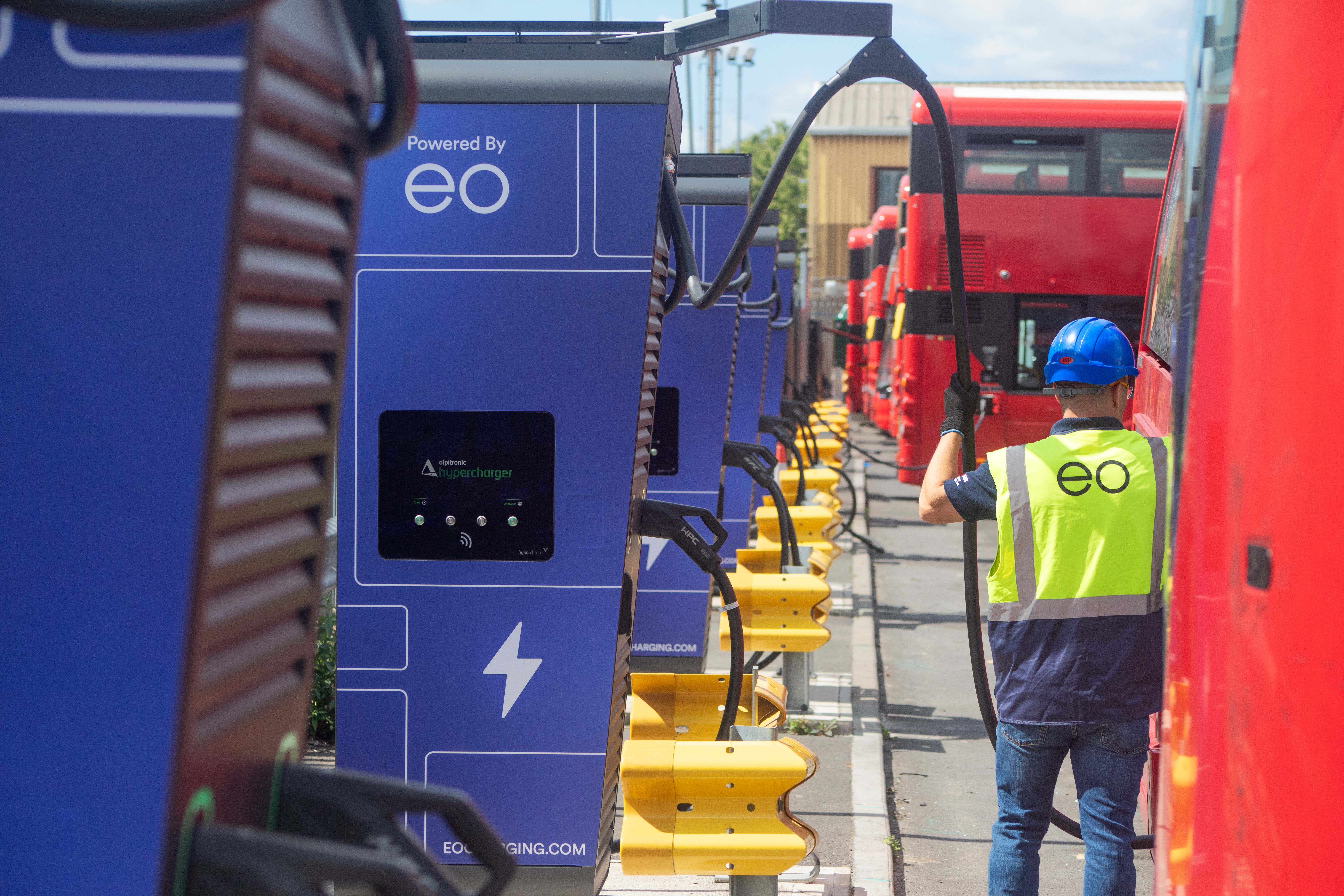
The software kept getting closer to the dispatcher's actual question. A 2025 update introduced a site-level operations view and faster automated fault response. EO said its self-healing system could already resolve 47 percent of faults without a visit. In March 2026, Cloud added trips, dynamic vehicle allocation and continuous reprioritisation based on departure time, dwell window and required state of charge. Charger uptime is a technical measure. Vehicle readiness is the business measure.
From electricity to an operating promise
The last number came from early customer data after energy-management improvements in 2026: up to 27 percent more available on-site power while retaining a 10 percent safety margin. It is a product claim, not a universal law, but it captures EO's value proposition. A smarter schedule can be cheaper than a larger grid connection.
“Milestones are not admin for a Gantt chart, they are the backbone of safe, scalable delivery.”EO Charging project guidance, February 2026
The one-stop shop had an expensive trolley
EO's breadth separated it from a plain charger vendor. It consulted, designed depots, handled grid upgrades, integrated AC and DC hardware, sold software and staffed maintenance. Customers included Amazon, DHL, UPS, Tesco, Ocado, Uber, Go-Ahead, Metroline and Stagecoach. By 2021, EO said it had deployed about 50,000 chargers in more than 35 countries. By late 2024 it reported more than 100,000.
The economics were more complicated than the growth chart. An enterprise fleet platform can earn recurring software and service fees, but somebody still has to finance equipment, trenching, switchgear, engineers and long sales cycles. EO tried to solve the customer's version of that problem with MOBILITe, launched in 2023. The programme bundled vehicles, charging and services into a fixed monthly cost. EO noted that converting 100 buses could cost as much as £50 million. Removing that upfront shock was sensible. Carrying the work was capital-hungry.
For households, the equation was smaller. The Mini Pro 3, launched in 2022 at a starting installed price of £1,139 including VAT, was about the size of an A5 notepad. Its commercial cousin, Genius 2, offered up to 22kW and connected to Cloud. Smart-charging regulation soon exposed the burden of supporting generations of connected products. EO stopped replacing Genius 1 and Hub 1 units in October 2024, phased out Cloud 1 and later moved Mini Pro 3 app users to ev.energy as it concentrated on fleets.
A $675 million door closes
EO's first conspicuous failure was financial rather than electrical. In August 2021 it agreed to merge with First Reserve Sustainable Growth Corporation, a special-purpose acquisition company. The proposed deal implied a $675 million enterprise value and was expected to deliver $222 million in gross proceeds, with more than $150 million available for growth, debt and transaction expenses. EO would trade on Nasdaq as EOC.
It never did. In March 2022, the parties terminated the combination, citing unfavourable market conditions for high-growth companies. No completed listing meant no promised capital. EO found another route in February 2023, when Vortex Energy and existing backer Zouk Capital invested about $80 million. The money underwrote expansion into North America and Europe. In May 2024, Richard Staveley became chief executive while Jardine moved to President and focused on international growth.
The market grew. Confidence shrank.
By 2025, EO changed its mind about global sprawl. It planned to leave the United States, sold its domestic charger hardware and manufacturing operation to Cogent Technology and sharpened its focus on commercial fleet software and service in Britain and Europe. A £25 million recapitalisation in November combined more debt from HSBC with equity from Zouk and Vortex. Management described a more capital-efficient, platform-led business.
The reset arrived too late. PwC's administrators later said uncertainty and delays during the fundraising had damaged customer confidence, reducing the order book and pipeline. Liquidity pressure returned. A sale process began in January 2026 but initially produced no acceptable offers. On April 8, Juuce Limited, the company trading as EO Charging, entered administration. The engineers could make chargers recover remotely; the balance sheet had no such button.
Pod bought EO in May for an undisclosed sum. The fit is tidier than the corporate journey that produced it. Pod brings home, workplace and public charging, plus smart tariffs and energy flexibility. Parent EDF brings electricity supply and a large balance sheet. EO brings depot software, fleet operating knowledge and service relationships. Pod said existing customers would continue without interruption and that EO would keep its name while the companies work toward an integrated offer.
What is left to copy
EO's durable insight is that electrification is an operating-system change disguised as a fuel change. Fleet managers should map routes and dwell windows, design around the existing grid connection, insist on open protocols, measure vehicles ready for duty rather than chargers online and price the human rescue layer from day one. A remote fix is worth more at midnight than an elegant dashboard screenshot.
The method has boundaries. It works best for predictable return-to-depot or return-to-home fleets, where vehicles sit long enough to schedule energy and avoided downtime has measurable value. It is less persuasive for tiny fleets with ample power, irregular vehicles that seldom return to base or operators unable to commit to the civil works and long contracts behind a managed service. Software can stretch a grid connection; it cannot invent electricity, depot space or patient capital.
EO now lives inside a larger energy company, which may be the point the sector was circling all along. The charger, the timetable, the service van and the electricity market are connected whether the org chart admits it or not. EO spent a decade making that system visible. Its next chapter will test whether Pod and EDF can make it financially durable too.