Tri Delta Transit already had electric buses and chargers. What it also had, according to bp pulse’s account of the project, was troublesome charger performance and electricity costs above expectations. The equipment had arrived; the easy economics had not. It is an excellent place to begin the story of bp pulse Americas, because an electric fleet can look finished in a photograph while remaining unfinished on a balance sheet.
A bus operator buys electricity to move people on a schedule. Buying that electricity badly can make the transition expensive. Buying it too late can leave a bus unavailable. Between those two mistakes sits a business: deciding which vehicle gets power, how much, at what time, and with whose responsibility when something goes wrong.
- The product: Omega software manages fleet charging around costs, capacity and departure needs.
- The customers: transit agencies, distributors, truck fleets and public EV drivers.
- The expansion: airport hubs, retail sites and travel centers bring the business beyond the depot.
- The lesson: installed chargers are the beginning of an operating plan.
The electricity bill has a timetable
For a fleet manager, “electricity” is an unhelpfully tidy word. There is the energy a vehicle consumes, the time-dependent price of that energy, and the power a site draws when several vehicles charge together. A tariff can make that last number particularly consequential. The depot also has a ceiling: its electrical connection cannot supply unlimited power simply because the vehicles have returned from work.
Omega, bp pulse’s charge-management software, works among these constraints. It monitors charging, manages load and schedules sessions around operational requirements and electricity costs. Connections to vehicle telematics and fleet systems can help it respond to the actual workday. The objective is a charged vehicle ready for its next assignment, rather than every charger running flat out whenever a plug clicks into place.
Conceptual workflow, not a measured performance chart.
The company describes its approach as hardware and vehicle agnostic. In practical terms, that means seeking to coordinate a mixed installation rather than requiring the fleet to become a showroom for one equipment maker. Compatibility still needs checking. The useful promise is flexibility across supported equipment, with one place to monitor operations.
A startup that sold the morning departure
The fleet operation began as AMPLY Power, founded in 2018 by Vic Shao. Shao had previously built Green Charge Networks, an energy-storage company. His next business carried a related insight into transportation: the cost of electricity depends on how you draw it, and the customer would quite reasonably prefer someone else to handle the complications.
AMPLY’s original Charging-as-a-Service offer bundled infrastructure and charging operations, with a price-per-mile-driven fee. That arrangement translated unfamiliar electrical obligations into something a transportation operator could budget around. It also gave the provider a reason to care about the ordinary daily result: vehicles ready to work.
In April 2020, AMPLY announced a $13.2 million Series A involving Soros Fund Management, Siemens and its existing investors. bp acquired the business in December 2021. The October 2022 rebrand introduced bp pulse to the US and wider Americas. The startup’s story became part of an energy company’s charging business, with access to a much larger portfolio of sites and relationships.
Today the offer includes fleet software, electrification support and public fast charging. The current fleet website also advertises Electrada’s 360 Charging as a Service, powered by Omega. That distinction matters to a prospective buyer: software, infrastructure finance and long-term operations can involve different contractual responsibilities. The historic AMPLY fee model should not be mistaken for a universal current price list.
Beer trucks, buses and a useful footnote
San Diego Metropolitan Transit System selected Omega in April 2023 after a pilot and competitive bid. The announced deployment began with 36 chargers at South Bay, with expansion planned to 150 across four locations over five years. Multiple charger manufacturers were involved. Here was a customer testing the proposition before buying more of it.
“It is a complex process to get this done, with many moving parts.”
Sharon Cooney, San Diego MTS CEO, April 2023
Manhattan Beer Distributors supplies a more cheerful illustration of the electricity bill. bp pulse reported more than $22,000 in energy-cost savings for January through June 2024, equivalent to 48%. The comparison was against modeled estimates of unmanaged charging without load management during the same period. This is a case-study estimate, with a specified baseline, rather than a discount available to anyone who installs the software.
Reported energy-cost savings against a modeled unmanaged-charging baseline.
Indexed comparison derived from the reported percentage. It does not represent metered kWh or a guaranteed result.Sysco’s Riverside project shows where the expertise fits inside a larger installation. Its 2023 plan included 40 electric tractors, 40 electric refrigerated trailers, additional solar generation and battery storage. Other partners supplied engineering, chargers and energy-asset management. bp pulse supplied Omega. The software had an important job, but the project required several kinds of specialist to do several different jobs.
The airport is a very large depot
Public charging extends that operating problem to people who do not share a fleet manager. Rental customers need to return cars. Ride-hail drivers need to get back to earning. Travelers need somewhere to stop. An airport collects these needs in one neighborhood, which helps explain bp pulse’s hub strategy and its collaboration with Hertz.
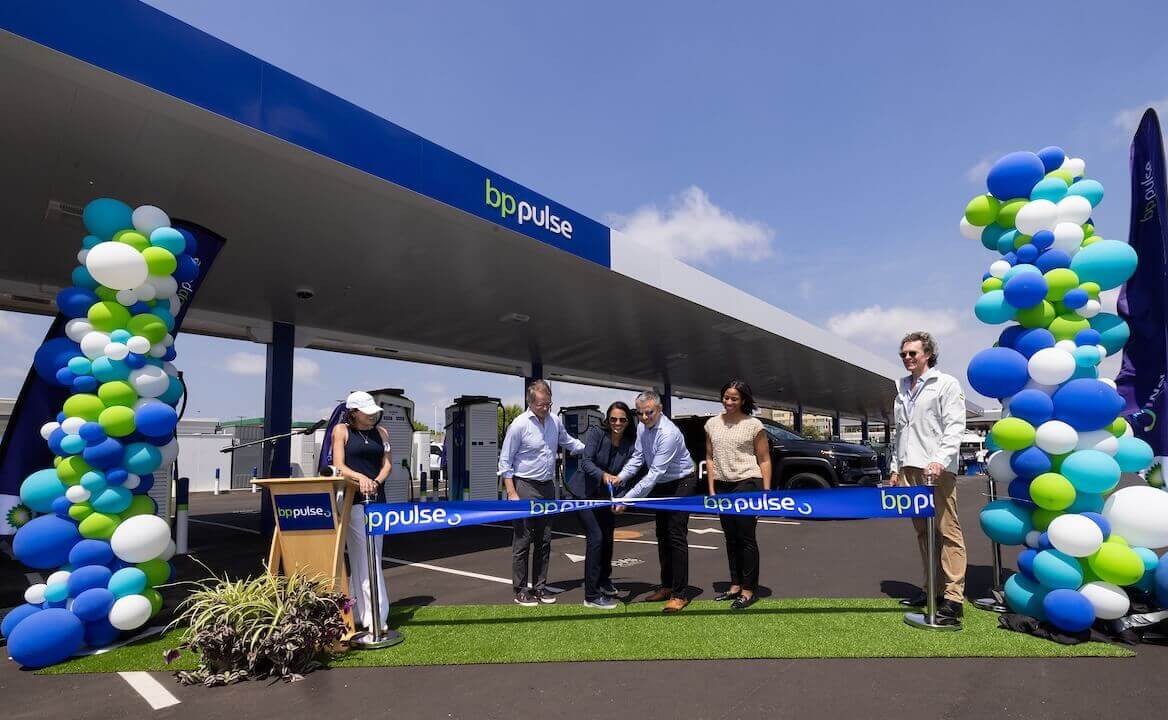
The LAX-area hub opened with 48 charging bays, using a mix of 150kW and 400kW equipment and CCS and NACS connectors. A $2 million California Energy Commission grant partly supported the project. Boston’s hub offers 20 bays and public access around the clock. A large sign advertising power is only part of the proposition; usable connections and a workable stop matter too.
In October 2023, bp announced a $100 million order of Tesla ultrafast charging hardware for its own network and selected fleet depots. Tesla was simultaneously an alternative public network and a supplier. The distinction is useful: buying someone’s equipment does not require handing them the customer relationship. The order’s value is a procurement figure, however, not the full cost of building those sites.
A charger, a landlord and a plate of waffles
bp pulse’s site strategy is also a property strategy. Its July 2024 agreement with Simon Property Group proposed charging at 75 locations, adding over 900 bays. Its May 2025 Waffle House agreement specified six bays per site, 400kW chargers and both CCS and NACS connections, with first openings expected in 2026. Those announcements describe plans, not proof that every promised bay is operating.
The diner pairing has a pleasing lack of glamour. A driver waiting for a battery may also want food, light and a bathroom. Waffle House already has a reason to keep its doors open at unusual hours. Existing destinations can give charging operators amenities without requiring them to become restaurateurs.
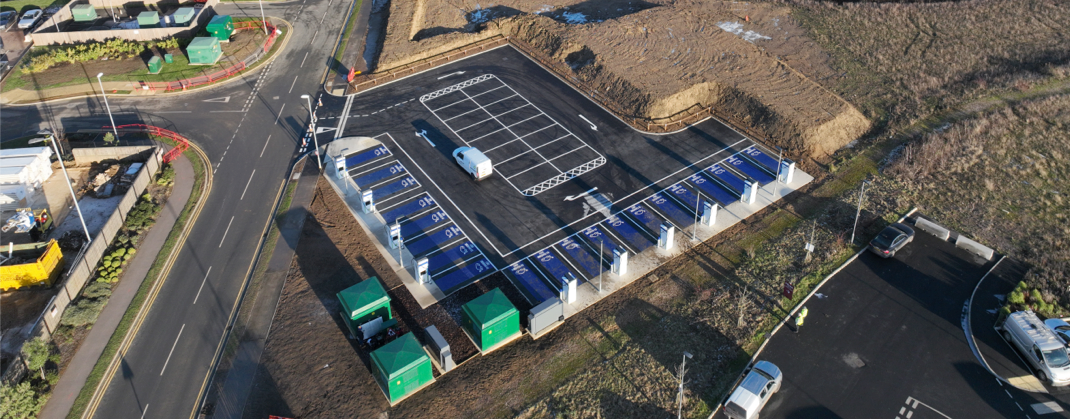
The expansion continued in 2026. A May roundup announced first sites in Michigan and Utah; another described entry into Louisiana and new Texas and Virginia sites. In May, Presto and bp pulse announced an agreement to bring charger discovery, availability and session access to Presto’s platform. Growing a network also means making it easier to use through someone else’s front door.
There is competition at both ends. Drivers can consider Tesla Superchargers and Electrify America; fleet buyers can consider ChargePoint software and services. bp pulse’s particular combination brings managed depot charging together with a public network and bp’s retail relationships. It does not make the basic questions of location, compatibility and price disappear.
Copy the questions before the equipment
For a fleet operator, the useful lesson is to write down return times, departure deadlines, required charge, tariffs and available site capacity before deciding how impressive the chargers should be. Test a representative group of vehicles. Identify who handles failed sessions and repairs. Ask how the proposed savings baseline is calculated. These are deductions from the deployments, and they are practical enough to use without buying anything.
The economics will be less attractive where vehicles have little time to charge or electricity prices offer little opportunity to shift demand. Software cannot produce a missing utility connection, make incompatible equipment cooperate by declaration, or rescue a project with no usable operating window. For public charging, drivers still need to check the live map, connector and local price before setting out.
bp pulse Americas is selling into that space between ownership and usefulness. Its fleet customers need tomorrow’s departures; its public customers need the next leg of the journey. The company’s most interesting work happens after the photograph of the new chargers, when somebody has to make them serve an ordinary day.