Pip Decker was 20 years old when someone handed him the keys to a hydrogen fuel-cell prototype worth $5 million. It was 2001, and he was spending a summer in Washington with the House Committee on Energy and Commerce. His work touched legislation for energy conservation and research. His extracurricular education happened at cocktail parties, where the young intern asked members of Congress what they made of the new technology arriving in front of them.
The car was exciting. The conjunction was more important. Technology could be astonishing and still need policy to leave the demonstration lot. Policy could be ambitious and still need machinery that worked. Decker saw the two forces meet, and he decided to build a career in the narrow, inconvenient space between them.
At William & Mary, where he studied public policy, an entrepreneurship class used the redevelopment of Richmond's Shockoe Bottom as a case. Old tobacco warehouses had become apartments, restaurants and offices, helped along by historic rehabilitation tax credits. The lesson was to look at a tired physical system and see a different use waiting inside it. Decker later put it neatly: “It encouraged us to see things not just as they were, but what they could be.”
A promise to find the wind
After college, Decker wanted into renewable energy badly enough to cold-call companies by the dozen. During one interview, somebody asked whether he had any windy land. He did not. He said he would find some and lease it. This is either a terrible answer or exactly the right one, depending on whether you have ever hired a project developer.
“I didn't have windy land, but I told them I'd go find them some and lease it.”Pip Decker
He got the opening. Over the next 17 years, Decker learned the ungainly craft of turning renewable ambition into operating assets. At Noble Environmental Power, he developed and worked on wind generation in the Northeast. He later handled project development for Brookfield Renewable Power. He founded the American solar developer SunEast, then joined Bruce Levy and Andrew Rovito in the founding management team at BMR Energy in 2013.
BMR focused on Central America and the Caribbean, places where imported fuel could be costly and project logistics unforgiving. Its work reached Jamaica, St. Croix, St. Thomas, Grand Cayman, Costa Rica and Guatemala. In 2017, Sir Richard Branson's Virgin Group acquired a majority stake. Decker's education continued far from the committee rooms: convincing farmers to accept 400-foot turbines near their homes, and moving giant components to the top of a mountain in Jamaica.
The operating route
William & Mary
US + Caribbean
Service + finance
The rooftop that changed the route
The turn toward trucks began with two people on a roof in Port-au-Prince. Decker watched them installing solar panels in a market where almost every part of infrastructure development was difficult. If renewable technology could establish itself there, he reasoned, perhaps another stubborn emissions problem was ready to move. Manufacturers were beginning to release electric semis, forklifts and vans. Freight had become the next piece of windy land.
He co-founded Current with Daniel Boyd and launched the company in January 2021. The thesis borrowed from project finance rather than the showroom. A fleet operator does not merely need a vehicle. It needs a charger, a utility connection, installation, maintenance, financing and someone accountable when the elegant diagram encounters a rainy depot at 5 a.m.
Current packages those dependencies into Trucks-as-a-Service, Charging-as-a-Service and related models. The company works from passenger vehicles through Class 8 semis. The intention is to reduce the upfront burden and keep the operator focused on routes rather than on assembling a small coalition of vendors. In freight, romance lasts until a load misses its window.
The early deployments were concrete. Current supplied the first charging station and electric vehicles for the Port of Virginia, the first charging station in the Port of Newark and the first electric bus at Denver International Airport. At Virginia, four electric yard tractors were paired with charging infrastructure. The projected annual reduction was 266 metric tons of carbon, but the more immediate proof sat on the terminal: equipment turning up for work.
Vehicle + charging + utility coordination + maintenance + financing. Current's wager is that electrification becomes easier to buy when the dependencies arrive as one operating system.
An operator climbs into the cab
Decker also earned a Class A commercial driver's license to operate electric semis. It is a small line in his biography and a revealing one. Plenty of climate founders can discuss total cost of ownership. Fewer can legally pull the truck onto the road. The license closes a loop that began with the hydrogen prototype: understand the policy, yes, but touch the machine.
That appetite for proximity shows up in his public comments. At a 2024 White House roundtable on zero-emission freight infrastructure, he described the Newark heavy-duty depot as a collaboration problem: “It truly takes a number of key players all pulling at the same time.” The sentence resists the founder myth of the solitary breakthrough. A useful charging depot requires the fleet, site owner, utility, equipment suppliers, capital providers and public agencies to arrive in roughly the right order.
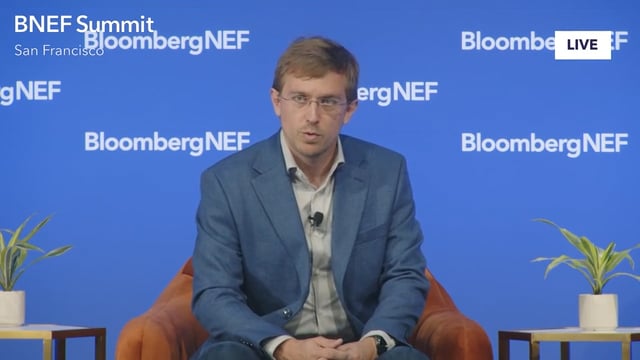
In January 2026, that systems view traveled to the BloombergNEF Summit in San Francisco. Decker joined executives from TRATON and DHL Supply Chain for a panel with a blunt title: “Where are the Electric Trucks?” The market had better vehicles, falling costs and more charging, yet adoption remained limited. His answer centered on two forces: smarter fleet data and broader access to electrification. Deployment had to become more visible and less awkward.
The farm as market research
There is a family parable underneath all this steel. At the height of the 2008 financial crisis, Decker's family bought Blue Star Farm in Stuyvesant, New York. Organic produce looked expensive and niche. They continued anyway. Years later the farm was still producing vegetables, hot sauce and strawberry-rhubarb jam - a portfolio with considerably better names than most infrastructure funds.
Decker has compared that early organic market with electric vehicles. The analogy is not that adoption is inevitable. It is that unfamiliar products have to survive the stage when their costs, habits and supply chains are still out of tune. The work is agricultural in the old sense: prepare conditions, plant, maintain, wait, learn.
Current's recent expansion suggests that the cultivation continues. In 2023, an Ares Management infrastructure fund acquired a controlling interest and said it could invest up to $250 million. In 2025, Current and InCharge announced rideshare charging work in California, Texas and Arizona. Current acquired eight high-speed chargers supporting more than 15 electric school buses. With Triangle Digital, it also launched a Zero-Emission Mile credit and pledged its next one million zero-emission miles to the product.
In April 2026, Current acquired operational, construction-stage and development-stage assets from Electrada, adding more than 30 operating charging sites and select personnel. Acquisitions sound clean in a release. The practical job is messier: keep customer agreements intact, preserve charger reliability and integrate people who already know where the buried complications live.
“When I close my eyes at night, the wind projects are spinning. The daytime projects are producing power from the sun. Our trucks are rolling with no emissions.”Pip Decker
What the work amounts to
Decker's career has an appealing continuity. The commodity changes from wind to sunlight to charged batteries, but the actual labor remains stubbornly similar. Find the site. Read the policy. Arrange the capital. Move the equipment. Win the operator's trust. Keep the asset working.
He describes William & Mary as the source of “lateral thinking and curiosity” that helped him materialize projects through a public-policy lens. Curiosity is a gentle word for a career involving turbine leases, mountain logistics and truck depots. Yet it fits. The path from a redeveloped tobacco warehouse to a charging yard makes sense only if you train yourself to see systems as provisional.
The useful lesson is not that every policy student should get a truck license, although the roads would become more interesting. It is that infrastructure rewards translators. Decker can move among lawmakers, landowners, investors, utilities and drivers because he has spent time learning what each one needs before saying yes.
The clean-energy transition is often drawn as a smooth descending line on a chart. Decker's version has cold calls, lease options, ports, cables, tractors and a family farm. It is less graceful and more believable. Somewhere between the public framework and the driver's seat, the transition becomes a working day.