The least interesting object at a Terawatt charging depot may be the charger. Look past the white cabinets and thick black cables. The real product is beneath them, around them and months ahead of them: land near a freight route, a utility willing to deliver megawatts, a permit, a transformer, concrete, traffic flow, software, spare parts and somebody who answers the phone at 2 a.m. Terawatt Infrastructure bundles that unphotogenic pile of work and sells fleets the thing they actually want - confidence that vehicles will leave charged.
The San Francisco company was assembled in 2018 by investors Benjamin Birnbaum, John Rapaport and Ethan Goldsmith, who believed demand for fleet charging would outrun supply. It emerged from stealth in 2021 with Neha Palmer as co-founder and chief executive. Palmer had spent roughly a decade leading energy strategy for Google, where power-hungry data centers teach a useful habit: plan the electricity before the machines arrive.
That habit now serves PepsiCo trucks, port drayage operators, taxis, rideshare vehicles and autonomous fleets. Terawatt acquires or controls sites, secures power, builds charging infrastructure, operates it and wraps the physical network in reservation, monitoring and energy-management software. Customers can take a dedicated depot or share a gated site with other contracted fleets. Instead of becoming a part-time utility developer, they get charging as an operating expense.
A parking lot with utility-grade consequences
“Charging-as-a-service” sounds suspiciously like someone attached a subscription to a plug. The phrase undersells the capital risk. A fleet can order vehicles, then discover its depot lacks sufficient grid capacity. It can choose a site that works electrically but adds empty miles to every route. It can install hardware that speaks imperfectly to a new truck. It can get caught between a city permit and a utility interconnection schedule while expensive vehicles wait.
Terawatt’s differentiation is ownership of that whole stack. Public charging networks generally optimize for individual drivers. A depot developer may hand over a finished project. A charger maker sells equipment. A fleet’s own facilities team can stitch those pieces together. Terawatt instead remains responsible for the site, the charging system and its operation. In business-model terms, the company spends capital up front and seeks recurring revenue from contracted capacity and managed energy. In human terms, there is one throat to choke when a truck cannot charge.
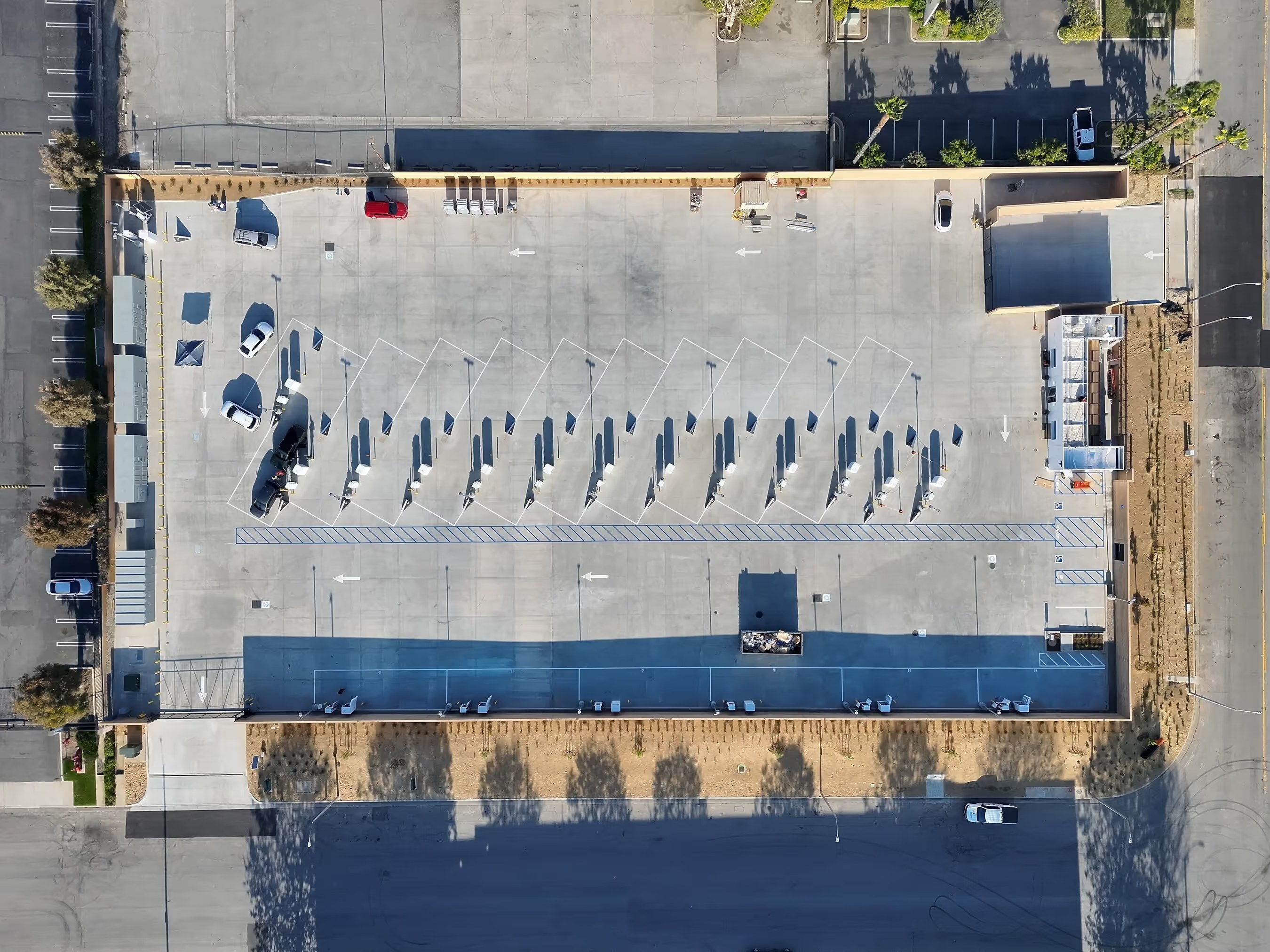
What $6.13 million buys
A California Energy Commission report offers an unusually clean window into the economics. Terawatt’s ridehail depot near Los Angeles International Airport had a total budget of $6,132,430. The state contributed $2 million, or 32.6 percent. Terawatt and other project funding covered the rest. The site contains 29 dual-port DC fast chargers, each able to deliver 120 kilowatts to one vehicle or split 60 kilowatts between two. There is gated access, security and an amenities building. All 29 chargers had customer commitments by the report date.
LAX-area depot / budget anatomy
$6,132,430 total budgeted cost
The grant did not make the project free. It absorbed roughly one-third of the budget while Terawatt retained the job of development, operation and long-term maintenance.
Site acquisition began in November 2022. Permits arrived in August 2023. Equipment and construction were complete in June 2024; energization followed in July, and commercial operation began August 14. That is almost two years from acquisition work to active charging, which explains why Palmer now tells operators planning for 2028 to begin in 2026.
What failed first was the schedule
The first villain was not a flaming charger. It was weather, paperwork and coordination. Severe rain caused construction delays and added mitigation costs. Permitting and utility interconnection extended the schedule. Once the depot opened, utilization was low for two quarters because contracted customers needed internal training and time to learn the charging system. The site was ready before the organizations using it were.
One port had a rough quarter. A port in the public reliability appendix recorded about 87.9 percent uptime. Yet the depot averaged 100 percent site uptime and greater than 99 percent port uptime across the year. Redundant capacity made one component’s bad days survivable.
That distinction is Terawatt’s most copyable operational idea. Fleets do not experience a charger’s laboratory score; they experience whether a usable stall exists when a vehicle arrives. The company keeps in-house technicians, monitors sites remotely, manages parts on site and tests hardware compatibility before deployment. A charger can fail while the charging service remains available. Reliability belongs to the system.
During its first reporting year, the LAX-area depot delivered 4.52 million kilowatt-hours. The report estimates that displaced the emissions equivalent of about 120,962 gallons of gasoline and avoided roughly 1,075 metric tons of carbon dioxide equivalent. Those are measured operating results, not a rendering of a station that might exist someday.
The phone call that widened the product
Terawatt launched with a broad idea: turnkey infrastructure for any fleet that needed it. A few weeks later, Palmer has written, a former colleague at an autonomous-vehicle company called to ask for help. The request sharpened the product. Autonomous fleets need more than electrons. They need secure urban locations near passenger demand, predictable traffic flow, data connectivity, cleaning and operational space, and uptime sturdy enough for vehicles designed to run for long hours.
By 2026, the company was describing itself as infrastructure for the autonomous and electric era. It hired executives with backgrounds at Uber, Lyft and Snowflake, and secured a five-year debt facility of up to $300 million led by RBC Capital Markets, with SMBC and UBS in the syndicate. Debt is a revealing choice. It frames depots not as science projects but as assets expected to produce contracted cash flows.
Trucking remains the other half of the map. The 7-megawatt Rancho Dominguez hub opened in April 2025 with 20 pull-through and bobtail stalls and a design capacity of up to 125 trucks a day. Its first named customers included PepsiCo and six drayage or logistics operators. A Rialto site later created a top-up point toward the Inland Empire. Farther east, Terawatt is the charging partner for a planned six-hub I-10 coalition connecting the Los Angeles and Long Beach port complex with El Paso.
These customers do not all buy the same outcome. A beverage company wants scheduled capacity that keeps delivery routes intact. A drayage carrier needs enough power near the ports to squeeze another revenue trip from an expensive electric tractor. An autonomous operator cares about deadhead miles, security and a depot workflow that can serve vehicles without passengers or conventional drivers. Terawatt customizes the site while standardizing the troublesome machinery behind it.
The coalition model also reveals how the market may grow. An electric corridor is hard to justify for one early fleet, and an early fleet is hard to justify without a corridor. By grouping shippers, carriers and shared infrastructure, Terawatt tries to break that circular wait. Major companies supply demand signals; public grants help fund first-of-a-kind capacity; a private operator builds once and serves several fleets. If enough trucks arrive, fixed costs spread across more charging sessions. If they do not, the powered land remains an expensive monument to a forecast.
The playbook worth stealing
- Buy the bottleneck early. Powered land near fixed routes takes longer to create than vehicles take to order.
- Contract demand before polishing utilization charts. The LAX depot opened with commitments for all 29 chargers, even though training slowed the early ramp.
- Design for the vehicle, not the brochure. Trucks need pull-through geometry; robotaxis need secure urban operations and data; taxis need fast turns.
- Measure service availability, not component perfection. Redundancy, spare parts and technicians can protect the customer while a port is down.
- Put public money beside private accountability. Grants can close project gaps, but an owner-operator still needs long contracts and a plan for the asset after reporting ends.
The business sits where climate technology, logistics, utilities, commercial real estate and project finance overlap. That overlap is both the advantage and the headache. Terawatt competes with charging developers such as Greenlane, WattEV, Forum Mobility and Voltera, with public networks, and with a fleet’s decision to build its own depot. Its pitch is most persuasive when time, internal expertise and capital are scarce, but vehicle demand is dependable.
When the model does not travel
Shared depots struggle where fleet demand is thin, routes move frequently, grid capacity is absent or customers will not commit enough use. A fleet with abundant powered land, a capable facilities team and cheap capital may prefer to own. Terawatt works best where many vehicles run predictable, high-utilization routes through expensive, power-constrained places.
Terawatt’s ambition is to make fleet charging fade into the background, as ordinary as a fuel stop. The irony is that achieving boring infrastructure requires unusual patience. Someone has to court the utility, survive the rain, revise the traffic plan, stock the spare part and teach the customer. The charger gets the photograph. The coordination gets the fleet back on the road.