At some hour when respectable software is asleep, Nikhil Bharadwaj was in a parking garage trying to keep electric-vehicle chargers alive. The young company he had co-founded had equipment running at more than a dozen properties. It also had the usual architecture: chargers talking to a central network, the network talking back, and a driver waiting for permission to draw electricity. Then the conversations stopped. Concrete and steel made a poor home for a dependable signal. Payments failed. Sessions would not start. The elegant diagram met the basement.
Bharadwaj and his colleagues improvised. They carried hotspots, started sessions locally and worked from cars or out of sight near building equipment. It was conscientious customer service and a ridiculous way to run infrastructure. The nuisance contained the clue. If connectivity was the brittle link, perhaps a charger should not need that link for every essential decision.
The sentence is cheekier than most climate pledges, and more demanding. It says the burden belongs with the builder. The driver should not need to understand cloud dependencies, mobile reception or the strange radio temperament of reinforced concrete. The driver has already done the necessary thing: arrived beside a charger. The charger ought to behave like infrastructure.
Before the garage, a solar education
Bharadwaj’s route to that basement began with physical work. At Penn State, where he studied energy engineering and minored in environmental engineering, his projects rarely stayed on paper. An internship with Tata BP Solar exposed him to photovoltaic layouts, line diagrams and rooftop systems. He developed an off-grid solar bus-station concept. He helped plan a solar picnic table for State College. He researched electric-bike conversions for commercial use.
In 2016, he traveled with a Penn State team to Honduras to install a 4-kilowatt solar array for a community water pump. The project reduced the pump’s reliance on expensive utility electricity, while the students also taught local children about solar power. It was the sort of assignment that compresses engineering into a clean test: a circuit is useful when the water moves.
That same year, Penn State gave Bharadwaj its Student Sustainability Leadership Award. The university marked the honor on Earth Day by planting a Macoun apple tree near the MorningStar Solar Home. There is something pleasingly literal about this. Many professional awards become a line in a biography. His grew roots.
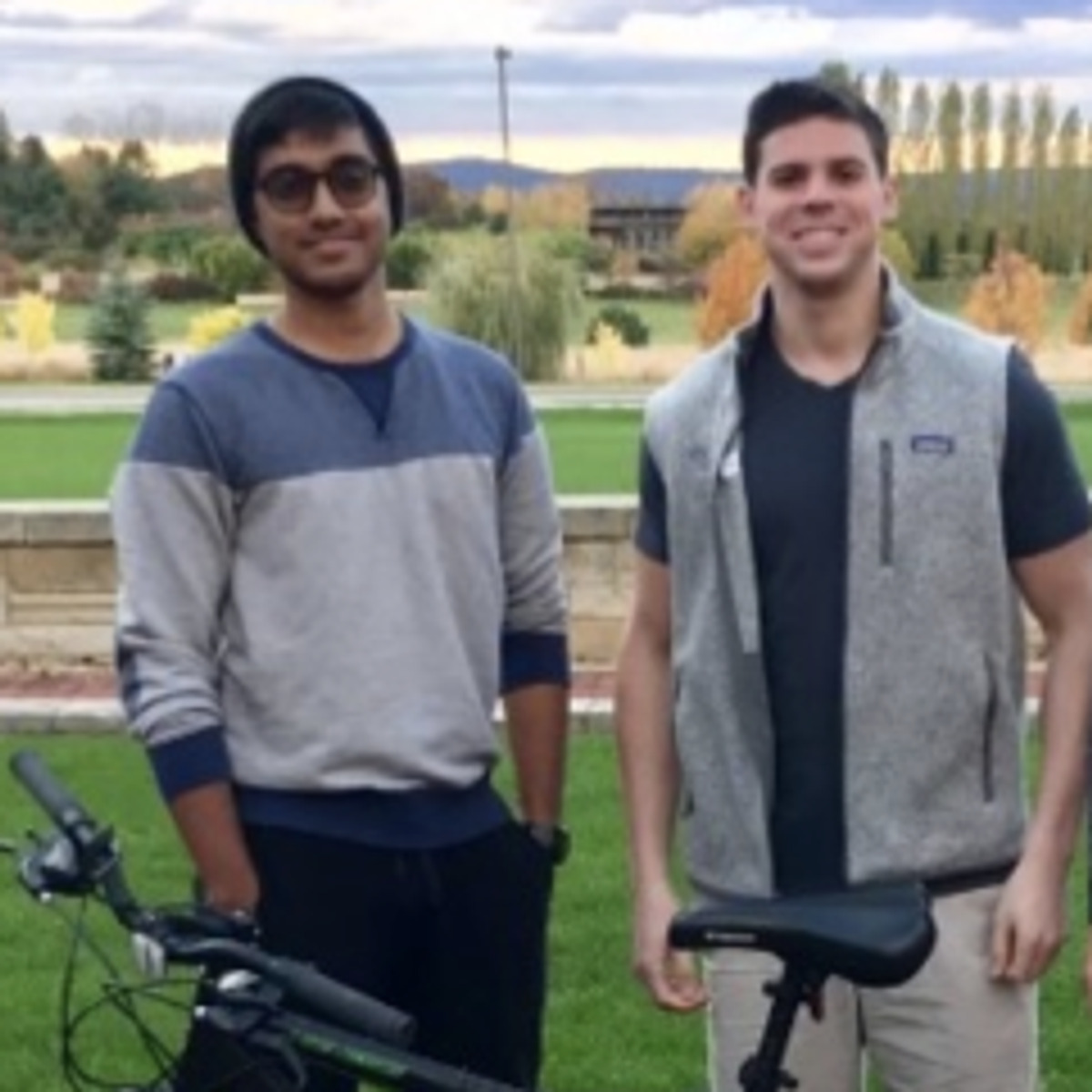
His technical interests were already mingling with a taste for organizing people. He led Penn State’s American Solar Energy Society chapter, worked on the university’s Student Sustainability Advisory Council and took part in entrepreneurial leadership coursework. In a student competition he delivered a talk about climate change and the art of sustainability. Alexander Isaacson, another Penn State student building a startup community, saw him speak and later invited him into an accelerator. Bharadwaj was making electric bikes. Isaacson was collecting founders. The overlap became a company.
A feature learns it is not a company
After graduating in 2018, Bharadwaj worked at Schneider Electric as an energy engineer and e-mobility innovation lead. Xeal took shape alongside Isaacson and launched in California in 2019. Its early product helped drivers reserve chargers for times that could be cheaper for a building and gentler on the grid. The pitch had logic. It did not yet have enough weight. Bharadwaj later described the lesson plainly: they had built a feature where a product was required.
Still, they won deployments with a Fortune 500 customer and high-end apartment properties. Real use then supplied the sharper criticism. Network failures kept chargers from authenticating drivers and processing payments. Operational data disappeared with the connection. A smart charger had become a remarkably expensive object waiting for bars to appear on a phone.
Xeal’s response was to change where the essential computing happened. Its Helix protocol uses cryptographic, time-based tokens and short-range communication so a phone and charger can handle access and payment logic locally. A central service can synchronize records later, but the immediate act of charging does not have to wait for the internet to recover. The cloud remains useful. It simply loses its veto.
This is edge computing rendered unusually easy to understand. Put the decision near the event. A garage that behaves like a Faraday cage stops being a freak condition and becomes part of the specification. Security also becomes physical: near-field communication requires the phone to be very close to the charger. For the driver, the visible choreography is tap, charge, go. Years of micro-problems disappear behind three verbs.
Selling electrons to buildings
EV charging sounds like an automotive business until one tries to install it. Then it becomes real estate, construction, utility coordination, payments and property operations arranged around a parking stall. Xeal learned to sell into that whole puzzle. Its offer came to include hardware, software, project design, installation and support. Property owners could set charging prices, use load management to control electrical demand and treat chargers as both an amenity and a source of revenue.
The company raised an $11 million Series A in 2021 when it introduced its token-ledger approach, then announced a $40 million Series B in 2022. It moved its headquarters to SoHo and expanded through relationships with large owners and developers. By early 2025, published company figures described more than 10,000 chargers planned or deployed across over 60 metropolitan areas, with partners including Brookfield, AvalonBay and Harrison Street. Xeal now says its footprint reaches more than 400 cities.
The numbers matter less as decoration than as a new engineering condition. A handful of chargers can be rescued with a hotspot and an energetic founder. Thousands of chargers turn every exception into an operating expense. Reliability at scale includes firmware discipline, diagnostics, cybersecurity and honest measurements of what drivers actually experience. A nominally online charger that cannot begin a session is not reliable because a dashboard says hello.
The inventor gets the whole company
Bharadwaj spent Xeal’s formative years as chief technology officer, the role most naturally attached to patents, protocols and stubborn field failures. In 2025, the board named him CEO. He framed the transition with three priorities: continuity, growth and scale. His concise summary was “New Title, Same Vision.” The order suggests an engineer’s respect for load-bearing structures. Preserve the working system before adding floors.
The appointment also widened his design problem. As CTO, he could ask how a charger behaves when the network vanishes. As CEO, he must ask how sales, installations, support, capital and culture behave as the network expands. Bharadwaj has said he favors an open innovation cycle in which ideas can come from engineers, customer-support staff and installation teams. That philosophy makes particular sense for a company educated by garages. The person nearest the failure often holds the clearest version of the truth.
His ambition now stretches beyond chargers. The same local-first protocol could support shared connected devices such as smart locks, package lockers or vending machines. Each has a small but consequential transaction to complete. Each becomes less intelligent when a distant service is unavailable. Xeal’s broader wager is that smart cities will need more devices capable of standing on their own feet.
There is a cultural challenge tucked inside that wager. Connected-device companies have spent years teaching customers to accept interruption as the price of intelligence. Refresh the app. Check the router. Wait for the service to return. Those rituals feel merely irritating when a music stream pauses. They become absurd when attached to transportation or access. Bharadwaj’s engineering argument is also an argument about manners: a device placed in public life should absorb more of its own uncertainty. That does not mean rejecting central services. Fleets still need updates, reporting and coordination. It means deciding carefully which functions belong at headquarters and which must survive at the curb. The distinction is small in an architecture diagram and enormous at the end of a driver’s day.
Infrastructure without theatre
Bharadwaj’s story is tempting material for the familiar founder fable: youthful mission, painful failure, elegant invention, accelerating scale. The better reading is quieter. His work has kept returning to places where technology must earn its keep. A water pump. An electric bicycle. A school roof. An apartment garage. The physics is not impressed by a pitch, and the customer should not be asked to admire the struggle.
That leaves a useful standard for climate technology. Make the greener choice practical enough to become ordinary. Hide complexity through good engineering, not through wishful marketing. Treat field embarrassment as information. Build the product for the least photogenic corner of the building. If it works there, at midnight, beside a driver who has no interest in the architecture, it has begun to deserve the name infrastructure.