Consider twelve electric vehicles arriving at a charging site. Beside them stands a system rated at 720 kilowatts. The number looks generous. Divide it evenly, however, and each vehicle gets 60 kilowatts before losses. That little calculation explains why StarCharge, a company whose name promises something wonderfully simple, has become interested in a much less simple question: how should a whole site use electricity?
- StarCharge sells chargers, batteries and the controls that connect them.
- Its customers range from automakers and fleets to factories and households.
- The useful lesson: design around the site’s power and schedule before choosing the cabinet.
The 720-kilowatt system is real. Schneider Electric markets it as Schneider StarCharge Fast 720, capable of charging up to twelve vehicles simultaneously. Its dynamic load management distributes capacity according to demand. Twelve is a connection count; 720 is a power budget. Confuse those two things and even a handsome charging station can disappoint.
A company learns to connect
StarCharge began in 2014 in Changzhou, in China’s Jiangsu province. Its founder, Shao Danwei, also known as Echo Shao, is publicly identified as its chairwoman. The international business now lists Singapore as its headquarters. Behind the brand sits Wanbang Digital Energy, the Chinese company pursuing a Hong Kong listing.
One revealing milestone came in 2019, when StarCharge joined Volkswagen, FAW and JAC to establish the CAMS charging venture. Here was a manufacturer working alongside the companies whose vehicles would need its equipment. By 2020, Bloomberg was reporting customers including Volkswagen, Hyundai and BAIC. The charging business was already entangled with the automobile business.

Over time, the catalogue widened. Today it includes ordinary AC charging, DC fast charging, household batteries, commercial storage and containerized systems for utilities. Cloud platforms and energy-management software sit alongside the hardware. A household wants to use its solar electricity later. A fleet wants vehicles ready for departure. A factory wants control over an expensive power peak. Different customers; a recurring problem of timing.
The cabinet has a calendar
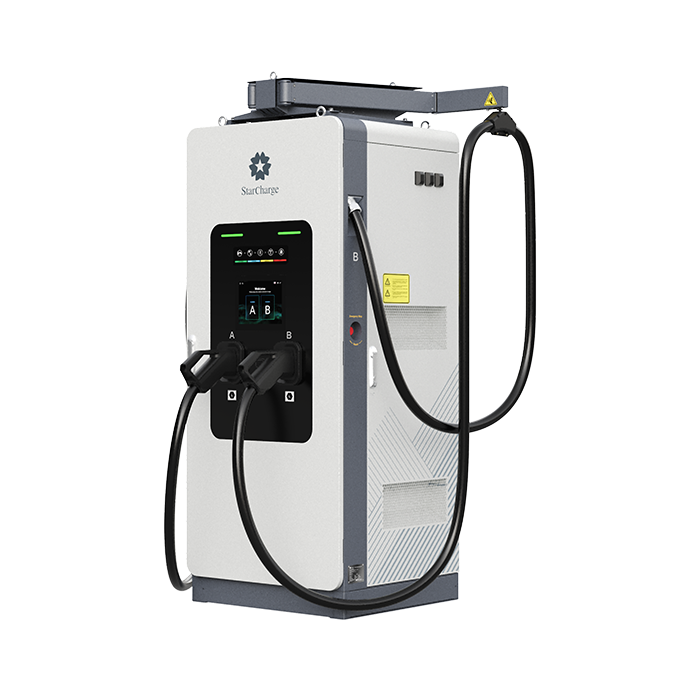
StarCharge’s product names suggest a small astronomy department: Titan, Venus, Jupiter, Artemis. Titan V5 is an all-in-one DC charger offered in configurations up to 240 kilowatts. The company specifies dynamic power distribution and a peak efficiency of 97 percent. These details matter because energy lost during conversion and capacity left idle both affect the operator’s economics.
A microgrid adds another layer. It coordinates local generation, storage and electricity use. StarCharge supplies controllers and an energy-management system to make those components work together. Its wider platform business also connects resources for demand response and electricity trading. A battery can hold energy; the control system determines when moving that energy is useful.
Imagine, as an illustrative planning exercise, a depot whose vehicles return at different times. Sharing power lets the site redirect capacity as charging needs change. Add storage and some electricity can be held for a later period. Whether that saves money depends on the tariff, battery costs and actual charging pattern. The equipment creates options. The schedule decides their value.
Illustrative equal split, before losses. Actual allocation changes with vehicle demand and site conditions.
An investor becomes a route to market
That expansion required capital. In September 2020, StarCharge raised RMB855 million, approximately $125 million at the time, in a Series A led by Schneider Electric and a CICC-affiliated fund. A May 2021 Series B, led by Hillhouse with investors including IDG, reportedly brought in nearly RMB1.5 billion. The reported post-investment valuation was RMB15.5 billion.
Schneider’s involvement became more concrete. The companies signed a European venture framework in May 2024; Schneider subsequently reported that the venture became effective on April 1, 2025, with Schneider as majority shareholder. The stated division of strengths is instructive: StarCharge contributes charging and storage technology and manufacturing capability; Schneider contributes European market knowledge, reach and energy-management expertise.
“Electrify Mobility, Digitize Energy”StarCharge’s stated mission
For a buyer, this positions StarCharge among suppliers of integrated electrical infrastructure. It competes for equipment budgets, while its network history gives it experience with charging operations. In Chinese public charging, alternatives include Teld and State Grid. A supplier’s factory capacity, regional certifications and local service arrangements deserve separate scrutiny. A familiar partner name cannot replace that work.
Two businesses inside one name
The corporate story contains a useful complication. Public reporting says Wanbang’s first mainland listing plan, begun in 2020, ended in June 2023 because of strategic considerations and market conditions. Another preparation effort ended in November 2025. In January 2026, the company submitted its Hong Kong application. An application is a step toward a listing, with an outcome still to be established.
Before that filing, reporting describes a September 2025 transfer of energy-operation subsidiaries to a related party for RMB47.4 million. That distinction matters. Selling a cabinet and operating a charging station expose a company to different cash flows and obligations. The StarCharge brand’s broad energy ecosystem should not be treated as identical to the business inside the listing applicant.
Wanbang’s draft application disclosed approximately RMB4.2 billion in 2024 revenue, up 20.4 percent. Those figures describe the applicant’s reporting perimeter. They also help explain why a reader should resist mixing equipment sales, network statistics and announced project values into one oversized number.
Start with the site
The recent direction remains broad. At SNEC in June 2026, StarCharge announced an Australia and New Zealand partnership with SolarJuice and showed a solid-state transformer designed for medium-voltage connection and six-way output. The company continues to bring distribution partners and power-conversion hardware into the same conversation.
What can a customer copy? Begin with arrival times, departure deadlines, available grid capacity and the building’s other loads. Then choose chargers, storage and controls against those constraints. A quiet site may struggle to justify a large installation. A small tariff spread may weaken the case for shifting energy. A vehicle’s charging limit can leave expensive capacity unused.
StarCharge’s most useful idea is to widen the frame around the parking space. The car is one load among several. The charger is one machine among several. Ask when the electricity must arrive, where it can come from and what each choice costs. Suddenly, the cabinet’s impressive number becomes the beginning of a conversation.