An electric car can announce itself with acceleration, a screen the size of a serving tray, or a price that requires a quiet sit-down. Its charger has a more restrained social life. It stands against a wall, waits for someone to arrive, and is expected to work. For Tony Jin, the chief executive of Shenzhen’s EN Plus, that modest expectation opens onto a surprisingly complicated business.
Jin’s name appears in two places that do not always overlap: the executive announcements of a charging manufacturer and the design credits of its products. He leads a company making AC and DC charging equipment. He is also credited with the Caro Series Wallbox and, alongside Yongkun Peng, the Nano Series Duo Wallbox. The titles put him close to both the commercial question and the object on the wall.
A useful way into his career is through the small decisions those objects contain. Where does the cable go? How can another driver use the charger? Can two cars charge from a compact unit? When someone needs to maintain it, can they get inside? Electric mobility has room for sweeping declarations. Jin’s working world also has room for a cable that needs tidying.
Before the plug, the supply chain
Jin studied at South China University of Technology, with his education listed from 1997 to 2001. His professional background includes seven years in supply-chain and project management at Eaton. EN Plus’s founding-team biography also describes experience in cost control, value analysis and value engineering, and 15 years of marketing management in the power industry. These are disciplines concerned with what a product requires, what it costs, and how it reaches a buyer.
Consider the different demands hidden inside an apparently simple purchase. A customer wants useful equipment at a price they can accept. A manufacturer has to procure components, organize production and deliver a functioning product. Value engineering examines the relationship between a product’s function and its cost. The phrase sounds suited to a meeting with fluorescent lighting; the consequences eventually turn up in someone’s driveway.
EN Plus was founded in 2015 and is headquartered in Shenzhen. Jin appears in its founding-team presentation with CTO Eric Dai, whose background includes Zever Solar and SMA China. The pairing brings commercial and manufacturing experience into the same company as power-electronics expertise. Their biographies describe different responsibilities. A charger gives those responsibilities a shared destination: a piece of equipment that must be made, sold and used.
In 2022, Eaton became a strategic investor in EN Plus. Jin was identified as CEO in the announcement, which described the relationship in the context of the growing electric vehicle charging market. His earlier employer had become part of the company’s financing story. The announcement offered no need for a grand personal reinvention. The connection was already there in his experience.
“EN+ is committed to contributing to the global transformation of vehicle electrification.”Tony Jin · 2022 investment announcement
A cable deserves a home
The Caro Series Wallbox is intended for households and companies. Its design gives the charging cable a storage arrangement that saves space. It also accommodates different power grids and charging standards, uses intelligent load balancing, and offers wireless ways to start charging. Jin is named as its in-house designer in the Red Dot award record.
The details make a revealing collection. Cable storage concerns the physical mess. Load balancing concerns the electrical load. Access for additional users concerns who gets to use the equipment. A wallbox has to negotiate all three. The jury drew attention to its simple appearance and the ability to make charging available to other users. A private purchase can therefore have a shared use.
The 2022 MUSE Silver-winning Silk Series Home Charger entry also credits Jin as EN Plus’s CEO. That design combines a curved enclosure with cable storage, configurable lighting and connected controls. Its entry describes load management and compatibility with distributed solar and energy storage. Appearance and electrical behavior occupy the same brief. The box must belong in its surroundings while managing something the eye cannot see.
By 2024, the Nano Series Duo Wallbox added another practical proposition: two charging connections in a compact design. Jin shares the in-house design credit with Yongkun Peng. The product incorporates power measurement, maintenance access, configurable lighting and cloud-supported charging planning. Its Red Dot recognition concerned a product with several jobs compressed into a small footprint.
Those credits do not tell us which line Jin drew or which component he chose. They do establish a public connection between the CEO and the design work. That connection matters to this story because the products are where commercial promises acquire dimensions. A partner can discuss an opportunity in broad terms. An installer eventually needs an enclosure, wiring options and somewhere to put it.
The business on the other side of the table
On October 27, 2023, Jin sat down with André Bouffioux at EN Plus’s headquarters in Shenzhen for a partnership signing involving Teconex. The cooperation concerned Belgium and Luxembourg. The photograph records two executives bent over documents, with their name cards facing the room and purple flowers standing between them. International expansion, for a moment, looks like stationery.
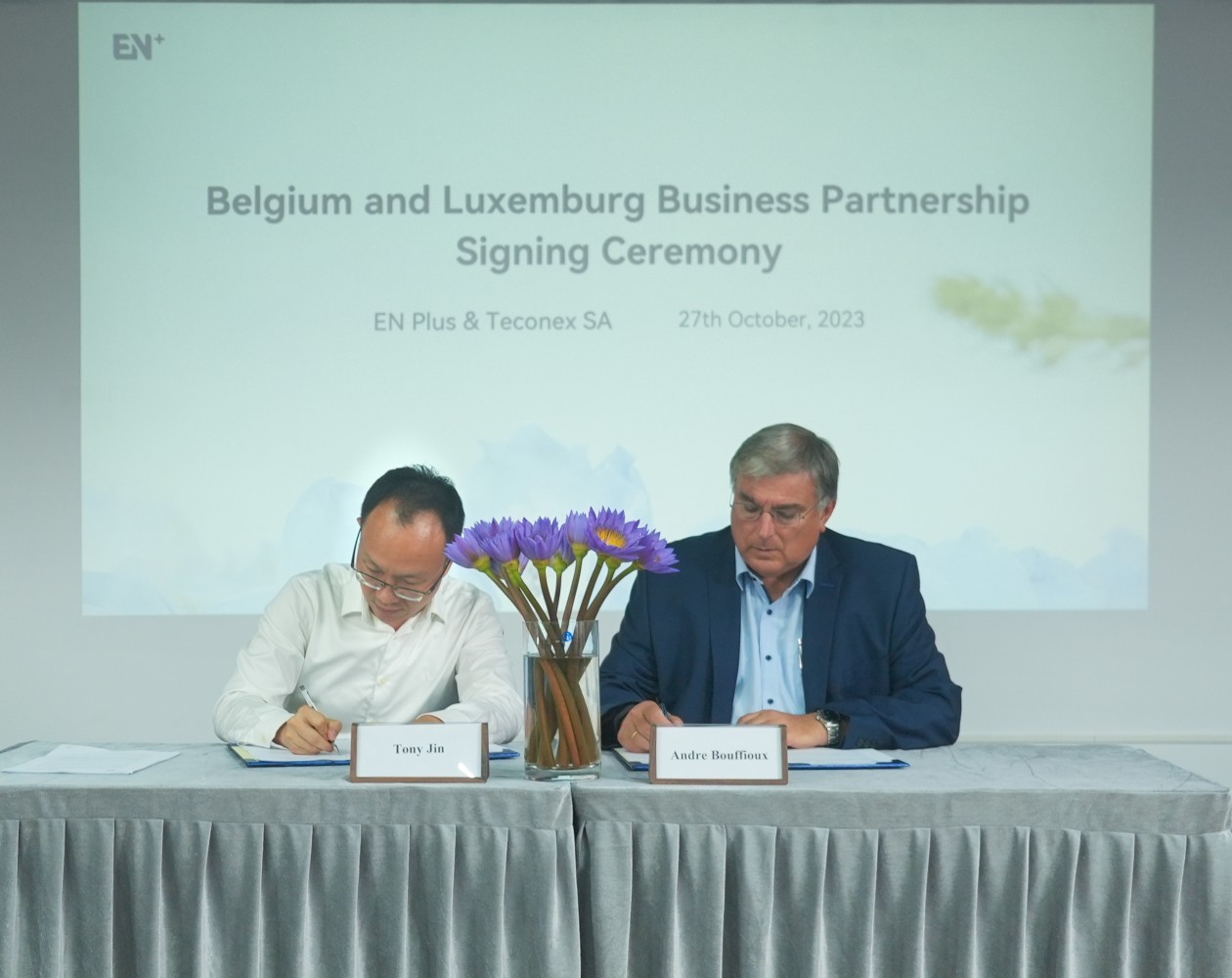
Jin described the cooperation as a way to connect products with markets and combine the parties’ resources. The proposed division of work was practical: EN Plus brought its products, while Teconex brought local business capacity and experience. The goal included commercializing the companies’ products and services in those two markets. The distance between Shenzhen and a European customer would be crossed through people as well as shipping.
That is a recurring feature of his professional record. Charzing, the electric vehicle charging network, lists Jin among its advisors and describes a partnership with EN Plus. The relationship places him alongside a business concerned with the network and software around charging equipment. A manufacturer’s work continues to meet the work of organizations that operate, connect or bring that equipment to customers.
It is easy to picture charging as a transaction between a car and a box. Jin’s partnerships make the picture more crowded. There are manufacturers, local businesses, network operators and users, each with a different responsibility. His executive role involves finding arrangements in which those responsibilities can meet. A successful product needs a route into everyday use.
When the equipment has to agree
EN Plus’s membership of CharIN takes that problem into technical cooperation. The association promotes charging interoperability, including work around the Combined Charging System. Jin has highlighted standardization as part of the industry’s development. Participation gives the company a place in discussions about how equipment from different participants should work together, rather than leaving each manufacturer to solve the entire problem alone.
The principle is straightforward even when the engineering is demanding. A driver may buy a vehicle from one company and encounter charging equipment from another. The systems have to understand enough of one another to perform the required task. Agreement on an interface makes different products usable together. The charger’s appearance offers little clue to how much agreement has to sit behind it.
Interoperability asks the participants to work together. Bidirectional charging adds power flowing back from the vehicle.
In a public 2026 update, Jin welcomed EN Plus’s completion of an AC vehicle-to-grid pre-test through Task 53, also known as INBID, at DEKRA’s laboratory in the Netherlands. The initiative concerns interoperable bidirectional charging in line with ISO 15118-20. He thanked participating partners, including CharIN and DEKRA. The milestone was a pre-test: a specific step in a collaborative development process.
Bidirectional charging extends the brief beyond putting energy into a battery. It introduces the prospect of returning power from a vehicle to the wider energy system. That gives collaboration another purpose. Vehicles, charging providers, laboratories and industry organizations all have work to do. Jin’s public discussion places EN Plus among those participants, with progress dependent on their equipment and decisions fitting together.
A dinner, and the next charging session
There is a less technical glimpse of that network in a dinner described by Nick Groves around the 2025 UK charging and solar exhibitions. Jin joined EN Plus colleagues Nick Jenkinson and Ryan Prakoso, along with shun zhao, Groves and Richard Britton, at Grace & Savour. Groves recalled the pleasure of catching up outside the exhibition halls. The professional relationships had somewhere to sit down.
The anecdote is small, but it belongs here. Jin’s work includes the coordination of people whose contributions come from different places. A signing ceremony formalizes a relationship. An industry association gives it a technical setting. A dinner gives people time together beyond the booth and the schedule. None of these arrangements charges a car by itself; all can belong to the business that does.
In June 2026, Jin wrote about customer priorities moving toward operational reliability: keeping equipment online, completing charging sessions and resolving problems remotely. He welcomed EN Plus’s inclusion in Monta’s assessment while acknowledging continuing work. It was a practical set of priorities for a chief executive whose career includes both manufacturing experience and product-design recognition.
The cable, the enclosure, the partner and the testing laboratory all lead back to that encounter between driver and equipment. Jin’s story gives the ordinary act of plugging in a car a longer history. Someone has to make the object, someone has to bring it to market, and several organizations may have to make it cooperate. The driver is entitled to have somewhere else to be.