At eleven, Louis Tremblay had already started a business and watched it fail. The product was snowboard clothing. The lesson, as he later put it, was brief: “I failed and learned a lot.” It is a pleasingly unceremonious beginning for an entrepreneur whose working life would eventually involve charging networks, public infrastructure and investors with considerably larger chequebooks.
The childhood venture survives in his own telling without a heroic rescue scene. By eight, he had decided that he wanted to work for himself; three years later, he tried. His recollection of those early ambitions gives the FLO co-founder’s career a useful starting point. The desire to build a business arrived before he knew which business would hold his attention.
Today, Tremblay is president and chief executive officer of FLO, based in Quebec City and serving drivers in Canada and the United States. He trained as an electrical engineer. He became interested in a question with very little glamour and a great deal of consequence: when an electric car needs energy, where does its driver go?
A small business before the big question
Cars supplied the next direction. In 2004, at Université Laval, Tremblay participated in a student vehicle project. His university-era experience included Formula SAE, where students design cars for competition. There is an obvious attraction for someone interested in automobiles: the machine is yours to understand, and the consequences of a design choice eventually turn up on the track.
As his interest moved toward electric vehicles, he kept encountering concern about range and recharging. A car could be persuasive on its own merits and still leave its prospective owner wondering about the journey home. Tremblay wanted to build the network that would give those drivers confidence. The customer’s hesitation became the entrepreneur’s assignment.
His engineering education at Laval included a bachelor’s degree and graduate-level studies in power electronics. On his LinkedIn profile, he describes research from 2007 to 2009 involving soft-switching power converters for automotive applications. Efficiency, reliability, power density and production cost all appear in that description. These are practical concerns to carry into a company that has to put equipment outdoors and keep it useful.
FLO dates its founding to 2009, when Tremblay was still a student. That year also brought first prize in the Bourses Pierre-Péladeau. He later recalled a change in how people received the idea: people who had heard him discuss the business repeatedly began paying attention. The prize supplied credibility as well as recognition. Sometimes an entrepreneur’s first useful accessory is somebody else’s confidence.
Université Laval
Pierre-Péladeau prize
EY Quebec recognition
The machinery behind an ordinary stop
A charger is a particularly unforgiving place to disappoint a customer. The person using it has a vehicle, a destination and a reason for stopping. The equipment has to communicate with the car; the transaction and the network have to cooperate. An attractive cabinet can do only so much for a driver who cannot begin a session.
Tremblay’s business brought charging equipment, software development and network management together. He has explained that early electric drivers needed to avoid being stranded, and that coordinating these functions gave FLO more control over the charging experience. That decision to bring the pieces together reaches beyond the appearance of the product. It concerns what happens after installation, when the equipment is expected to earn its place.
He is precise about the physical work. Discussing FLO’s operations in 2023, he distinguished assembly from the processes performed by partners. Component production, including aluminium die casting and printed circuit boards, belonged within a partner network; FLO controlled final assembly and product quality. The distinction is revealing. A founder can care about an entire system without pretending his company performs every task inside it.
In the same interview about public charging, he advocated standards and insisted that the service mattered alongside the count of installations. He also argued for a mix of charging speeds. Faster equipment has a place on highways, but different locations and grid constraints call for different approaches. The word “fast” is an excellent advertisement. It is a less complete answer to an engineering question.
“We are for standards.”
Louis Tremblay, February 2023
Three connected responsibilities. One driver waiting to charge.
The driver without a garage
For Tremblay, the charging problem extends to the person who has no private place to plug in. In discussing FLO’s product development, he described attention to street charging, commercial fleets and condominiums. A home charger answers an important need. It leaves another set of drivers looking toward the curb.
His public argument for multi-unit residential buildings is straightforward: access has to extend to everybody if electric vehicles are to become established. Apartment living is a circumstance the charging network must accommodate. It cannot be treated as a minor inconvenience for the customer to solve alone.
That emphasis gives his career a geographic texture. The question changes between a highway stop, an urban street and a shared residential building. Each location has its own constraints, and a useful network has to recognize them. Tremblay’s interest in the electric car became a continuing interest in the places its driver lives, works and travels.
A company with room to talk
The university connection continued after the student project. In 2021, Tremblay became honorary president of Université Laval’s Global Entrepreneurship Week. The opening activity paired him with rector Sophie D’Amours for a conversation about responsible entrepreneurship. Returning in that role put him on the other side of the university’s entrepreneurial relationship: a graduate with an operating business, discussing decisions that students might one day face.
Inside FLO, colleagues described a founder who continued to share his vision every week as the organization grew. A 2022 account included employees working across design, software and physical equipment, with user problems moving between teams. Their description of the workplace emphasizes room to learn and collaborate. Those details place Tremblay in a company of other people, rather than alone beside a founding date.
FLO’s fiscal 2022 report gives that communication a concrete form. It documented weekly informal virtual meetings with the CEO for sharing news and accomplishments, including small victories. The meetings began during the pandemic and continued as a popular feature of company life. At least twice a year, they took place in person at the Shawinigan plant, with Tremblay talking to employees in smaller groups.
A 2024 Found podcast conversation also explored how he wanted FLO to be a rewarding, enjoyable workplace. The ambition sits beside the business obligations: building charging equipment, working with cities and coordinating software with hardware. A company organized around reliability still needs people who can ask questions, exchange information and enjoy showing up.
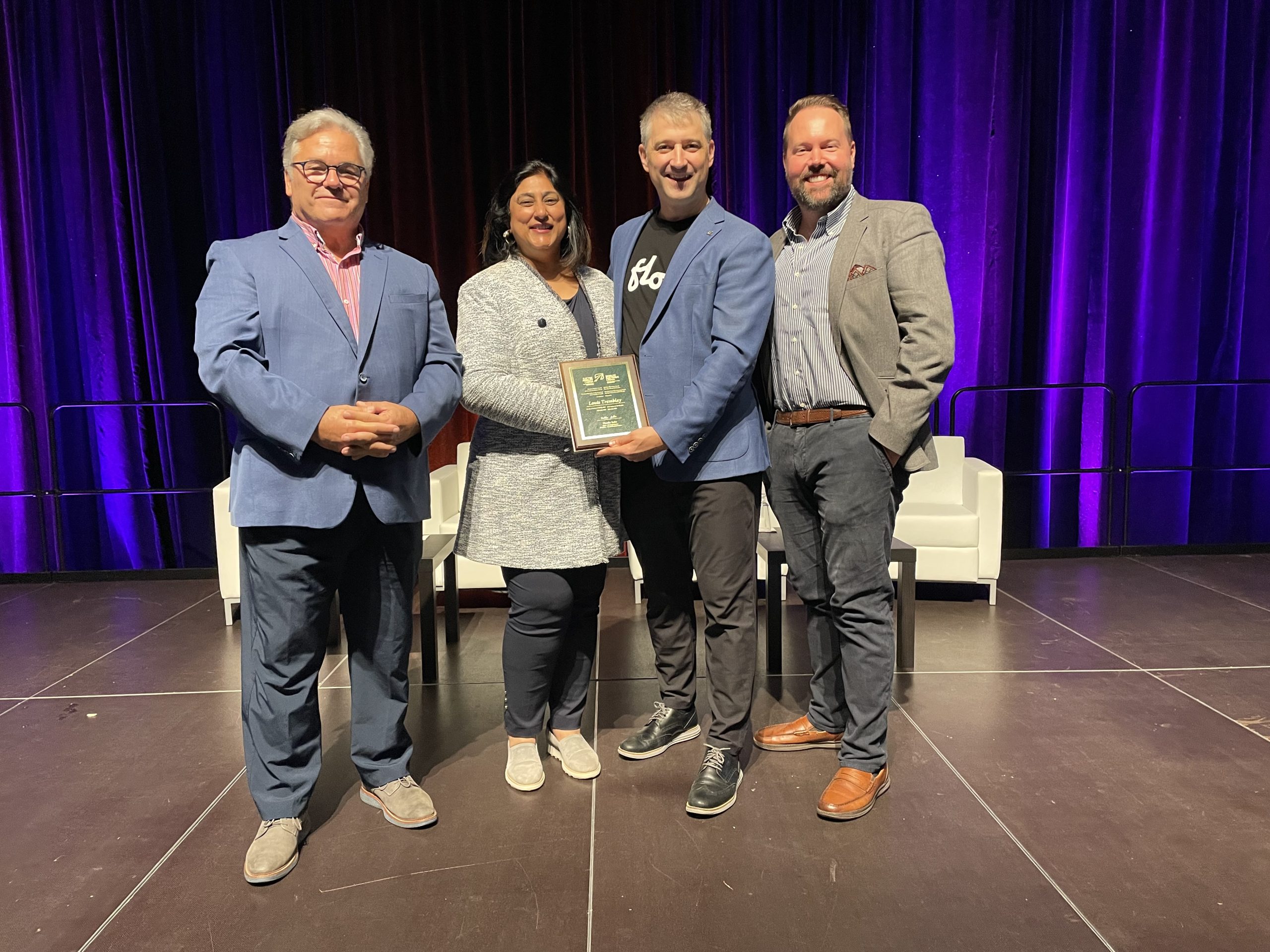
Electric Mobility Canada recognized him with the 2024 Al Cormier Award, which honours individual contributions to transportation electrification. He was also named an EY Entrepreneur of the Year for Quebec in 2024. These recognitions mark a career that grew beyond the university project and into an industry’s practical concerns.
The expensive part of patience
In June 2024, FLO announced C$136 million in long-term capital, principally through Series E equity financing led by Export Development Canada. Other backers included CDPQ, Investissement Québec, BDC, Energy Impact Partners and MacKinnon, Bennett & Company. The plans included network expansion, FLO Ultra fast chargers and a new generation of home charging equipment.
The announcement joined capital to things that needed to be delivered and installed. FLO said Ultra deliveries would begin that month. Financing gave the company resources to pursue its plans; the obligations attached to those plans continued after the announcement. A charger requires considerably more commitment than a photograph of a charger.
The following year brought a harder turn. In July 2025, FLO confirmed that it was closing a Shawinigan manufacturing plant and cutting just over eighty jobs across Canada and the United States, while keeping some operations in the city’s Grand-Mère area. Tremblay cited trade tensions, shifting politics, particularly in the United States, and inconsistent signals around electric vehicles.
He called the decision “a responsible step” toward adjusting operations and accelerating the move to profitability. The closure and job reductions belong beside the funding and awards in any account of his career. The people leaving the company experienced a different consequence of the changing market from the founder explaining the decision. Neither experience can be made to disappear inside an expansion story.
Coffee, a cable, and fewer passwords
FLO’s later 2025 announcements returned to the driver’s routine. In August, it and Tim Hortons set out a plan to install fast charging at one hundred restaurants across Canada by the end of 2028. The first participating location was already operating in Regina. The larger numbers remained targets, with fifty locations envisaged by the end of 2026.
The restaurant plan suits Tremblay’s original question because the stop already has a purpose. Drivers can get coffee, take a break and charge at a place they recognize. In the announcement, he also described FLO’s investment in installations as part of its focus on owning and operating charging infrastructure. That adds responsibility for the continuing service to the initial deployment.
Tim Hortons restaurants targeted for fast charging by the end of 2028.
A rollout plan, with the first location operating in Regina at announcement.In September, FLO and SWTCH announced reciprocal roaming through their existing apps. Drivers could access the other network without setting up another account and payment method. This addresses a less visible obstacle than an empty battery: the collection of small digital chores that can gather around a physical journey.
The snowboard-clothing venture and the charging company are separated by years of study, work and consequences. Yet the early wish to work for himself remains recognizable in Tremblay’s account. His career has given that wish a demanding public setting. The question that drew him toward charging still waits at the curb, beside an apartment building, or outside a coffee shop. A driver arrives. The answer has to work.