A customer pays, and a transaction disappears into a machine. For Hansen Han, that little ending has become a remarkably durable beginning. He founded iBoxPay in 2011, entering the business of helping merchants take payments. Fifteen years later, he is presenting AI employees for those merchants. The shop counter remains in the picture. The job he wants his company to do around it keeps expanding.
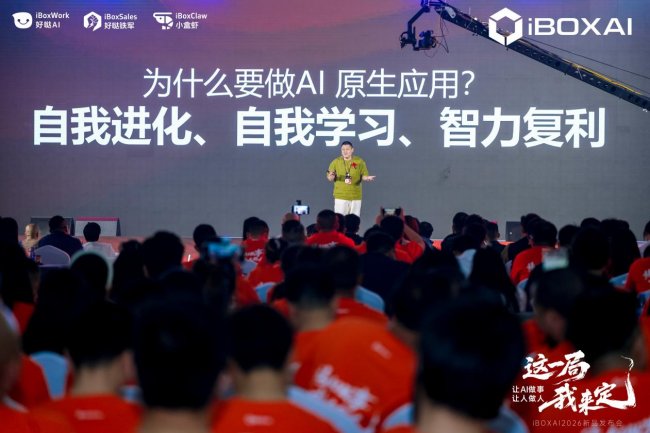
At the May 18, 2026 launch in Shenzhen’s Xiaomeisha, Han appeared onstage in a green shirt, holding a programme. Behind him, the company’s latest English name, iBOXAI, announced the change. He described a business producing and distributing digital employees. His phrase, translated from Chinese, was direct: “Treat AI as a person.” A shopkeeper, in this account of the future, would be able to give technology work to do.
There is an appealing practicality beneath the theatre. A payment tells an owner that something sold. It leaves a queue of other questions: who might buy tomorrow, what should be promoted, which customer might return? Han’s career can be read as a succession of attempts to move further into that queue. The interesting part is how often the same customer reappears under a new technological heading.
The shop was the opening
Han’s earlier working life already involved changes of direction. He began entrepreneurial projects while at university, working in integrated-circuit trading, gaming, tracking systems and overseas transit cards. In 2009 he moved to Shenzhen and entered the mobile-phone business. During a 2018 interview at his company’s headquarters, he kept talking for two hours after the journalist arrived at ten at night. The subject offered little assistance to anyone hoping for an early bedtime.
That varied beginning gives the later business a useful context. Devices, networks and everyday transactions were already among the things he had worked with. When he founded iBoxPay, mobile payments gave those interests a commercial meeting place. The company’s early proposition was concrete: a phone-connected card reader for merchants. Its own retrospective account puts the cost at a tenth of a conventional POS machine.
Price mattered to that proposition because the intended customer was a small business. A shop owner has to judge an expense against the work it makes possible. A compact reader offered a way into electronic payments without requiring the same equipment outlay. In Han’s story, the counter became a place where a technical change could meet an immediate business need.
The company’s subsequent recognition gives this early chapter a dated marker. In the 2016 Deloitte Shenzhen Technology Fast 20, iBoxPay ranked first, recording revenue growth of 1,209 percent between 2013 and 2015. That figure belongs to a particular period. It helps explain the momentum of the payment business without pretending to measure every chapter that followed.
Revenue growth, 2013-2015.
First place in the 2016 Deloitte Shenzhen Technology Fast 20.
A receipt leaves plenty unfinished
Han’s ambitions were already spreading beyond collection. In a 2018 internal business address, he called for faster product development and faster delivery of services to merchants. He discussed training, new operating models and cooperation with other businesses. The address linked emerging technologies with a familiar objective: helping physical shops do business in a changing market.
This is where a payment company encounters a larger, messier assignment. Accepting money is a relatively clear event. Helping someone run a shop involves habits, choices and relationships. Software may organise a task, but an owner still has to fit it into a working day. The commercial opportunity grows, and so does the number of ways an apparently useful product can become another chore.
In 2018, the company launched Huidian, a WeChat mini-program for merchants. Its functions covered attracting customers, selling, encouraging repeat purchases and managing orders and staff. The product extended the relationship beyond the act of paying. A merchant could use the same general commercial connection to work on the business before and after a transaction.
The launch also shows a choice about distribution. A small shop already operates in a world of customer habits and established platforms. A service introduced through a familiar app can meet that world where it is. The question for the founder becomes how much of the merchant’s day the service can usefully support. Every extra function has to earn attention from someone who has other things to do.
The complaint department gets a meeting
By the company’s tenth anniversary in 2021, Han was describing comprehensive merchant services and a counter that could become an intelligent platform. He discussed store management, marketing, data analysis and other operating tools. He treated product quality as an obligation and service as an additional source of value. That view places continuing work beside the device itself.
His account of company meetings is more revealing than the vocabulary of platforms. He said service partners could bring complaints directly to him at regular sessions. A complaint meeting is a pleasingly unromantic instrument for a technology business. Someone has found the thing that does not work. Someone else has to listen. The agenda writes itself, although probably without much concern for the founder’s feelings.
For Han, those partners are part of the business’s connection to merchants. A product reaches a counter through people who introduce it, explain it and respond when the owner needs help. The complaint meeting makes that route run in both directions. It gives the founder a way to hear about the work his strategy has created outside the presentation room.
“Making products well is an obligation; making service work well adds value.”Hansen Han, 2021 · translated from Chinese
Changing the name, carrying the people
The company’s names chart its changing public emphasis. iBOXPAY was followed by iBOXSaaS, then iBOXCHAIN, and now iBOXAI. The corporate name changed in 2017 to Shenzhen Box Information Technology. Its own chronology dates the iBOXCHAIN English rebrand to March 2018. Read together, the names resemble labels on successive drawers in the same workshop.
There is an obvious temptation to make the labels the entire story. They are neat, short and easy to put on a timeline. The harder question is what happens to the people carrying the service when its description changes. A payment-service partner has one set of things to explain. A merchant-software adviser has others. An AI-services seller will need another vocabulary and another kind of demonstration.
Han’s 2023 letter to employees treated change as necessary and risky. He used the image of a dark cave: the company had to move through it without knowing whether the far side held open space or a cliff. He also urged small, quick steps. The metaphor gives the founder’s appetite for change a less polished setting. A direction can be deliberate while its outcome remains uncertain.
In 2024, his company’s partner gathering brought 2,000 participants to Shenzhen. Han spoke about providing entrepreneurial opportunities through the platform. His co-founder and COO, Wu Song, presented a programme of support for partners. The scale of the gathering gave a visible form to something that can sound abstract in a software pitch: the organisation included people building local businesses around the service.
A different classroom in Sixian
There is another, smaller setting in Han’s public life. He attended Sixian No. 2 Middle School in Anhui, graduating in the class of 2000. In 2019, he backed the school’s Chunhui class, with an annual education fund of 300,000 yuan. He attended the opening ceremony in September. The programme supported academically strong students facing financial constraints.
The episode brings his biography away from the vocabulary of product categories. Here the relationship was with a former school and a group of students. It is a specific commitment, with a place, a date and a stated amount. It also broadens the view of a founder whose public working life is largely described through the next commercial change.
A classroom and a shop counter ask different things of technology and money. Both keep the individual in view. In one, a student needs a chance to continue learning. In the other, an owner needs a workable way to keep trading. The school programme belongs in Han’s story on its own terms, without requiring it to serve as a tidy explanation for every business decision.
The AI pitch meets the power cable
At the 2026 launch, iBOXAI presented hardware and software as a merchant’s AI operating team. The offerings included the iBoxPop device and digital roles for data, marketing and product management. Han said the aim was to free operators from routine tasks so they could concentrate on creativity, empathy and strategic judgment. The event also included a cooperation signing with Volcano Engine.
The proposition asks for a different relationship with software. A merchant would describe a task and expect work to follow. That is an ambitious promise for any service placed in a real shop. The test is practical: whether an owner can understand what happened, rely on it and use the result. A convincing stage presentation begins that conversation; daily use has to continue it.
In late June, Han spoke at a partner training camp in Shenzhen about producing ten million digital employees over the next three to five years. That is his stated target. It puts a number on the ambition while leaving the work ahead in the future tense. Training the people who will take the offer to merchants was already part of the next chapter.
July brought a more modest set of announcements. The merchant app gained a customisable home page and daily sales-target tracking. Payment alerts were expanded. The company also announced a fix for an iBoxPop charging problem. There is something useful about finishing a founder’s story beside a power cable. Even an AI employee has to turn on.
Han’s career keeps returning to that contact between an idea and a working day. The names change; the merchant has another customer to serve. His next chapter will be written in those ordinary encounters, where the owner decides whether a new service is worth keeping beside the till.
Continue reading
Interviews, company announcements and public profiles